By Dr. Asnat Raziel, bariatric surgeon specializing in obesity treatment, metabolic health and healthy longevity; Director of the Multidisciplinary Center for Obesity Treatment, Assia Medical, Assuta Ramat HaChayal, Tel Aviv
Why patients choose injections: a surprise no one predicted
Why patients choose injections over weight-loss pills may be the most interesting question in obesity medicine in 2026. For years, it seemed that an effective pill would mark the end of the injection era. After all, if you can swallow a pill, who would pick a needle? Yet the reality in the United States tells a different story. Once price stopped being a barrier, most patients actually chose the injection. This article looks at that real-world choice and what it teaches us.
What happened in Medicare’s new program
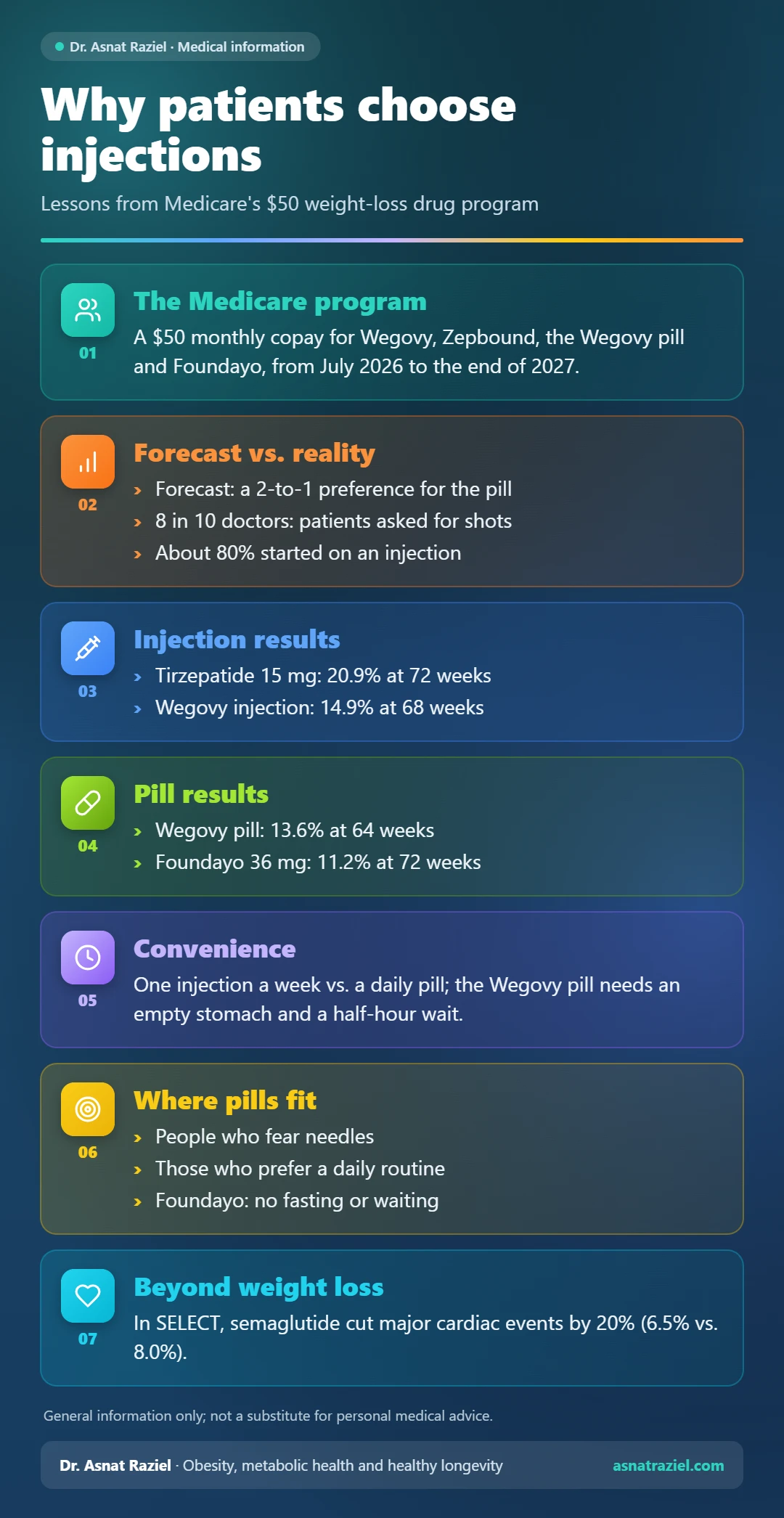
On July 1, 2026, a new pilot program opened in the United States through Medicare, the government health insurance for people aged 65 and over. The program will run until the end of 2027. It offers obesity medications for a copay of $50 a month. The list includes Wegovy and Zepbound injections; Zepbound is the US brand name for Mounjaro. It also includes two pills: the Wegovy pill and Foundayo.
Before the launch, the forecasts were clear. Novo Nordisk’s US head said the company’s research pointed to a two-to-one preference for the pill. On the ground, however, the picture flipped. According to a Reuters report, eight out of ten doctors interviewed said their patients were asking for the injections. Later, a Lilly executive said that about 80% of patients in the program had started treatment with an injection.
Patients read the research: why patients choose injections first
The main reason for this preference is effectiveness. In the SURMOUNT-1 trial, tirzepatide, the active ingredient in Mounjaro, led to an average weight loss of 20.9%. That was at the 15 mg dose, after 72 weeks. In the STEP 1 trial, the semaglutide injection, Wegovy, led to a 14.9% loss after 68 weeks.
The pills also show good results. In the OASIS 4 trial, participants on the Wegovy pill lost 13.6% of their body weight after 64 weeks. By comparison, in the ATTAIN-1 trial, Foundayo at 36 mg led to an 11.2% loss after 72 weeks. In other words, the gap between the Wegovy pill and the injection is small. The gap versus Mounjaro, on the other hand, is still significant. You will find a detailed comparison of the two pills in my article on the Wegovy pill vs. Foundayo.
What about Rybelsus?
Rybelsus also contains semaglutide, but it is approved only for type 2 diabetes. That is why it is not part of the US obesity program. In addition, its doses are low, and the weight loss it brings is modest. If you want to understand the differences, read my article on Rybelsus vs. the Wegovy pill.
The injection is no longer scary
In the past, the very thought of an injection put many patients off. Today the picture is different. Injection pens are simple to use, the needle is very fine, and the injection is given only once a week. If you are still nervous, you are welcome to read about attitudes toward the injections and ways to overcome the fear.
What’s more, many patients say a weekly injection is more convenient than a daily pill. The Wegovy pill and Rybelsus must be taken on an empty stomach with a little water. Then you have to wait half an hour before eating or drinking. Foundayo, by contrast, requires no fasting or waiting. That is a real advantage for anyone who struggles with restrictions. Still, convenience is one more reason many patients choose injections today.
Still, the question remains open, and I weigh it up in could the orforglipron pill replace injections.
The era of the informed patient
Patients have changed too. In the past, they relied almost entirely on their doctor’s recommendation. Today, many come to a consultation after reading studies, listening to podcasts and following other people’s experiences on social media. As a result, many patients choose injections, knowing they currently have an edge in average effectiveness. Pharmaceutical market analysts sum it up simply: effectiveness is what decides.
Three reasons patients choose injections
Putting the evidence together, the Medicare experience points to three clear reasons. Each one comes from the data above:
- Effectiveness: weekly injections led to average losses of 20.9% and 14.9% in their trials, compared with 13.6% and 11.2% for the pills.
- Convenience: one injection a week, versus a daily pill that often comes with fasting rules.
- Information: today’s patients read the studies and know which option tends to work better.
For a general, decision-focused comparison of the two forms, see my guide to choosing between a pill and an injection for obesity.
Why patients choose injections when the price drops
Until recently, price was the big barrier. In the United States, the list price of the injections sometimes topped $1,000 a month. Many people could not even consider treatment. Now that the copay is low, cost has moved to the back seat. The choice rests mainly on the expected result. In Israel the situation is different, and I cover local prices separately.
Injections vs. pills: the pill still has its place
The preference for injections does not mean the pills have failed. Quite the opposite. For people who fear needles or prefer a daily treatment, the Wegovy pill and Foundayo are an excellent option. In addition, pills are cheap to manufacture, which may widen access in the future. Finally, even more effective pills are likely to arrive and narrow the gap. You can read about the pill that is already available in Israel in my article on Foundayo in Israel.
How do we choose the right treatment?
In the clinic, we do not just ask “injection or pill?” First, we look at the goal: how much weight needs to come off, and which related conditions are present. Second, we consider lifestyle and daily habits. Price, availability and the history of previous treatments matter as well.
- When the goal is a large weight loss, the weekly injection currently leads.
- If you fear needles or prefer a daily routine, the pill is a good alternative.
- If fasting in the morning is hard for you, a pill without food restrictions will serve you better.
- In every case, sticking with treatment over time matters as much as choosing the drug.
It is no longer just a weight-loss drug
It is now clear that this drug family does much more than reduce weight. In the SELECT trial, for example, the semaglutide injection lowered the risk of a major cardiac event by 20% in people with heart disease and obesity. Such an event occurred in 6.5% of patients on the drug, compared with 8.0% on placebo. In addition, these drugs help control diabetes, improve fatty liver and reduce sleep apnea. New studies are also examining their effects on the kidneys, the brain and even the aging process.
The bottom line: patients vote with results
The first experience from the United States teaches an important lesson. When treatment is truly accessible, patients do not necessarily choose the most convenient option. Instead, they choose the one that gives them the best chance of success. That is why patients choose injections so often in the Medicare program. Still, the decision between injections and pills is personal. It depends on your medical situation, preferences and lifestyle. So it is best made together with a doctor who knows all the options.
The information in this article is general and does not replace personal medical advice.
Sources
A New Medicare Option for Weight Loss Drugs: What Older Americans Should Know
Medicare patients pick GLP-1 shots over pills
Patients keep choosing pricier GLP-1 injections over cheaper new pills
Tirzepatide Once Weekly for the Treatment of Obesity
Once-Weekly Semaglutide in Adults with Overweight or Obesity
Oral Semaglutide at a Dose of 25 mg in Adults with Overweight or Obesity
Orforglipron, an Oral Small-Molecule GLP-1 Receptor Agonist for Obesity Treatment
Semaglutide and Cardiovascular Outcomes in Obesity without Diabetes
The studies were funded by the drug manufacturers, Eli Lilly and Novo Nordisk.