By Dr. Asnat Raziel, bariatric surgeon specializing in obesity treatment, metabolic health and healthy longevity; Director of the Multidisciplinary Center for Obesity Treatment, Assia Medical, Assuta Ramat HaChayal, Tel Aviv
Who prescribes weight loss injections in Israel: four routes
Who prescribes weight loss injections in Israel? The answer is not a matter of a single signature. Along the way, you deal with your doctor, your health fund (HMO) and sometimes its supplementary insurance as well. In this article, I explain who can write the prescription, how the routes differ and how each route affects the price you pay.
For a practical checklist before your appointment, see my article on the medical weight loss consultation. Here, we will focus on the road map: your health fund doctor, the specialist, supplementary insurance and the private route.
Who the treatment suits
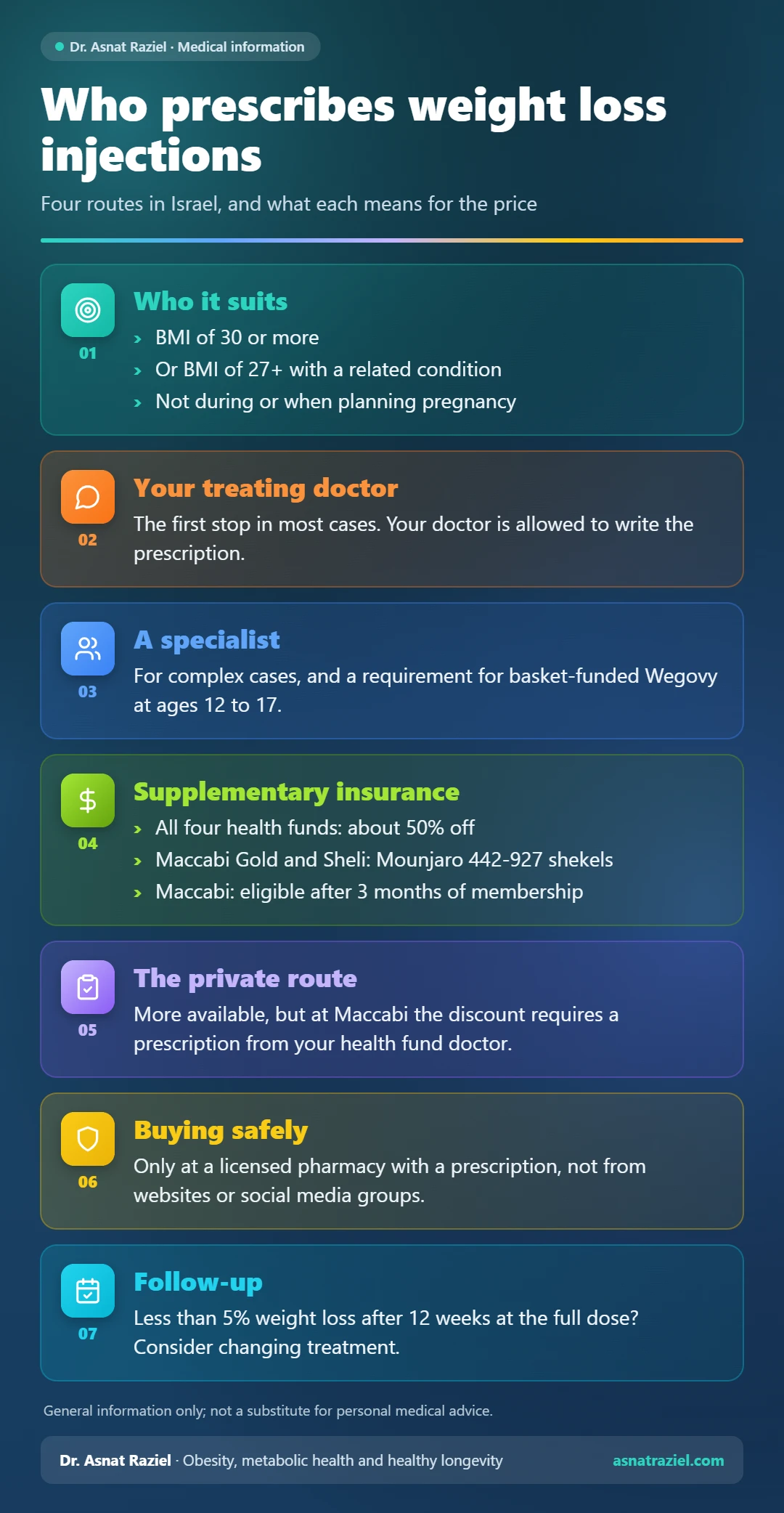
Most of these injections are GLP-1 receptor agonists, drugs that mimic a natural gut hormone. They increase the feeling of fullness and reduce appetite. According to the U.S. National Institute of Diabetes and Digestive and Kidney Diseases (NIDDK), they target adults with a BMI of 30 or more. BMI, or body mass index, is weight divided by height squared.
In addition, the treatment also suits people with a BMI of 27 or more who have a weight-related condition, such as high blood pressure or type 2 diabetes. However, there are situations in which you must not use these drugs. These include a personal or family history of medullary thyroid cancer or MEN 2 syndrome, pregnancy and planning a pregnancy. That is why your doctor will ask about your medical history before writing a prescription.
Who prescribes weight loss injections: your health fund doctor
In most cases, the first stop is your treating doctor at the health fund. They know your other conditions, your medications and your latest test results. Your treating doctor can write a prescription for Wegovy or Mounjaro. At Maccabi, for example, the supplementary insurance subsidy requires a referral and prescription from your Maccabi treating doctor.
It helps to arrive with your current weight and height, recent blood tests and a full list of medications. That way, your doctor can decide at the first visit. Also, ask whether it makes sense to bring in a dietitian from the start.
For a full picture of what to expect at the appointment itself, see my article on what happens at the first obesity specialist visit.
Readers sometimes ask about my own background, so I describe it in my profile on Dr. Asnat Raziel’s path in obesity medicine.
Who prescribes weight loss injections in complex cases and for teens
Sometimes it is worth seeing an endocrinologist or an obesity specialist, for example at a dedicated obesity clinic. This is especially true when you have several medical conditions, when previous treatments have not worked or when you are considering bariatric surgery. The specialist will tailor the type of drug and the pace of dose increases. At the same time, they will coordinate between the dietitian, the psychologist and your family doctor.
For adolescents, a specialist referral is a requirement. According to Maccabi’s eligibility page (in Hebrew), basket-funded Wegovy for 12- to 17-year-olds requires a referral from an endocrinologist, a pediatric endocrinologist or the team at a dedicated obesity clinic. The conditions also include a weight of at least 60 kg, a BMI of 30 or more and participation in a supervised nutrition program. You will find more in my article on teen obesity treatment.
Who prescribes weight loss injections with a health fund subsidy
For adults, all four health funds, Clalit, Maccabi, Leumit and Meuhedet, provide Wegovy and Mounjaro through supplementary insurance at a discount of about 50%. Each fund publishes its prices on its website. At Maccabi Gold and Maccabi Sheli, for example, Wegovy is available from age 18 with a BMI above 30. Alternatively, it is also available with a BMI of 27 to 30 and a related condition, such as high blood pressure, fatty liver or prediabetes. The co-payment for Wegovy is 51% of the drug’s price. For Mounjaro, you pay between 442 and 927 shekels, depending on the dose.
Eligibility starts three months after joining the supplementary plan. Approval is usually automatic when your doctor writes the prescription, and a review usually takes up to 7 working days. If the health fund rejects the request, your doctor can file an appeal. However, eligibility rules and waiting periods vary between health funds, so check them on your own fund’s website. I discuss coverage further in my article on insurance coverage for obesity drugs.
The private route: what you need to know
You can also see a private doctor. The advantage is availability and a longer appointment. However, at Maccabi, eligibility for the supplementary insurance subsidy requires a referral and prescription from your Maccabi treating doctor. In other words, a private prescription alone may leave you paying the full price. So if you see a doctor at a private clinic, ask for a summary letter and show it to your health fund doctor.
Online, you will also find private clinics from all over the world, such as Stay Medical Clinic in Miami, which offer a range of services. But in Israel, you buy the injection itself at a licensed pharmacy, with a valid prescription.
Buying safely without getting scammed
The FDA warns about unapproved GLP-1 drugs sold online. So do not buy products labeled “for research purposes,” and do not use an injection that arrived warm. In addition, be wary of suspiciously low prices and of delivery without a medical evaluation. In Israel, buy only at a pharmacy and with a prescription, not in social media groups.
After the prescription: follow-up and persistence
The prescription is only the beginning. Treatment starts at a low dose and increases gradually to reduce nausea and digestive side effects. According to NIDDK, if weight loss is less than 5% after 12 weeks at the full dose, your doctor will consider changing treatment. Also, the drug works well together with a healthy lifestyle, with protein at every meal and strength training.
Drug availability changes quickly, so it pays to stay up to date. I wrote about the latest developments in my article on new weight loss injections in Israel. For an overview of all drug families, see my page on anti-obesity medications.
The rules can change too. In 2024, for example, Ynetnews reported that the Health Ministry told health funds to stop prescribing Ozempic for obesity. Patients were referred to their doctor for a registered obesity drug instead.
Bottom line
Who prescribes weight loss injections? Usually your treating doctor, and sometimes a specialist. For adults, all four health funds provide the injections through supplementary insurance at a discount of about 50%, and at Maccabi the discount requires a referral from your health fund doctor. The private route is fast, but it can cost a lot of money. Ultimately, the right path combines medical suitability, close follow-up and a budget you can sustain over time. You can read more about my approach on my about page.
The information in this article is general and is not a substitute for personal medical advice.
Questions and answers
Can my health fund doctor prescribe weight loss injections?
Yes. Your treating doctor can write the prescription, and in complicated cases they will refer you to a specialist.
Does a prescription from a private clinic qualify for a discount?
Not always. At Maccabi, for example, the supplementary insurance subsidy requires a referral and prescription from your health fund doctor. So check with your own health fund in advance.
How long does health fund approval take?
At Maccabi, approval is usually automatic when your doctor writes the prescription. When the fund needs to review the request, it usually takes up to 7 working days.
Can I buy weight loss injections online?
It is not recommended. Buy only at a licensed pharmacy and with a prescription. That way, you stay away from counterfeit drugs and from injections that did not stay cold.
References
Prescription Medications to Treat Overweight & Obesity
FDA’s Concerns with Unapproved GLP-1 Drugs Used for Weight Loss