By Dr. Asnat Raziel, bariatric surgeon specializing in obesity treatment, metabolic health and healthy longevity; Director of the Multidisciplinary Center for Obesity Treatment, Assia Medical, Assuta Ramat HaChayal, Tel Aviv
Medical weight loss consultation: why see a doctor at all?
A medical weight loss consultation is right for anyone who has tried diet after diet, lost weight and gained it back. Most people who come to see me do not lack willpower. They are simply fighting their own biology alone. That is why the goal of the first visit is to understand why the weight goes up, not just how many kilograms need to come off.
Today we understand that obesity is a chronic disease, not a personal failure. In addition, we now have effective and safe treatments that did not exist a decade ago. However, the right treatment differs from person to person, so a proper diagnosis is essential. In this article, I will explain what the process includes, when it is worth starting and what a good treatment plan looks like.
The body fights to keep the weight
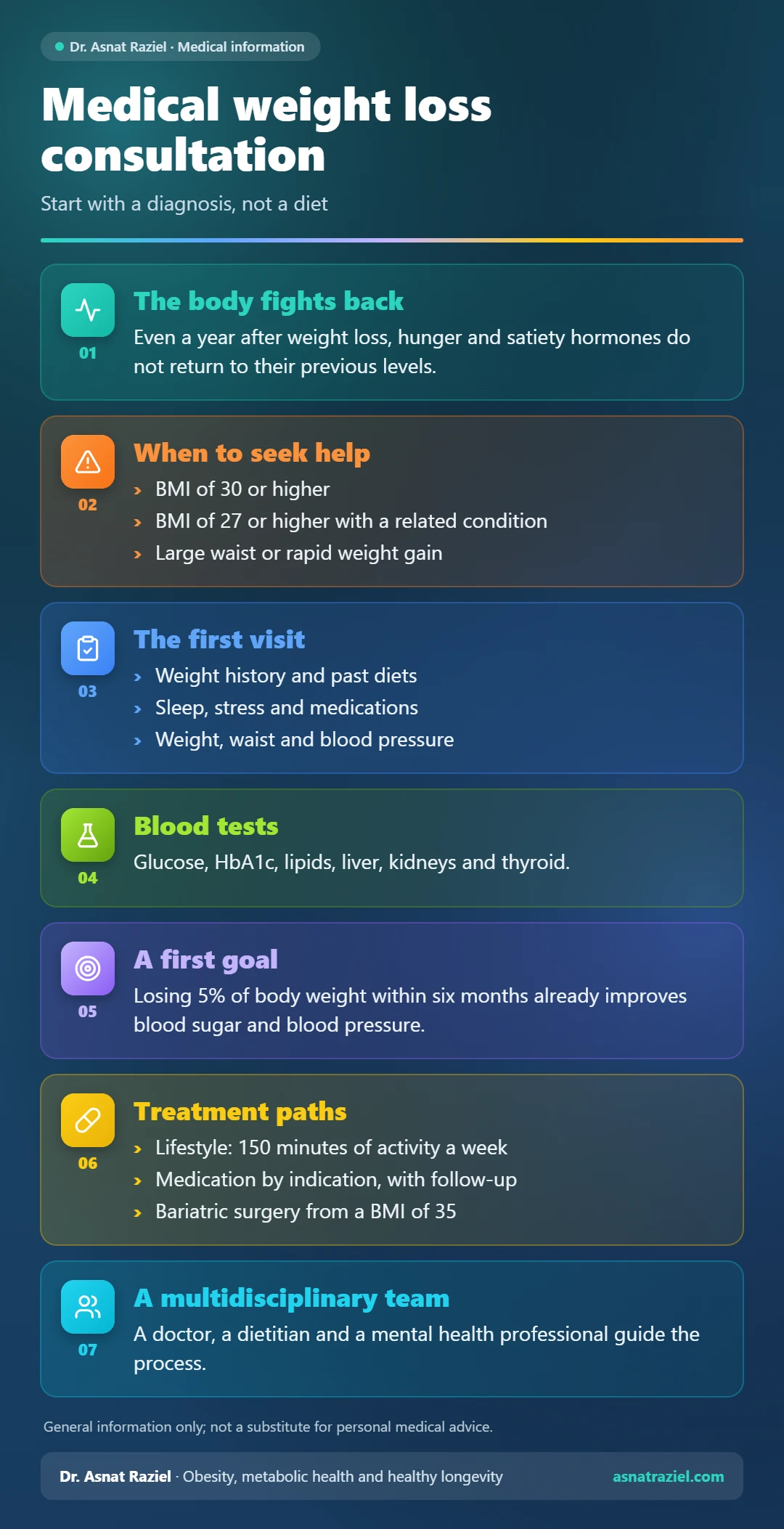
After weight loss, the body reacts as if it were in danger. In a study published in the NEJM, researchers followed 50 patients who lost an average of 13.5 kg on a low-calorie diet. Even a year later, their hunger and satiety hormones had not returned to their previous levels. In other words, hunger stayed high, and leptin, the hormone that tells the brain how much fat is stored, stayed low.
Put simply, regaining weight is not a matter of “lack of discipline.” It is a well-known biological mechanism. That is why a doctor who specializes in obesity treatment knows to expect this response and builds a plan that deals with it from the start.
When should you get a medical weight loss consultation?
There is no need to wait for complications. For example, it is worth getting checked in these situations:
- A BMI (body mass index, the ratio of weight to height) of 30 or higher.
- A BMI of 27 or higher together with high blood pressure, prediabetes, fatty liver or sleep apnea.
- A large waist circumference, even when your BMI is relatively normal.
- Rapid weight gain with no clear reason, or after starting a new medication.
- Repeated attempts to lose weight that ended with the weight coming back.
If you are not sure, I have gathered the main signs in my guide on when to seek medical treatment for obesity. You can also start with a simple check using a BMI calculator.
What happens during a medical weight loss consultation?
First, I ask about your weight history: when the gain began, which diets you tried and what happened afterward. Next, we go over your eating habits, sleep, stress and physical activity. It is also important to review which medications you take, because some of them promote weight gain.
Mayo Clinic’s guide to obesity diagnosis and treatment describes a similar first step. It covers weight history, past weight-loss efforts, eating and activity habits, stress, medications and family history.
Then comes a physical exam: weight, height, waist circumference and blood pressure. According to the new international definition published in The Lancet Diabetes & Endocrinology, BMI alone is not enough to decide whether a disease is present. Therefore, we add another measure, such as waist circumference, and check whether excess fat is already harming how the organs work.
Tests in a medical weight loss consultation
I usually recommend basic blood tests: fasting glucose, glycated hemoglobin (HbA1c, the average blood sugar over the past three months), a lipid profile, liver and kidney function, and thyroid function. When needed, we add personalized tests, such as a body composition scan or a sleep apnea test.
Your treatment plan after a medical weight loss consultation
After the diagnosis, we build a personal plan. According to the US National Institute of Diabetes and Digestive and Kidney Diseases (NIDDK), a reasonable first goal is to lose 5% of your body weight within six months. Even this much weight loss already improves blood sugar, blood pressure and blood fats.
Lifestyle as the foundation
Every treatment rests on the basics of weight management: a diet you can stick with, physical activity and good sleep. For example, the standard recommendation is at least 150 minutes of moderate activity a week, along with strength training to preserve muscle mass. A clinical dietitian guides the change, and sometimes a psychologist does too. Small, consistent changes are what last for years, not an extreme diet of a few weeks.
Medication
When lifestyle alone is not enough, obesity medication may be an option. These drugs are usually approved for a BMI of 30 or higher, or 27 or higher with a related condition. The new medications, such as semaglutide and tirzepatide, act on the hunger and satiety centers in the brain. Even so, they require medical follow-up, dose adjustment and a protein-rich diet.
Bariatric surgery
In some cases, surgery is the most effective treatment. According to the international guidelines of the bariatric surgery societies, surgery should be considered at a BMI of 35 or higher, even without related diseases. Moreover, at a BMI of 30 to 34.9 with metabolic disease, surgery can be considered when other treatments have not worked.
How do you choose a doctor for a medical weight loss consultation?
It is important to choose a doctor who treats obesity regularly and knows all the treatment options, not just one of them. In addition, look for a multidisciplinary team that includes a dietitian and a mental health professional. I discuss this in more detail in my article on how to choose an obesity doctor.
Common mistakes to avoid
- Getting medication without a prescription or medical follow-up.
- Focusing only on the number on the scale and forgetting about muscle mass.
- Stopping treatment all at once when the weight goes down.
- Expecting fast results and giving up after a month.
The bottom line
A medical weight loss consultation starts with a diagnosis, not with a diet. It identifies the causes of weight gain, checks for complications and builds a plan you can stick with over time. After all, obesity is a chronic disease, so treating it is also an ongoing process. If you are on the fence, a single consultation can help bring clarity.
The information in this article is general and does not replace personal medical advice.
Questions and answers
Do I need a referral for a medical weight loss consultation?
It depends on your health fund (HMO) and your insurance plan. So it is best to check in advance with your health fund or insurance company.
How long does treatment last?
Obesity is a chronic disease, so follow-up continues over time. Usually, visits are frequent at first and become less frequent once things stabilize.
Does everyone who comes in get medication?
No. Medication is appropriate only when there is a medical indication, and always alongside lifestyle changes.
What should I bring to the first visit?
Recent blood test results, a list of the medications you take and a short summary of your previous attempts to lose weight.
References
Long-term persistence of hormonal adaptations to weight loss
Definition and diagnostic criteria of clinical obesity