By Dr. Asnat Raziel, bariatric surgeon specializing in obesity treatment, metabolic health and healthy longevity; Director of the Multidisciplinary Center for Obesity Treatment, Assia Medical, Assuta Ramat HaChayal, Tel Aviv
BMI calculator: how to calculate it and what the number means
A BMI calculator is the fastest way to check whether your weight raises your health risk. The calculation is simple and takes less than a minute. However, the number you get is only a starting point, not a diagnosis. In this article, I explain how to calculate it, how to read the result, and when it is worth adding other measures.
What is BMI and how does a BMI calculator work?
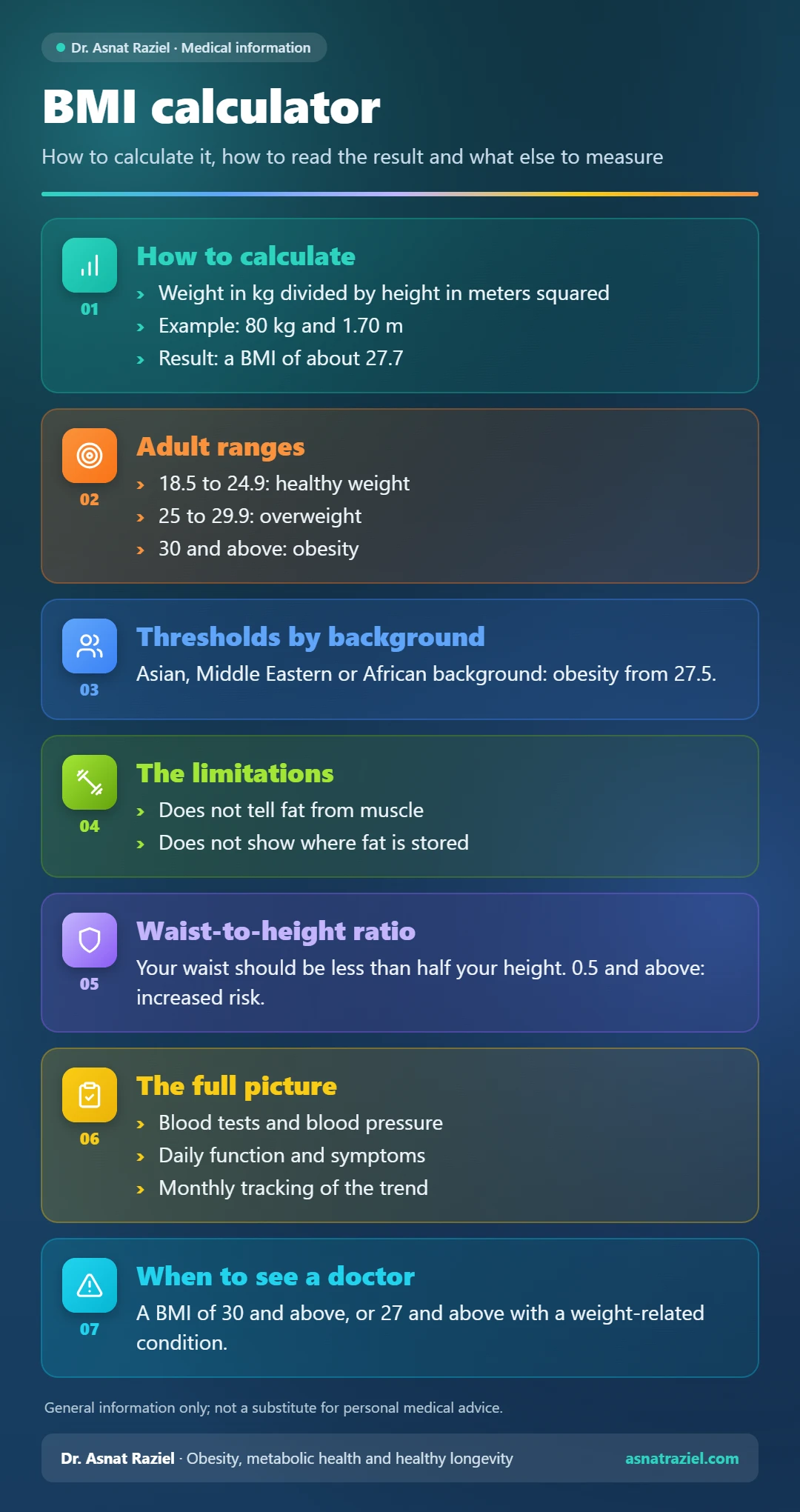
BMI, or body mass index, is the ratio between weight and height. The formula is weight in kilograms divided by height in meters squared. For example, take a person who weighs 80 kg and is 1.70 meters tall: 1.70 times 1.70 equals 2.89. Next, divide 80 by 2.89, and the result is a BMI of about 27.7.
Doctors have used this measure for decades, because it is cheap, quick and needs no special equipment. Every online BMI calculator does exactly this calculation. That is why it is important to enter an accurate height and weight, ideally after weighing yourself in the morning. In addition, at the population level, BMI matches direct measurements of body fat fairly well.
How to read your BMI calculator result
According to the World Health Organization, in adults a BMI of 25 or higher is defined as overweight, and 30 or higher as obesity. The UK’s NICE guidelines set out the ranges as follows:
- 18.5 to 24.9: healthy weight.
- 25 to 29.9: overweight.
- 30 to 34.9: obesity class 1.
- 35 to 39.9: obesity class 2.
- 40 and above: obesity class 3.
A value below 18.5 is underweight, and it also needs to be looked into.
Not the same cutoffs for everyone
People of South Asian, Chinese, other Asian, Middle Eastern, Black African or African-Caribbean background build up metabolic risk at a lower BMI. For this reason, the NICE guidelines recommend lower cutoffs for them: overweight from 23, and obesity from 27.5. Keep this in mind when you interpret the result.
The limitations of a BMI calculator
A BMI calculator sees only two numbers: height and weight. The main problem is that the measure does not distinguish between fat and muscle. Someone who trains and has a lot of muscle mass may get a “high” BMI without excess fat. On the other hand, an older person who has lost muscle may get a normal BMI despite excess fat. I wrote about this in detail in my article a normal weight does not always mean good health.
In addition, BMI does not show how fat is distributed in the body. Harvard’s Nutrition Source notes that people of Chinese and South Asian origin tend to carry belly fat at a relatively low BMI. Belly fat surrounds the internal organs, and it is far more harmful than fat on the thighs. So body composition and fat distribution matter as much as the number, as I explained in why body composition matters more than weight.
What to add to your BMI calculator result
In January 2025, an international commission of 58 experts published a new definition of clinical obesity in The Lancet Diabetes & Endocrinology. The commission recommended using BMI only for screening, and not as the sole measure of a particular person’s health. In other words, excess fat needs to be confirmed with another measure. Only above a BMI of 40 can excess fat be assumed without further testing.
Waist-to-height ratio
The simplest measure to add is the waist-to-height ratio. Measure your waist and divide it by your height, using the same units. According to NICE, a ratio of 0.5 to 0.59 reflects increased risk. A ratio of 0.6 or higher reflects an even higher risk. Put simply, your waist should be less than half your height.
This ratio also plays a key role in a newer approach. According to Israel Hayom, a study led by Prof. Dror Dicker of Sharon Hospital, with the European Association for the Study of Obesity, tested a framework in which a BMI of 25 to 30 counts as obesity when the waist-to-height ratio exceeds 0.5 and obesity-related conditions are present. Applied to U.S. data, it would reclassify about 50 million Americans as having obesity.
Blood tests and daily function
Beyond these measurements, your doctor also checks blood sugar, blood fats, blood pressure and liver function. It is just as important to ask about joint pain, snoring, fatigue and limits on movement. Under the new approach, these are the signs that separate excess fat from active disease. Next, you can read about early diagnosis of obesity, not only by weight.
Why a BMI calculator is still worth using
Despite its limitations, a high BMI is a real warning sign. The World Health Organization estimates that 940 million adults worldwide were living with obesity in 2024. Obesity raises the risk of type 2 diabetes, heart disease, fatty liver, sleep apnea and certain types of cancer. You will find the full details in my article on the health risks of excess weight.
It is important to remember that even a small loss makes a difference. In a person with obesity, losing 5% to 10% of body weight already improves blood sugar, blood pressure and blood fats. So you do not need to reach a “perfect” BMI to gain health.
A practical tip: measure once a month, at the same time of day and under the same conditions. Write down your weight, your waist and how you feel overall. Personal tracking works best when it is consistent. Indeed, a trend over several months says much more than a single measurement.
Your BMI calculator showed a high value: when to see a doctor
It is worth getting an evaluation when your BMI is 30 or higher, or 27 or higher with a weight-related condition. A waist-to-height ratio of 0.5 or higher is also a good reason to get checked. Today there are effective treatments, from nutrition and coaching to medication and surgery. The choice between them depends on the full picture, not on a single number. If you are unsure, here is how to choose a personalized treatment.
The bottom line
A BMI calculator is a simple and useful screening tool, but it does not tell the whole story. Add a waist measurement, pay attention to your blood tests and daily function, and follow the trend over time. If the result worries you, an evaluation with an obesity specialist will help you understand the number.
This article provides general information and is not a substitute for personal medical advice.
Questions and answers
Is a BMI calculator suitable for children?
Not in the usual way. In children and teenagers, the doctor compares BMI with growth charts by age and sex. So it is best to consult your pediatrician.
I work out a lot and my BMI is high. Is that a problem?
Not necessarily. High muscle mass raises BMI. In that case, your waist circumference and a body composition test will give a much more accurate picture.
What is a healthy BMI for adults over 65?
The ranges are the same, but NICE recommends interpreting them with caution. In older age, a slightly higher BMI may even be protective. Above all, it is important to preserve muscle mass.
How often should I calculate my BMI?
For a healthy adult, a check every few months is enough. During weight loss, a monthly measurement gives good tracking.
Sources
Identifying and assessing overweight, obesity and central adiposity