By Dr. Asnat Raziel, bariatric surgeon specializing in obesity treatment, metabolic health and healthy longevity; Director of the Multidisciplinary Center for Obesity Treatment, Assia Medical, Assuta Ramat HaChayal, Tel Aviv
Weight loss drug budget: what drives the cost
Building a realistic weight loss drug budget is one of the first practical steps in treatment, because cost is a major reason people in Israel put off effective care. The question “How much will it cost?” comes up at almost every first visit to my clinic. Three things determine the answer: the medication, the dose and your insurance. In this article I explain what makes up the price, what Israel’s health funds (HMOs) cover, and how to plan the expense for the long term.
Three ways to pay for new obesity medications
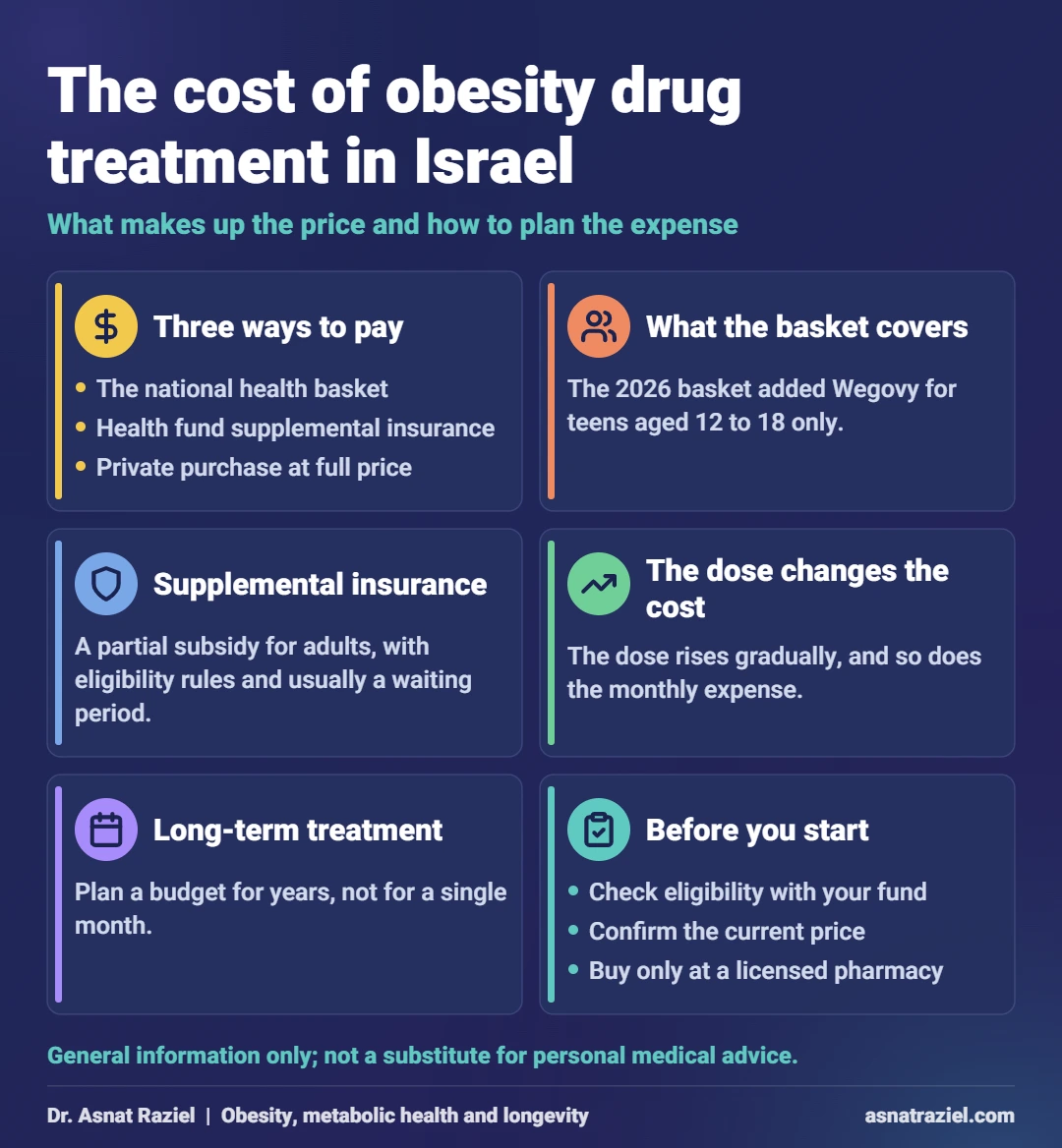
In practice, there are three ways to pay for the new medications today. First, the national health basket, Israel’s state-funded list of covered treatments, which covers only defined groups. Second, the supplemental insurance offered by the health funds, which subsidizes part of the price for adults. Finally, private purchase at a pharmacy at full price.
Each route has its own rules, waiting periods and eligibility criteria. So it is worth checking all of them before you start. I also wrote a separate article on subsidies for weight loss medications.
What the national health basket covers
The 2026 health basket added Wegovy injections for teenagers aged 12 to 17 (up to their 18th birthday). Adults were not included in the expansion. The chair of the basket committee explained that the committee had to set priorities, and it chose adolescents.
According to Maccabi’s eligibility page, basket eligibility for ages 12 to 17 includes several conditions. For example, a weight of at least 60 kg, a BMI (body mass index) of 30 or more and above the 95th percentile for age and sex, and a prescription from a specialist. In addition, the patient must take part in a supervised, documented nutrition program. I covered this in detail in my article on weight loss drugs in the health basket.
Your weight loss drug budget with supplemental insurance
Most adults get these medications through their health fund’s supplemental insurance. Each fund sets its own copayment, depending on the drug and the dose. There are also eligibility conditions, and usually a waiting period from the day you join the insurance plan.
As an example, I checked Maccabi’s website on October 22, 2026 (the eligibility page was last updated on September 22, 2026). In Maccabi Gold and Maccabi Sheli, the copayment for Wegovy is 51% of the drug’s price, depending on the dose. For Mounjaro, the copayment is 442 to 927 shekels (NIS), depending on the dose. Eligibility begins three months after joining the supplemental insurance.
The other health funds have different terms and prices, so check directly with your own fund. I expanded on insurance coverage for obesity medications in another article.
Paying full price at the pharmacy
Anyone who is not eligible for a subsidy pays the retail price. I checked this on Maccabi’s website on October 22, 2026, too. A 5 mg Mounjaro pen was listed there at 1,056.40 NIS, and a 10 mg pen at 1,468.64 NIS. Maccabi notes that the final price is set at the time of dispensing. Drug prices change from time to time, so it is important to confirm the current price before you buy.
Keep in mind that all the figures in this article are as of the date of the source. For current per-dose prices and a detailed comparison of the products, see my main guide to weight loss drug prices in Israel.
Why your weight loss drug budget grows over time
Treatment starts at a low dose and increases gradually to reduce nausea and other side effects. Because the price depends on the dose, the monthly expense usually rises during the first months. In other words, the first month’s price does not reflect the long-term cost.
In addition, obesity is a chronic disease. Studies show that most patients regain weight after stopping the medication. That is why it makes sense to think about the budget in years rather than months. I wrote about this in my guide on what happens when you stop a weight loss medication.
Related costs
Beyond the drug itself, good treatment also requires blood tests, doctor visits and support from a dietitian. Some of these services are provided by the health fund, while others are paid privately. Therefore, include them in your planning too.
Weight loss drug budget versus health value
It is easy to look only at the monthly amount. However, obesity raises the risk of diabetes, heart disease, fatty liver and joint problems. Treating each of these conditions costs money, time and quality of life. The new medications also improve blood sugar control, blood pressure and blood lipids, as I explained on my page about medications for metabolic disease.
Interestingly, the production cost of these drugs is much lower than their retail price. I wrote about this gap in my article on the production cost of semaglutide. You will also find broad scientific background on all the drug families in this overview of anti-obesity medications.
How to plan your weight loss drug budget wisely
A few simple steps can save a lot of money and frustration:
- Check eligibility in advance: ask your health fund about the conditions, the copayment and the waiting period.
- Plan by the maintenance dose: calculate the cost based on the dose you will stay on long term, not on the first month.
- Buy only from a licensed pharmacy: “cheap” pens sold online may be counterfeit and dangerous.
- Check that the medication works for you: according to FDA-approved medications and the recommendations of the US National Institutes of Health, anyone who has not lost 5% of their body weight after 12 weeks on the full dose should consider changing the plan.
As in every area of life, planning ahead prevents surprises. A personal budgeting app can also help you track the monthly expense. In addition, keep an eye on Ministry of Health guidelines and on updates from your health fund.
The bottom line
The cost of drug treatment for obesity in Israel depends on the medication, the dose and the insurance route. The health basket provides Wegovy for teenagers, while adults rely mainly on partial subsidies through supplemental insurance. Since this is a long-term treatment, plan the expense for years, not for a single month. At our clinic, we help patients choose a medication that suits both their body and their budget. You can read more about me on the About Dr. Asnat Raziel page.
The information in this article is general and does not replace personal medical advice.
Questions and answers
Does the health basket cover weight loss drugs for adults?
No. In the latest basket expansion, Wegovy was added only for teenagers aged 12 to 17. Adults receive a partial subsidy through supplemental insurance.
Why does the monthly price change?
The price depends on the dose. Since the dose is increased gradually, the expense also grows during the first months.
How long is the wait for supplemental insurance eligibility?
At Maccabi, for example, eligibility begins three months after joining. At Clalit, Leumit and Meuhedet as well, Wegovy and Mounjaro are provided through supplemental insurance at a discount of about 50%, and the prices are published on the health funds’ websites.
Can I buy the medication without a prescription?
No. You need a doctor’s prescription, and it is best to buy only from a licensed pharmacy.
Sources
Injections for the treatment of obesity and diabetes – Maccabi Healthcare Services
MOUNJARO PEN 5MG/0.6ML – Maccabi drug guide
MOUNJARO PEN 10MG/0.6ML – Maccabi drug guide
The 2026 drug basket: a budget of 650 million shekels, with an emphasis on cancer (Walla, in Hebrew)