By Dr. Asnat Raziel, bariatric surgeon specializing in obesity treatment, metabolic health and healthy longevity; Director of the Multidisciplinary Center for Obesity Treatment, Assia Medical, Assuta Ramat HaChayal, Tel Aviv
Medicare weight loss drugs: an investment in public health
Medicare weight loss drugs went from a distant dream to real policy in the United States over the past year. For years, the new obesity drugs were almost a luxury. Only people who could pay hundreds or even thousands of dollars a month could benefit from them. Since July 2026, however, millions of Americans covered by Medicare can get them for a fixed and much lower payment. This raises a question: will Israel’s health funds (HMOs) and insurers also start to see obesity treatment as an investment rather than an expense?
Coverage questions extend beyond government programs, too. I discuss employers and weight-loss drug coverage separately.
$50 a month: what started in July 2026
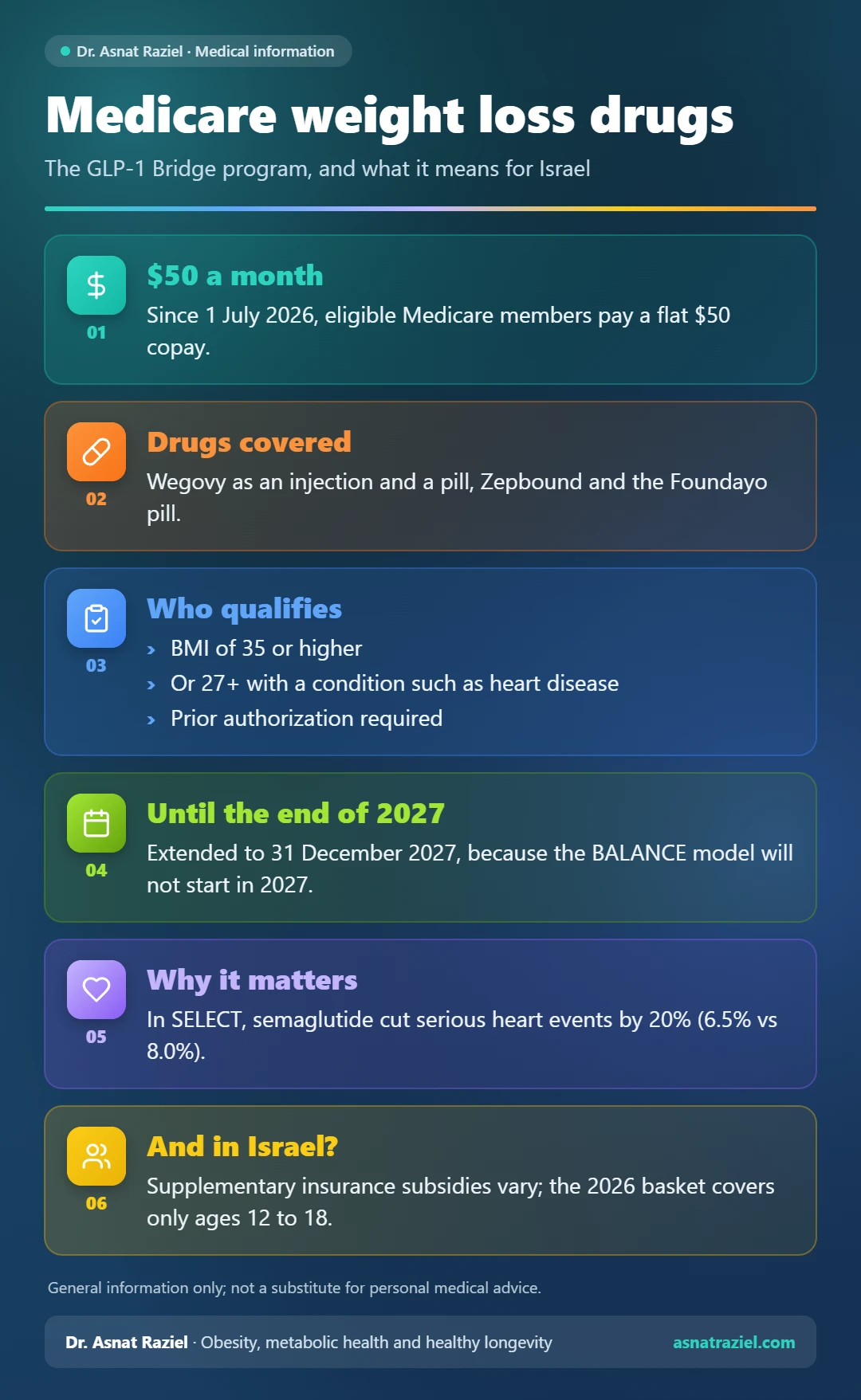
Medicare is the U.S. government health insurance program, mainly for people aged 65 and older. U.S. law bars it from paying for weight loss drugs. To get around this limit, the government launched the Medicare GLP-1 Bridge program on 1 July 2026. Under this program, eligible patients pay a fixed copay of $50 a month for these Medicare weight loss drugs.
According to the NPR overview, the program covers Wegovy as an injection and as a pill, Zepbound, and the Foundayo pill. To qualify, a person needs a BMI of 35 or higher, or a BMI of 27 or higher together with a related condition, such as heart disease or prediabetes. In addition, the doctor must get prior authorization. This is an unprecedented step. It reflects a deep shift in thinking: obesity is not a cosmetic problem, but a chronic disease that is worth treating early.
Not another diet, but disease prevention
The U.S. move is not only meant to help patients lose weight. Obesity is a major risk factor for type 2 diabetes, heart disease and stroke. It also raises the risk of kidney failure, fatty liver, sleep apnea and several types of cancer.
When treatment succeeds in lowering weight, the risk of complications also drops. For example, the SELECT trial included 17,604 patients with heart disease and excess weight, without diabetes. A major heart event occurred in 6.5% of patients on semaglutide, compared with 8.0% in the placebo group. That is a 20% relative reduction in risk. You can read more in my article on Wegovy and heart protection.
The possible result is fewer hospital stays, fewer cardiac catheterizations and fewer chronic treatments. However, long-term savings have not yet been proven. That is exactly what the U.S. program is supposed to test.
How Medicare weight loss drugs coverage works
The program runs outside Medicare’s regular drug coverage. One central system, managed by the government, handles approvals, prescriptions and payments to pharmacies. In other words, the private insurance plans don’t bear the cost. The program was originally planned to run until the end of 2026, but the government extended it to 31 December 2027. The reason: a long-term model called BALANCE will not start in 2027.
The program also has drawbacks. According to an analysis by KFF, the copay does not count toward the member’s annual out-of-pocket cap. In addition, people with low incomes get no discount on it. Also, people who receive these drugs for diabetes or sleep apnea stay on the regular track, and they sometimes pay more than $50.
And what about Israel?
Here the picture is complicated. On one hand, many patients today get subsidies through the health funds’ supplementary insurance plans. The copay depends on medical criteria and on the type of plan.
On the other hand, there is no uniform policy. The copay varies between health funds, between types of plans and between drugs. Many patients still pay hundreds of shekels a month, and some give up effective treatment because of the cost. In the national health basket, progress is cautious. The 2026 health basket included weight-reducing drug treatment only for adolescents aged 12 to 18. So adults with obesity still have no basket coverage, as I explained in my article on weight loss drugs and the national health basket.
Meanwhile, the new drugs are also reaching Israel. For example, the Foundayo pill has been available here since September 2026, as I wrote in my article on Foundayo in Israel. Even so, it also costs hundreds of shekels a month. Without a clear funding policy, access to treatment depends mainly on each patient’s finances. This creates a health gap between those who can pay and those who cannot.
Private insurers in Israel have not adopted a broad approach either. In most policies, coverage applies to medical consultations or to certain situations, but not to regular funding of the drugs. I wrote in detail about the existing options in my guide to insurance coverage for obesity drugs.
Subsidizing weight loss drugs in Israel: is it time?
The question is no longer whether the drugs work. Large trials have shown that they reduce weight, improve metabolic control and lower the risk of heart disease. The real question is whether the health system is ready to see obesity treatment as an investment.
If the health funds see these drugs only as a budget line, they may end up paying later for heart surgery, dialysis, diabetes care and many hospital stays. In contrast, a preventive approach may save the system large sums over time. That is why it is worth learning from the U.S. experiment, and carefully checking whether subsidizing weight loss drugs really pays for itself.
The future is already here, and its name is metabolic health
The real news is not just cheaper drugs. It is the change in thinking. Around the world, there is now an understanding that obesity is a chronic disease that needs long-term treatment, just like high blood pressure or diabetes. Treatment also goes beyond a prescription. It combines good nutrition, physical activity, preserving muscle mass, good sleep, stress reduction and ongoing medical support.
This is also the essence of longevity medicine. The goal is not only to extend life, but to extend the healthy, independent and active years.
The bottom line on Medicare weight loss drugs
The new Medicare program may be much more than an economic step. It may open an era in which health systems reward prevention instead of paying for disease. In the end, the big question remains open. Will Israel be among the countries that lead in subsidizing weight loss drugs, or will it join only after the data are clear to everyone?
This article is general information and does not replace personal medical advice.
References
A new Medicare option for weight loss drugs is coming. Here’s what to know
What Medicare’s Temporary Program Covering GLP-1s for Obesity Means for Beneficiaries
Semaglutide and Cardiovascular Outcomes in Obesity without Diabetes
Mako: The 2026 health basket – 107 new drugs and technologies for 86,000 patients (in Hebrew)
The SELECT trial was funded by Novo Nordisk, the drug’s manufacturer.