By Dr. Asnat Raziel, bariatric surgeon specializing in obesity treatment, metabolic health and healthy longevity; Director of the Multidisciplinary Center for Obesity Treatment, Assia Medical, Assuta Ramat HaChayal, Tel Aviv
My path from surgery to holistic medicine
My path from surgery to holistic medicine began with a pause. When I turned sixty, I stopped and took a breath. Behind me were three straight decades in operating rooms and thousands of operations. There were countless hours on my feet, countless decisions, and responsibility for life and death. For the first time in years, I did not put on green scrubs or stand at an operating table.
It was not an easy decision. For someone whose whole world was the hospital, it is almost unthinkable. Still, something in me knew it was time for a change. Here I want to share the story of that transition, its stages and what I learned along the way.
Medicine is changing, and I am changing with it
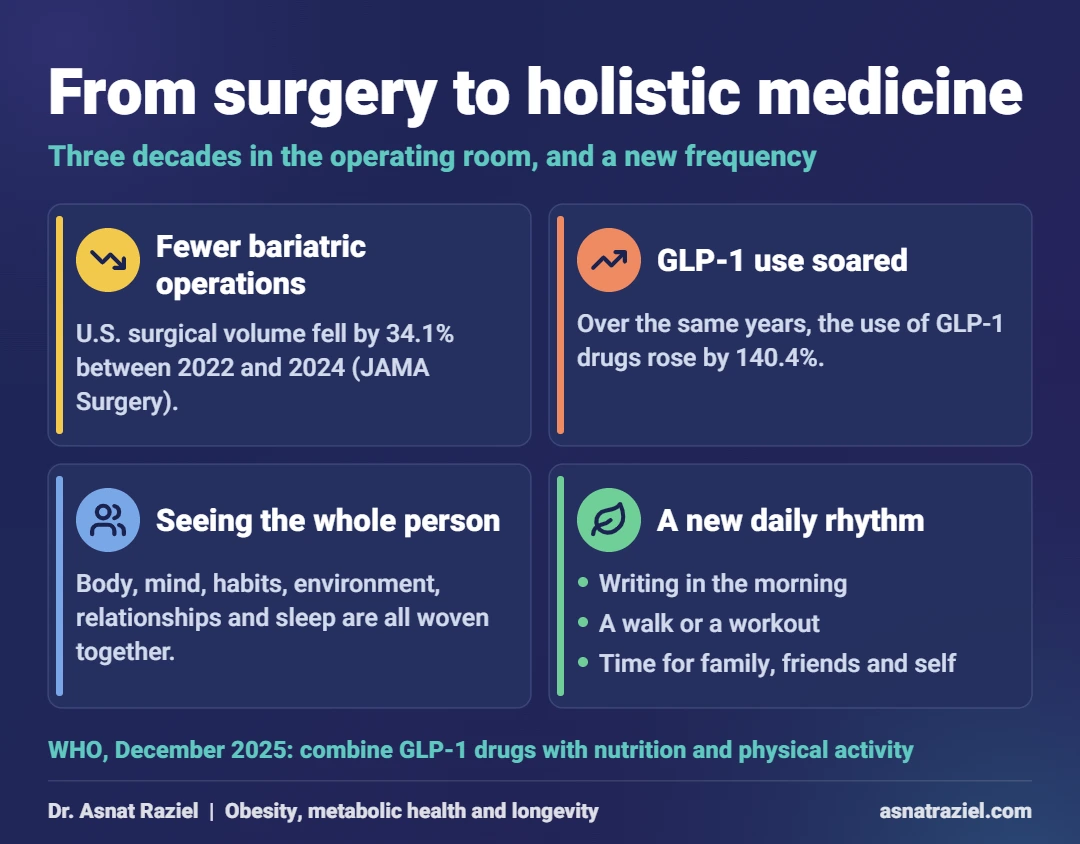
The change was not only personal. It was also part of a global shift in obesity medicine. The number of bariatric operations has dropped sharply, while the use of the new weight loss drugs has soared. These drugs act on satiety hormones; examples include Ozempic, Wegovy and Mounjaro. For example, a study published in JAMA Surgery found that in the United States, surgical volume fell by 34.1% between 2022 and 2024. Over the same years, the use of GLP-1 drugs rose by 140.4%, as the Harvard T.H. Chan School of Public Health also summarized.
For many years, I stood at the forefront of bariatric surgery in Israel. That is why I saw up close how the incretin revolution is changing the face of metabolic medicine. If you want to understand the differences between the two paths, you can read about obesity drugs versus bariatric surgery.
An inner revolution: seeing the whole person
For me, this was not only a medical revolution. It was also an inner one. Over the past decade, I have studied mind-body medicine and integrative medicine in depth. In addition, I studied nutrition, movement, sleep, mindfulness and stress management.
That is how I came to understand that obesity is not just a matter of the stomach. It is a matter of the whole person. The body, the mind, habits, environment, relationships and sleep are all woven together. An international Lancet commission also concluded that the causes of obesity are many and complex. I wrote about this approach at length in my guide to holistic obesity treatment.
From the sterile room to life in full
After years of precise surgery, I discovered the joy of a life that is not sterile. I discovered writing, and it became a great love. The pen replaced the scalpel. Instead of cutting tissue, today I cut words and join them together. In this way, I tell the story of change.
Between medical articles on obesity and metabolism and columns on Israeli society, I found a new voice. It is a voice that listens, asks and observes. It does not rush to fix things; instead, it tries to understand.
Writing opened new worlds of thinking, expression and public influence for me. Today I write about medicine, society, policy and health. I also write about the relationship between people and the system, and about the doctor’s place in an age of artificial intelligence. Above all, I write about our responsibility as caregivers to also be humane guides.
When life slows down, the soul breathes
In past decades, I lived at the pace of the operating room: fast, precise and with no time to spare. Today, by contrast, I live at a different pace. It is a pace of listening, quiet and depth. I have learned to value free time. I do not see it as “lost productivity,” but rather as an opportunity for growth.
My days look different now. In the morning I write, and then I go for a walk or a workout. I cook, study, travel and meet with family and friends. I also spend time with myself. Perhaps this is the biggest change of all: the leisure to be present. You will find practical tools for this kind of quiet in my article on meditation and stress relief.
My new life is not less busy, but it is far richer. Instead of running a surgical team, I hold in-depth conversations with patients. We talk about awareness, nutrition, meaning, movement and self-love. Instead of moving between operating rooms, I move between worlds: between medicine and words, between science and the soul, and between treatment and creativity.
Between two loves: surgery and the person
I feel deep gratitude for my years as a surgeon. Surgery was a great love, full of purpose, challenge and lifesaving work. Even so, there comes a moment when that love changes. Today I know that my contribution to patients is not only the number of operations I performed. It is also the quality of my listening and the life changes I helped create. Beyond that, it is the message I share: healing can also come from within.
I feel that everything I did in the past prepared me for this stage. In this stage, I bring together science and spirit, and body and mind. So my move from surgery to holistic medicine has become a bridge between modern medicine and holistic medicine. The change I made in myself is also an invitation to others. The invitation is not only to lose weight, but to raise your frequency.
Looking ahead: from surgery to holistic medicine
The coming years bring a new mission. I want to keep writing, lecturing, teaching and guiding the cultural and medical change we are now at the heart of. There is no longer a split between drugs and surgery. Instead, there is a connection between medicine and comprehensive care. The World Health Organization guideline from December 2025 also recommends combining GLP-1 drugs with a nutrition and physical activity program.
My change is also the story of a whole generation of doctors and patients. This generation understands that health is not just the absence of disease, but the presence of life. A similar idea already appears in the Constitution of the World Health Organization, which defines health as complete physical, mental and social well-being. I wrote about the tools that lead there in my article on lifestyle medicine.
Bottom line: from surgery to holistic medicine
Looking back, I do not miss the operating room. Perhaps I miss the energy, the precision and the focus. However, I have found them again in other places: in words, in movement, in a glance and in conversation. In the end, my journey from surgery to holistic medicine did not take anything away from me. It only added.
And the new frequency? It is gentler, calmer and more human. It is less loud, but much deeper.
The information in this article is general and does not replace personal medical advice.
References
Trends in Metabolic Bariatric Surgery Utilization in the Era of GLP-1s, 2022-2024
Bariatric surgeries on the decline as use of GLP-1 drugs rises
Definition and diagnostic criteria of clinical obesity
WHO issues global guideline on the use of GLP-1 medicines in treating obesity