By Dr. Asnat Raziel, bariatric surgeon specializing in obesity treatment, metabolic health and healthy longevity; Director of the Multidisciplinary Center for Obesity Treatment, Assia Medical, Assuta Ramat HaChayal, Tel Aviv
Semaglutide and biological aging: what did the new study find?
Semaglutide and biological aging are a pair we would not have thought to connect a few years ago. GLP-1 drugs first showed significant weight loss. Then they showed heart protection, improvement in fatty liver and kidney protection. Now a new question joins the list: do they also slow the pace of biological aging?
A study from the University of California, San Diego, published in May 2026 in the journal Nature Communications, offers a first answer. It is an analysis of a randomized, double-blind, placebo-controlled trial in humans. The researchers found that semaglutide, the active ingredient in Ozempic, Wegovy and Rybelsus, slowed molecular markers of aging. However, this is only an early signal.
Biological age versus the age on your ID card
We all know how old we are by our date of birth. But in longevity medicine, biological age is the number that really matters. Two 60-year-olds can look very different. One travels, exercises and works full time. The other lives with chronic diseases, weakness and declining memory. The difference depends on genes, but also on the pace at which the body ages.
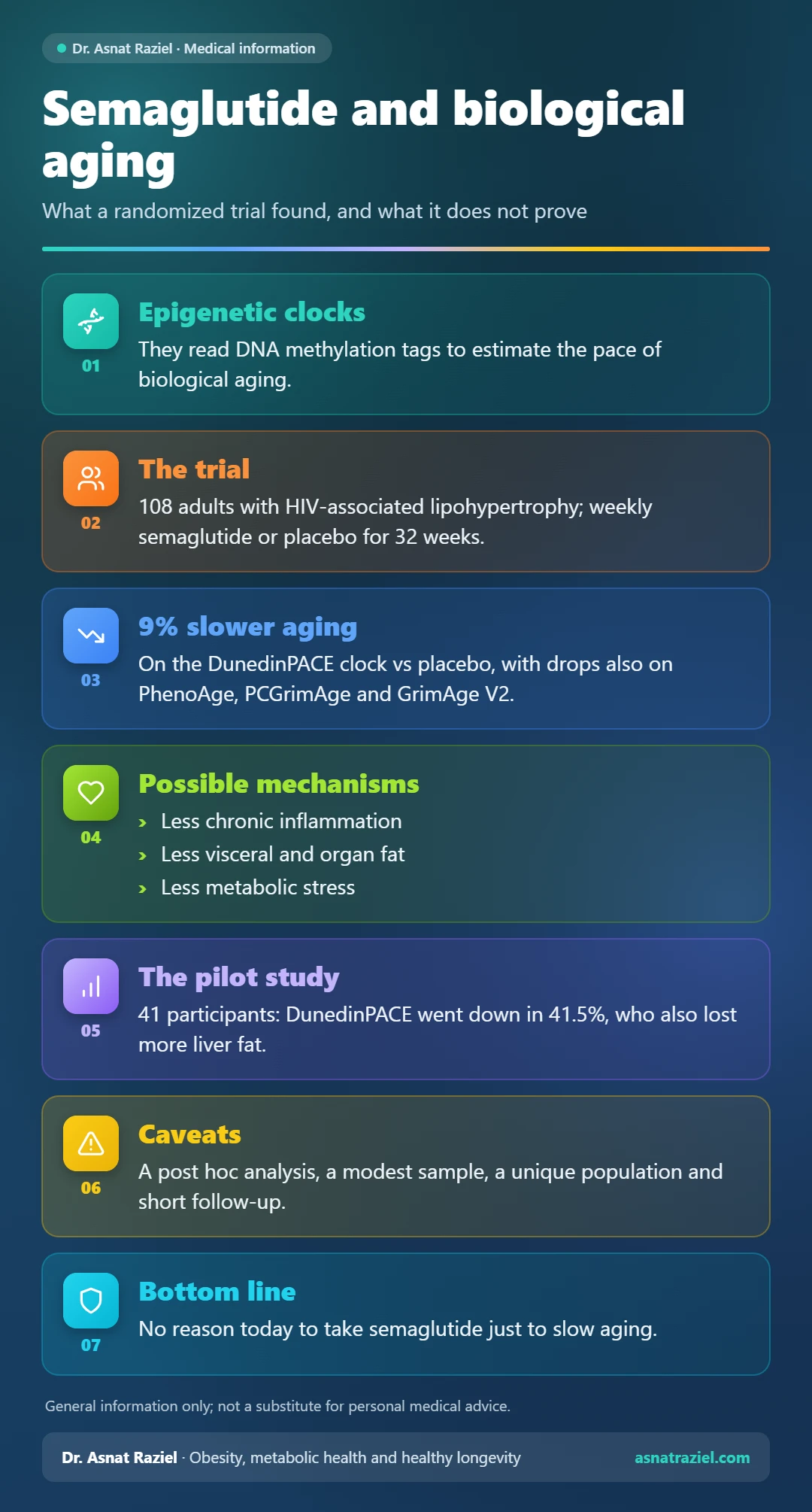
To measure this pace, researchers developed epigenetic clocks. These clocks read DNA methylation patterns, which are chemical tags on the genes. The tags do not change the gene sequence, but rather how the genes work. In addition, some of the clocks predict future disease and death.
How was the trial designed?
The original trial included 108 adults living with HIV and with lipohypertrophy. This is a condition in which fat builds up in the abdomen, including visceral fat around the organs. About half of the participants received a weekly semaglutide injection, and the rest received placebo. Treatment lasted 32 weeks.
The trial’s main goal was a change in visceral fat. Therefore, the team ran the epigenetic testing after the fact, as a post hoc analysis, meaning one that no one planned in advance. The researchers tested blood samples at the start of the trial and at week 32. Full data were available for 84 participants: 45 in the semaglutide group and 39 in the placebo group. They examined clocks from three different generations.
Semaglutide and biological aging: a 9% slower pace
According to the paper in Nature Communications, semaglutide slowed the pace of aging on the DunedinPACE clock by 9% compared with placebo. This clock measures the speed of aging, not age itself. In addition, the researchers saw a significant drop on the PhenoAge, PCGrimAge and GrimAge V2 clocks. These clocks are linked to the risk of death and of diseases of older age.
Moreover, the change did not appear on a single measure only. According to the early version of the study, eleven body-system clocks showed a similar trend. The most prominent were the inflammation, brain and heart clocks. On the other hand, a clock of “intrinsic capacity,” meaning overall functional fitness, did not change. The researchers also adjusted the analysis for body mass index and for inflammation markers.
Semaglutide and biological aging: which mechanisms might be at work?
What might link semaglutide and biological aging? The researchers suggest several possible mechanisms. First, semaglutide reduces chronic low-grade inflammation. This phenomenon is called inflammaging, a quiet, ongoing inflammation that accompanies aging. I expanded on this link in my article on GLP-1 drugs and chronic inflammation.
Second, the drug reduces visceral fat and the fat that builds up in the liver, heart and pancreas. This kind of fat tissue releases substances that promote inflammation. Third, it reduces metabolic stress and chronic activation of the immune system. Finally, the researchers mention early data suggesting that GLP-1 drugs may reprogram cells in different organs. It is important to remember that these are hypotheses, not proven mechanisms.
Why people living with HIV?
The question of semaglutide and biological aging was tested in a special population. Even when the virus is well controlled with treatment, people living with HIV often show accelerated biological aging. They also live with chronic inflammation and metabolic disorders. That makes them an important research model. In them, researchers can detect a biological change over a relatively short time.
The lead researcher, Dr. Michael Corley, said in the university’s announcement that many of these processes are also central to aging in the general population. However, he stressed that the study does not show that semaglutide reverses aging or makes people “younger.”
The pilot study: a mixed picture
In April 2026, the same research group published a pilot study in npj Aging. The study included 41 people living with HIV and with metabolic fatty liver disease (MASLD). All of them received semaglutide at a dose of 1.0 mg a week for 24 weeks, with no control group.
On average across the group, the pace of aging stayed stable. However, in 41.5% of participants, the DunedinPACE value went down. In these participants, liver fat also dropped markedly. According to the university’s announcement, PCGrimAge went down in 34%. In addition, estimated telomere length rose in about half of the participants, and they walked faster compared with the start of treatment. In other words, the clocks may one day help identify who responds well to the drug.
Is semaglutide already a longevity drug?
Not yet. The study on semaglutide and biological aging is of good quality, but it is a post hoc analysis of a phase 2b trial. The population is unique, the number of participants is modest, and follow-up was short. The researchers themselves write that these limitations restrict how far the results can be generalized.
In addition, slowing an epigenetic clock is not yet the same as extending life. There is no proof that the change will translate into less disease or a longer life. It is also unclear how long the effect lasts and what the ideal dose is. So there is currently no reason to take semaglutide just to slow aging. You may also find it interesting to read about familiar drugs being tested as longevity drugs.
What do we already know about the drug?
Alongside this new question, semaglutide has a broad research base. It is approved for type 2 diabetes and for obesity treatment. In addition, the SELECT trial showed that it reduces heart events in people with obesity and heart disease, as I wrote in my article on the SELECT trial. In 2025, Wegovy also received FDA approval for the treatment of fatty liver inflammation (MASH).
Further SELECT analyses, reported by Ynetnews, found that people on semaglutide were also less likely to die from infections than those on placebo. Prof. Harlan Krumholz of Yale commented that improving people’s health in this way slows the aging process. Note that Novo Nordisk funded the trial.
Beyond that, basic habits also affect the clock. A 2026 meta-analysis found a link between high physical activity and a lower biological age on the Horvath and GrimAge clocks. However, most of the data there are cross-sectional. For further reading on the topic, see my article on aging clocks and weight-loss drugs.
The bottom line: semaglutide and biological aging
The link between semaglutide and biological aging marks a shift in thinking. For years, we saw GLP-1 drugs as a treatment for obesity and diabetes. Today we understand that they reduce inflammation, protect the heart and liver and improve metabolic health. Perhaps they also affect the pace of aging itself.
If large studies confirm the findings, GLP-1 drugs may become a key tool in longevity medicine. The goal there is not only to extend life, but to add years of health, vitality and function. Until then, treatment should be based on proven indications and close medical follow-up.
The information in this article is general and does not replace personal medical advice.
References
Semaglutide slows epigenetic aging in a randomized trial of HIV-associated lipohypertrophy
Pilot study of epigenetic aging and treatment response to semaglutide in the SLIM LIVER study
Study: Popular GLP-1 Drug May Slow Down Biological Aging
The studies were funded by the US National Institutes of Health (NIH) and the James B. Pendleton Charitable Trust. The lead researcher serves as a scientific adviser to TruDiagnostic, which partnered in the study.