By Dr. Asnat Raziel, bariatric surgeon specializing in obesity treatment, metabolic health and healthy longevity; Director of the Multidisciplinary Center for Obesity Treatment, Assia Medical, Assuta Ramat HaChayal, Tel Aviv
Obesity and depression: a link that calls for care and precision
If you live with obesity and depression, starting weight-loss medication raises practical questions. What should be checked first? Who needs closer follow-up? And when is it time to pause and reassess? In this article, I focus on that preparation stage, before the first prescription. For the trial data on mood during treatment, see my article on what the STEP trials show about Ozempic and depression.
Obesity and depression are linked in a deep, two-way and sometimes elusive way. Depression, anxiety, emotional eating and low self-esteem are common in people with obesity. At the same time, these mental health conditions can themselves lead to weight gain and make treatment harder. When drug treatment enters the picture, a sensitive question arises: how does treatment affect mood, and how should we manage it?
Over the past two years, the picture has become clearer. Drug regulators in the United States and Europe have reviewed the data in depth. Their conclusion is reassuring, but it does not remove the need for vigilance.
The two-way link between obesity and depression
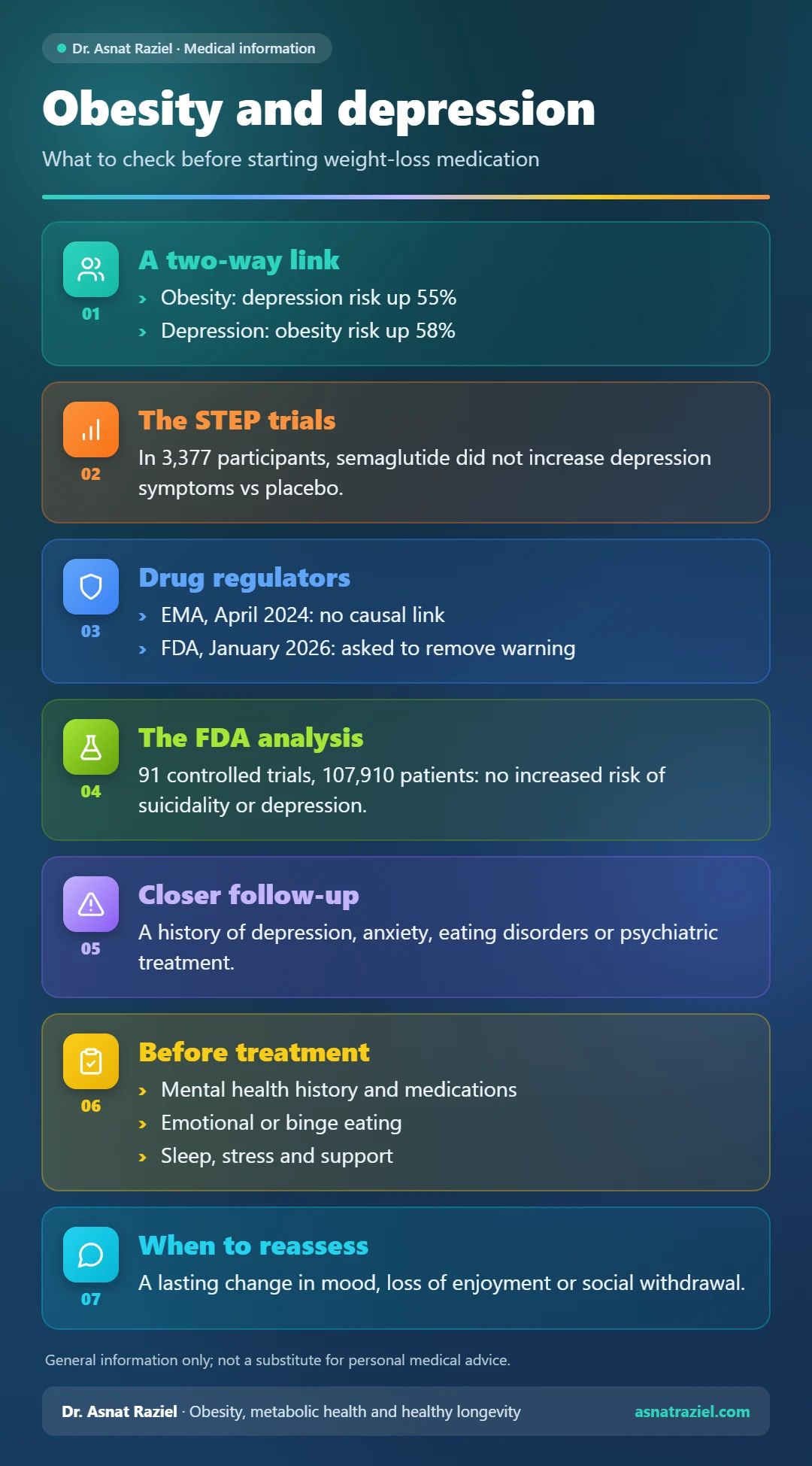
A meta-analysis of 15 long-term studies with 58,745 participants looked at both directions. Obesity at the start of follow-up raised the risk of developing depression by 55%. Likewise, depression raised the risk of developing obesity by 58%. In other words, this is a self-reinforcing cycle.
There are many reasons for this. Obesity often comes with social stigma, poor body image, pain and fatigue. Depression, in turn, drains energy and motivation and disrupts eating regulation. In addition, there is biological overlap: chronic inflammation, changes in stress hormones, insulin resistance and poor sleep are shared by both conditions.
Treating depression also has an effect. Some psychiatric medications cause weight gain. I wrote about this in detail in my article on psychiatric medications and weight.
In a Camoni column on switching psychiatric medications because of weight gain (in Hebrew), I stress that any change should be made gradually and together with the treating psychiatrist.
Emotional eating and the brain
For some patients, food is a way to regulate emotions. Foods high in sugar and fat activate the brain’s reward system. As a result, they bring momentary relief from stress or sadness. However, the relief is temporary, and the cycle returns, sometimes with great intensity. In this situation, treatment that focuses only on calories or weight misses the real problem. You will find practical tools in my practical guide to overcoming emotional eating.
What we know today about weight-loss drugs and mood
Most patients who receive effective obesity treatment actually report better mood, self-confidence and quality of life. Weight loss, better medical markers, better sleep and improved functioning all contribute to mental health.
The research data support this. In a pooled analysis of the STEP trials with 3,377 participants, semaglutide, the active ingredient in Wegovy, did not increase symptoms of depression compared with placebo. On the contrary, patients on the drug were less likely to move into a more severe category of depression. Suicidal thoughts or behavior were reported in 1% of participants or fewer, with no difference between the groups. That said, it is important to be precise: the trials did not include people with a known serious mental illness.
In addition, a study of 240,618 patients from medical records examined the question in the real world. Compared with other weight-loss medications, semaglutide was linked to a much lower risk of suicidal thoughts, both first-time and recurrent.
What drug regulators have decided
In April 2024, the European Medicines Agency’s safety committee concluded that the evidence does not support a causal link between GLP-1 drugs and suicidal thoughts. On January 13, 2026, the US Food and Drug Administration (FDA) went a step further. It asked to remove the warning about suicidal thoughts from the labels of Wegovy, Saxenda and Zepbound.
The decision was based on an analysis of 91 controlled trials with 107,910 patients. The analysis found no increased risk of suicidality, depression, anxiety or psychosis. Even so, the FDA still advises patients to tell their doctor about new or worsening depression. In other words, vigilance remains. For a broader look at this topic, see my article on what a Swedish study found about GLP-1 drugs and depression.
Who needs closer follow-up?
Patients with a history of depression, anxiety, eating disorders or psychiatric treatment need an early assessment and close follow-up. This is not a reason to avoid obesity treatment. Rather, it calls for a personalized approach, open conversation and cooperation between the care providers. For example, Mysimba (naltrexone/bupropion) contains the antidepressant bupropion, so it requires special attention to mood.
Obesity and depression: what I check before starting treatment
A short conversation before treatment prevents many difficulties later. In my clinic, I ask about several topics:
- Past and current mental health diagnoses, including hospitalizations.
- Psychiatric medications the patient takes, and weight changes since starting them.
- Patterns of emotional eating or binge eating.
- Sleep quality and the level of stress in daily life.
- Who in the family or close circle can offer support during treatment.
The answers do not rule out treatment. Instead, they help choose the right medication, set how often to follow up and bring in mental health support early. In cases of binge eating disorder, for example, treatment also includes dedicated psychological work.
Obesity and depression: how the answers shape your treatment plan
Each answer in that first conversation has a practical purpose. First, a history of depression or psychiatric treatment means closer follow-up from the start, not a refusal to treat. Second, knowing which psychiatric medications you take helps explain past weight gain and guides the choice of drug. For instance, Mysimba contains bupropion, so mood needs extra attention. Third, emotional eating or binge eating signals that psychological support should start alongside the medication. Finally, poor sleep, high stress and a lack of support at home are reasons to plan more frequent check-ins. In short, the assessment turns a general treatment into a personal one.
Multidisciplinary care for obesity and depression
The right approach is not to choose between physical and mental care, but to combine them. Emotional, psychological or behavioral support is not a sign of failure. It is an essential part of successful treatment. When patients gain tools to cope with emotions, stress and eating patterns, drug treatment also works much better. That is why, in treating obesity and depression, a psychologist, a dietitian and a physician work as one team.
When should you stop and reassess?
A lasting change in mood needs attention. So does a sharp loss of enjoyment, unusually negative thoughts or social withdrawal. In these situations, we need to pause, reassess the treatment and add the right intervention. In most cases, good management allows treatment to continue safely. Anyone having suicidal thoughts should seek help immediately, from a doctor or a mental health helpline.
The bottom line on obesity and depression
Obesity is not only a disease of the body. It affects the whole person. Successful treatment sees this complexity, respects it and acts with care. The link between obesity and depression is not a reason to fear drug treatment, but a reason for precision. Ultimately, with the right assessment, multidisciplinary support and open conversation, we can treat obesity and improve mental health too.
The information in this article is general and does not replace personal medical advice.
References
Overweight, obesity, and depression: a systematic review and meta-analysis of longitudinal studies
Association of semaglutide with risk of suicidal ideation in a real-world cohort
Meeting highlights from the Pharmacovigilance Risk Assessment Committee (PRAC) 8-11 April 2024
The pooled analysis of the STEP trials was funded by Novo Nordisk, the manufacturer of semaglutide.