By Dr. Asnat Raziel, bariatric surgeon specializing in obesity treatment, metabolic health and healthy longevity; Director of the Multidisciplinary Center for Obesity Treatment, Assia Medical, Assuta Ramat HaChayal, Tel Aviv
Lewy body dementia made headlines in Israel when the family of Mickey Berkowitz, one of the country’s greatest athletes, spoke about his illness. This article focuses on that specific disease: what it is, how its first signs differ from Alzheimer’s, and what can still be done. For the broader question of how to lower your overall risk, see my guide on everyday steps that reduce dementia risk.
Lewy body dementia: when even a star athlete is affected
For decades, Berkowitz has stood for fitness, discipline and a healthy lifestyle. That is exactly why his story raises a troubling question. If an athlete who never smoked and took care of himself developed severe dementia, can anyone really protect the brain?
The answer is complex, but it is certainly not “there’s nothing to be done.” We can’t prevent every case, and a healthy lifestyle does not guarantee immunity. However, research in recent years has changed the way we look at brain aging. Much of the risk comes from factors we can influence. In addition, even once cognitive decline has started, an accurate diagnosis and the right care greatly improve quality of life.
What do we know about Mickey Berkowitz’s condition?
In the documentary “The Secret of Mickey Berkowitz,” broadcast on Keshet 12 in August 2026, his family said that he is living with dementia. According to his wife, the first signs appeared during the COVID period. He noticed flickering in his vision while reading and watching TV, and he drifted out of his lane while driving. Later came confusion and advanced cognitive decline. Some reports said the diagnosis is dementia with Lewy bodies, or DLB for short.
An important caveat: this information comes from the family and the media. We have no medical file or neurological assessment, so we should not draw conclusions beyond what the family shared. Still, the reported diagnosis is a chance to learn about a disease that many people have barely heard of.
What is Lewy body dementia?
Dementia is not a single disease. It is an umbrella term for conditions that damage thinking to the point of affecting daily function. Alzheimer’s disease is the most common cause. There is also vascular dementia, frontotemporal dementia and dementia with Lewy bodies. In this disease, deposits of a protein called alpha-synuclein build up inside nerve cells. As a result, the disease harms the networks for thinking, attention, perception, movement and sleep.
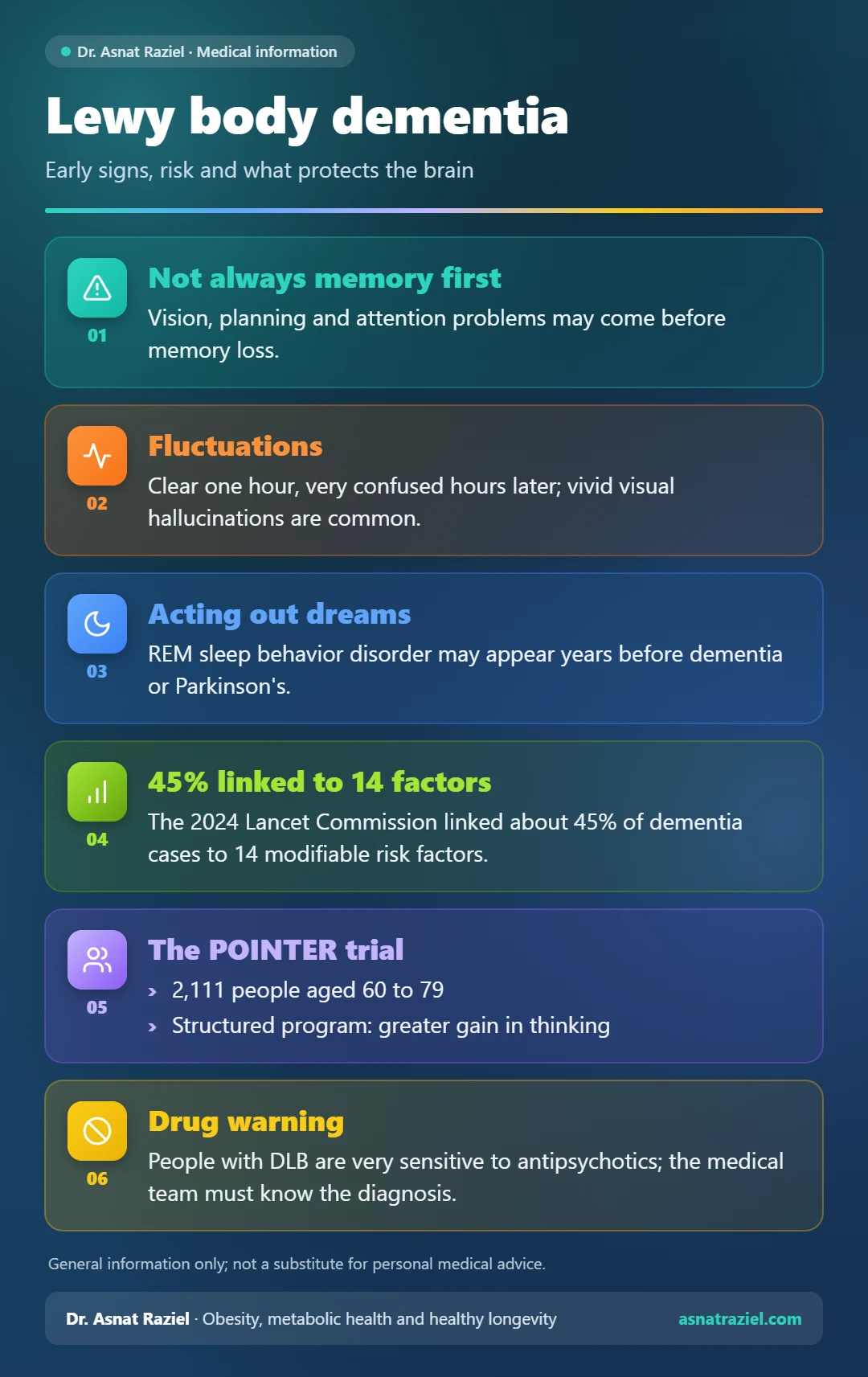
According to the international diagnostic criteria for DLB, memory problems are not necessarily the first sign. Sometimes difficulties with spatial vision, planning and attention come first. A striking feature is fluctuation: a person is clear-headed one hour and very confused a few hours later. Detailed visual hallucinations are also common, along with Parkinson-like stiffness or slowness, and falls.
Another interesting feature is REM sleep behavior disorder. During REM, the dreaming stage of sleep, our muscles should go almost completely limp. In some people, this mechanism breaks down, so they “act out” their dreams: they talk, shout or kick. This disorder may come many years before dementia or Parkinson’s disease.
How is it related to Parkinson’s disease?
Both diseases belong to the same biological family of alpha-synuclein buildup. If dementia appears before Parkinson’s symptoms, or around the same time, the diagnosis is usually DLB. On the other hand, if a person has lived with Parkinson’s for more than a year and only then develops dementia, doctors use the term Parkinson’s disease dementia.
How can a fit, healthy person develop Lewy body dementia?
A healthy lifestyle is not a vaccine. Dementia risk comes from a mix of age, genetics, brain biology, blood vessel disease and environment. In Lewy body dementia, much of the disease is still unexplained. So a person can “do everything right” and still get sick. That does not mean lifestyle doesn’t matter, though. In medicine, we talk about reducing risk, not eliminating it.
Lewy body dementia warning signs at a glance
Because this disease does not always start with forgetfulness, families often miss its early signs. Here are the features described above, in one place:
- Fluctuating alertness: clear one hour, very confused a few hours later.
- Visual hallucinations: often detailed and vivid.
- Movement changes: Parkinson-like stiffness or slowness, and falls.
- Acting out dreams: talking, shouting or kicking during sleep, sometimes years earlier.
- Vision, planning and attention problems: these may come before memory loss.
Finally, people with DLB are very sensitive to antipsychotic drugs. For this reason, the medical team should always know the diagnosis.
Dementia prevention starts with risk factors you can change
In 2024, the Lancet Commission on dementia estimated that 14 modifiable risk factors account for about 45% of dementia cases in the population. These include less education early in life, hearing loss, high LDL cholesterol, high blood pressure, obesity, diabetes, smoking, physical inactivity, depression, head injury, heavy drinking, social isolation, air pollution and untreated vision loss.
It is important to read this number correctly. It does not mean that every person can cut their own risk by 45%, and it does not apply specifically to DLB. From a public health point of view, however, the message is dramatic: we build brain health over decades, not just at age 80. The link between obesity and the brain is also part of this picture.
What did the POINTER trial show?
In the past, most of our knowledge came from observational studies. Then came the U.S. POINTER trial, which included 2,111 people aged 60 to 79 at risk of cognitive decline. All of them received advice on exercise, nutrition, mental and social activity, and monitoring of blood pressure and blood sugar. After two years, thinking skills improved in both groups. However, the group that received a structured, intensive program improved more, and the difference was statistically significant.
The trial was too short to prove that it prevents dementia itself. In addition, a 2026 imaging sub-study found no difference in brain markers between the groups. Even so, the results support the idea that a combined, multi-area approach improves thinking in older age.
What can you do today to protect your brain?
The modern approach to longevity doesn’t only ask how many years we will live. The more important question is how many of those years we will spend with a body and brain that work well. That is why protecting the brain starts long before the first signs:
- Do aerobic and strength training: brisk walking, swimming or cycling, plus strength training two to three times a week. Exercise improves blood flow to the brain, insulin sensitivity, sleep and mood.
- Take care of your blood vessels: the same factors that harm the heart’s arteries also harm the brain’s blood vessels. Therefore, controlling blood pressure, blood sugar and cholesterol is part of prevention.
- Don’t smoke: even quitting at an older age helps.
- Check your hearing and vision: people who don’t hear well take part in fewer conversations and pull back from social life. Cataract treatment and vision correction matter too.
- Eat a Mediterranean-style diet: vegetables, legumes, nuts, whole grains, olive oil and fish. No single food prevents dementia.
- Keep learning: a language, a musical instrument or a new skill builds cognitive reserve, the brain’s ability to cope with damage. Curiosity also contributes.
- Don’t stay alone: meeting people, volunteering and working with others engage memory, language and emotion.
- Sleep well: heavy snoring, pauses in breathing or unusual daytime fatigue are worth checking. I wrote about this in my article on sleep and brain health.
- Protect your head: wear a helmet when cycling, prevent falls and strengthen your muscles.
What about supplements? Today, no study has shown that any vitamin, peptide or supplement reliably prevents dementia in a healthy person. Of course, if you are low in B12, folic acid or vitamin D, your doctor should treat it. Genetic tests are not fortune-telling either: they change risk, but they don’t decide who will get sick.
Lewy body dementia: when to get checked
Not every lapse of memory is dementia. Forgetting a name or where you left your phone is very common. On the other hand, getting lost in a familiar place, mistakes while driving, new trouble managing money, personality changes, hallucinations or repeated falls all deserve a medical evaluation. With Lewy body dementia, it is especially important to report changes in alertness and unusual behavior during sleep. Today there are also blood tests that help with diagnosis.
Treating Lewy body dementia
There is still no drug that cures DLB. But the phrase “there’s nothing to be done” belongs to another era. In some patients, medication improves thinking and reduces hallucinations. When there are Parkinson’s symptoms, doctors can also treat movement, with care. In addition, doctors treat depression, sleep problems, constipation, drops in blood pressure and swallowing difficulties. Physical therapy, occupational therapy and adapting the home are just as important as medication.
An important warning: people with DLB are very sensitive to antipsychotic drugs. Some of these drugs can severely worsen stiffness, alertness and overall condition. So when such a person arrives at the emergency room or enters the hospital, the staff must know about the diagnosis.
And what about the new Alzheimer’s drugs? Lecanemab and donanemab target the amyloid protein. The FDA approved donanemab (Kisunla) in July 2024 for early-stage Alzheimer’s disease. These drugs don’t cure the disease, but in trials they slowed decline. They also require monitoring, because they can cause brain swelling or tiny bleeds. Importantly, they are not an accepted treatment for DLB. I covered them in more detail in my article on Kisunla and the Alzheimer’s blood test.
Care is also for the family
Dementia changes the life of an entire family. Sometimes the person needs supervision, a day center, a home caregiver or a nursing facility. Family members also need guidance and support, so they can learn how to communicate and avoid burnout. At an advanced stage, the goal is to prevent falls, pain and infections, to preserve mobility, and to allow dignity, safety and moments of connection.
The bottom line: protecting the brain is a long-term investment
Mickey Berkowitz’s story is painful because it reminds us that there is no formula for immunity. You can be an athlete, never smoke, train for decades and still get sick. But that is no reason to give up on dementia prevention. Longevity medicine tries to delay disease and to extend the years in which body and brain work well. When we control blood pressure, exercise, keep our muscles, treat hearing loss, sleep well and stay connected to people, we invest in the brain we will live with twenty or thirty years from now. Just as important, the first signs of cognitive decline are not “just part of getting older.” They deserve an evaluation, there is treatment, and there is a lot to do even after the disease has begun.
This article is general information and does not replace personal medical advice.
References
Dementia prevention, intervention, and care: 2024 report of the Lancet standing Commission
Diagnosis and management of dementia with Lewy bodies: Fourth consensus report of the DLB Consortium
FDA approves treatment for adults with Alzheimer’s disease
Maariv: Mickey Berkowitz’s medical condition revealed for the first time (in Hebrew)
ice: Mickey Berkowitz’s disclosure reminds us it is time to talk about dementia (in Hebrew)