By Dr. Asnat Raziel, bariatric surgeon specializing in obesity treatment, metabolic health and healthy longevity; Director of the Multidisciplinary Center for Obesity Treatment, Assia Medical, Assuta Ramat HaChayal, Tel Aviv
Obesity and brain health: a link that starts early
Obesity and brain health are closely connected. The link starts at a young age and deepens over the years. Over the past decade, a troubling but important understanding has emerged: obesity affects not only the heart, blood sugar or joints, but also the brain. The metabolic and inflammatory processes that accompany obesity harm the structure and function of the brain. They affect memory and concentration, as well as the risk of dementia later in life. The good news is that timely treatment may change this course.
The brain is a metabolic organ
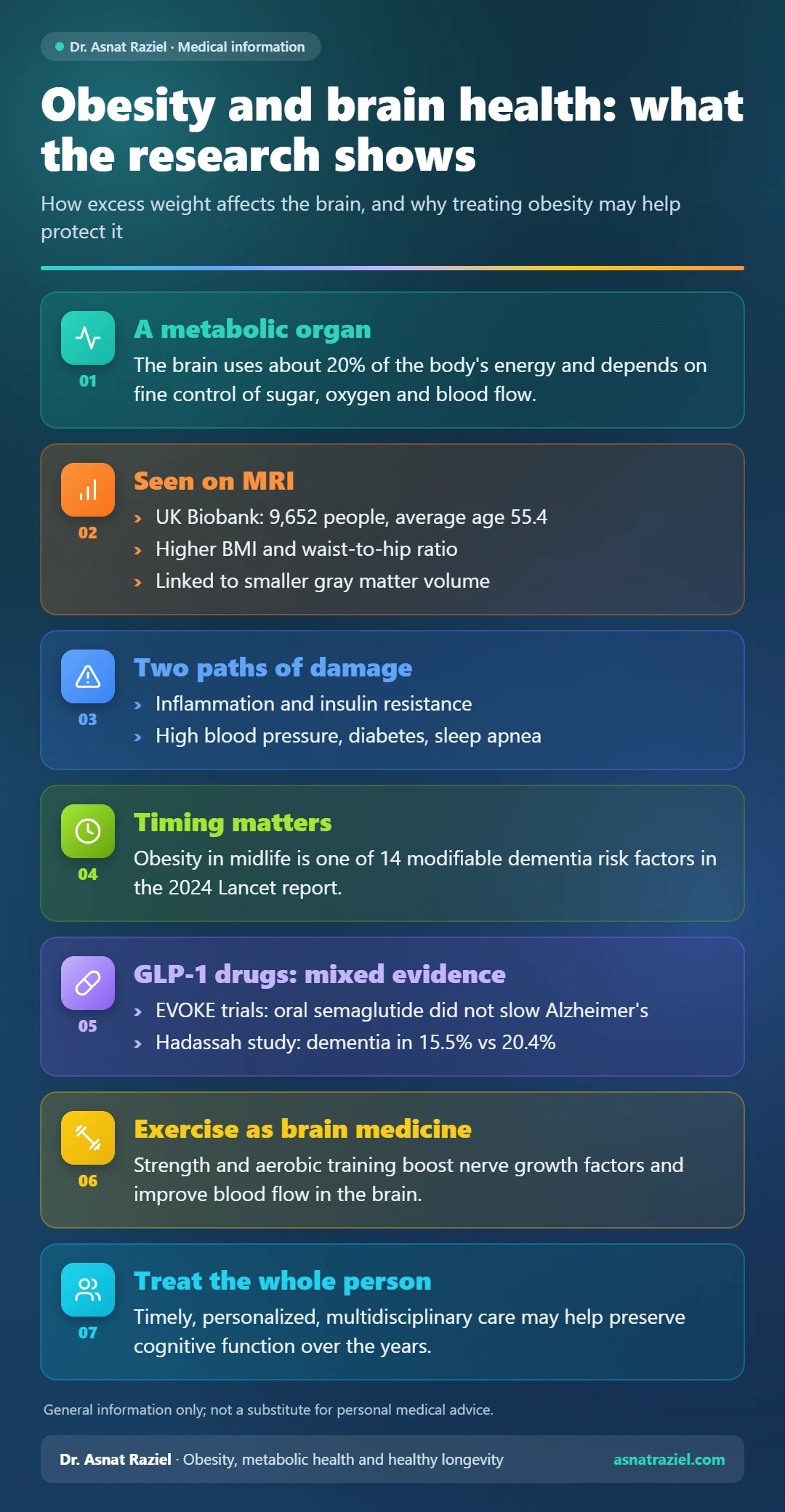
The brain uses about 20% of the body’s energy. It depends on fine regulation of sugar, oxygen and blood flow. Obesity creates conditions that upset this balance: insulin resistance, chronic inflammation and impaired function of the small blood vessels. Together, these factors disrupt the brain’s energy supply and its ability to process information.
What brain imaging shows
In a UK Biobank study, 9,652 people underwent brain MRI. Their average age was 55.4. The researchers found that the higher the BMI and the waist-to-hip ratio, the smaller the volume of gray matter. Gray matter is the part of the brain that contains the cell bodies of nerve cells. The combination of general obesity and belly fat went hand in hand with the lowest volume. However, this was a cross-sectional study, so it shows an association rather than cause and effect. Other studies have found a similar link already at a young age, in areas responsible for memory, attention and self-control.
Inflammation, insulin and everything in between
Chronic low-grade inflammation is typical of obesity. Inflammatory signals also reach the brain and affect nerve cells. At the same time, insulin resistance in the brain disrupts nerve signals that are essential for learning and memory. For this reason, some researchers call Alzheimer’s disease “type 3 diabetes”. This nickname is not an official diagnosis. Rather, it reflects a hypothesis about a metabolic disorder in the brain.
In addition, obesity raises the risk of high blood pressure, diabetes and sleep apnea. Each of these conditions damages the small blood vessels in the brain. As a result, the damage builds up from two directions: through metabolism and through the blood vessels. That is also why treating these risk factors matters just as much as the number on the scale.
Obesity and brain health across the lifespan
The link between obesity and dementia also depends on timing. In its 2024 report, the Lancet Commission on dementia listed fourteen modifiable risk factors. Obesity in midlife is one of them. According to the commission, addressing all of these factors together could prevent or delay nearly half of dementia cases.
On the other hand, unintentional weight loss in older age may be an early sign of a developing disease. This fact highlights the need for precise clinical context. In other words, the same number on the scale means different things at age 50 and at age 80.
Mood, appetite and cognition
Obesity is also linked to mood changes, anxiety and depression. These conditions themselves impair concentration and memory. Moreover, the brain circuits that regulate appetite, reward and self-control change with obesity. That makes it much harder to make food choices and to stick with treatment. I explain how the brain controls hunger and fullness in my article on the brain, hunger and satiety. Poor sleep also makes the cycle worse, as I describe in my article on obesity and sleep.
Does treating obesity improve brain function?
The growing body of data is encouraging. Weight loss and metabolic improvement are tied to better blood flow to the brain, less inflammation and better scores on memory and attention. Some studies of drug treatment and bariatric surgery have shown improvement in cognitive measures, sometimes within months of starting treatment. Still, the effect is not “magic”. It depends on preserving muscle, physical activity, good sleep and blood sugar control.
GLP-1 drugs and the brain: what we know today
Drugs in the GLP-1 family raised great hope in this field. However, in November 2025, the results of the EVOKE and EVOKE+ trials came out. These trials tested oral semaglutide against placebo in people aged 55 to 85 with early-stage Alzheimer’s disease. According to Alzheimer Europe, the drug did not slow disease progression in either trial. Participants received doses of up to 14 mg, and the main phase of the trials lasted two years.
By contrast, a 2026 Israeli study from Hadassah examined real-world data on 1,320 people with type 2 diabetes and mild cognitive impairment. During an average follow-up of 3.9 years, dementia developed in 15.5% of those who started a GLP-1 drug, compared with 20.4% of those who started a different diabetes drug from the DPP-4 family. The researchers stress that this study generates a hypothesis, not proof.
The bottom line: obesity drugs are not a treatment for Alzheimer’s disease. Perhaps they protect the brain indirectly, by improving blood sugar, heart health and blood vessels. You can read about the effects of these drugs on mental health in my article on GLP-1 drugs and mental health.
Exercise: medicine for the brain
Strength training and aerobic activity are not just tools for weight loss. They boost the production of nerve growth factors, improve blood flow in the brain and support the flexibility of neural networks. In this sense, obesity treatment that includes movement is brain treatment in every sense of the word. I explain how to choose the right type of workout in my article on aerobic versus strength training.
A neurometabolic view of obesity and brain health
Understanding that obesity is also a disease of the brain changes the approach to treatment. This is not just a matter of eating or willpower. Instead, it is a combination of biology, behavior and environment. Therefore, timely, personalized and multidisciplinary treatment may improve physical measures and also help preserve cognitive function over the years.
A final thought on obesity and brain health
Brain health goes hand in hand with physical health. Obesity creates a metabolic and inflammatory burden that also reaches the brain. Likewise, proper obesity treatment may help protect it. When the goals are function, mental clarity and long-term quality of life, the link between obesity and brain health must be at the center of treatment decisions.
The information in this article is general and does not replace personal medical advice.
References
Association of body mass index and waist-to-hip ratio with brain structure: UK Biobank study
Dementia prevention, intervention, and care: 2024 report of the Lancet standing Commission
Results of EVOKE and EVOKE+ trials show no effect of oral semaglutide on AD progression




