By Dr. Asnat Raziel, bariatric surgeon specializing in obesity treatment, metabolic health and healthy longevity; Director of the Multidisciplinary Center for Obesity Treatment, Assia Medical, Assuta Ramat HaChayal, Tel Aviv
Ketamine-assisted psychotherapy: a smile that appeared after three minutes
Ketamine-assisted psychotherapy sparks a great deal of curiosity today, and quite a few worries as well. Dr. Gita Vaid, a psychiatrist and psychoanalyst from New York, opened her talk at the Nervous System Reboot summit with a story about a new patient. The woman arrived in very bad shape. She was depressed, anxious, stuck in a difficult marriage and could not see a way to go on.
In addition, she was afraid of ketamine, because she had heard it was addictive. After a long conversation, Dr. Vaid gave her a low test dose. Within about three minutes, a broad smile spread across her face. She touched her cheek again and again, as if checking that the smile was real. Afterward, she said that during her inner journey she had scolded herself for thinking about giving up on life.
What is ketamine-assisted psychotherapy?
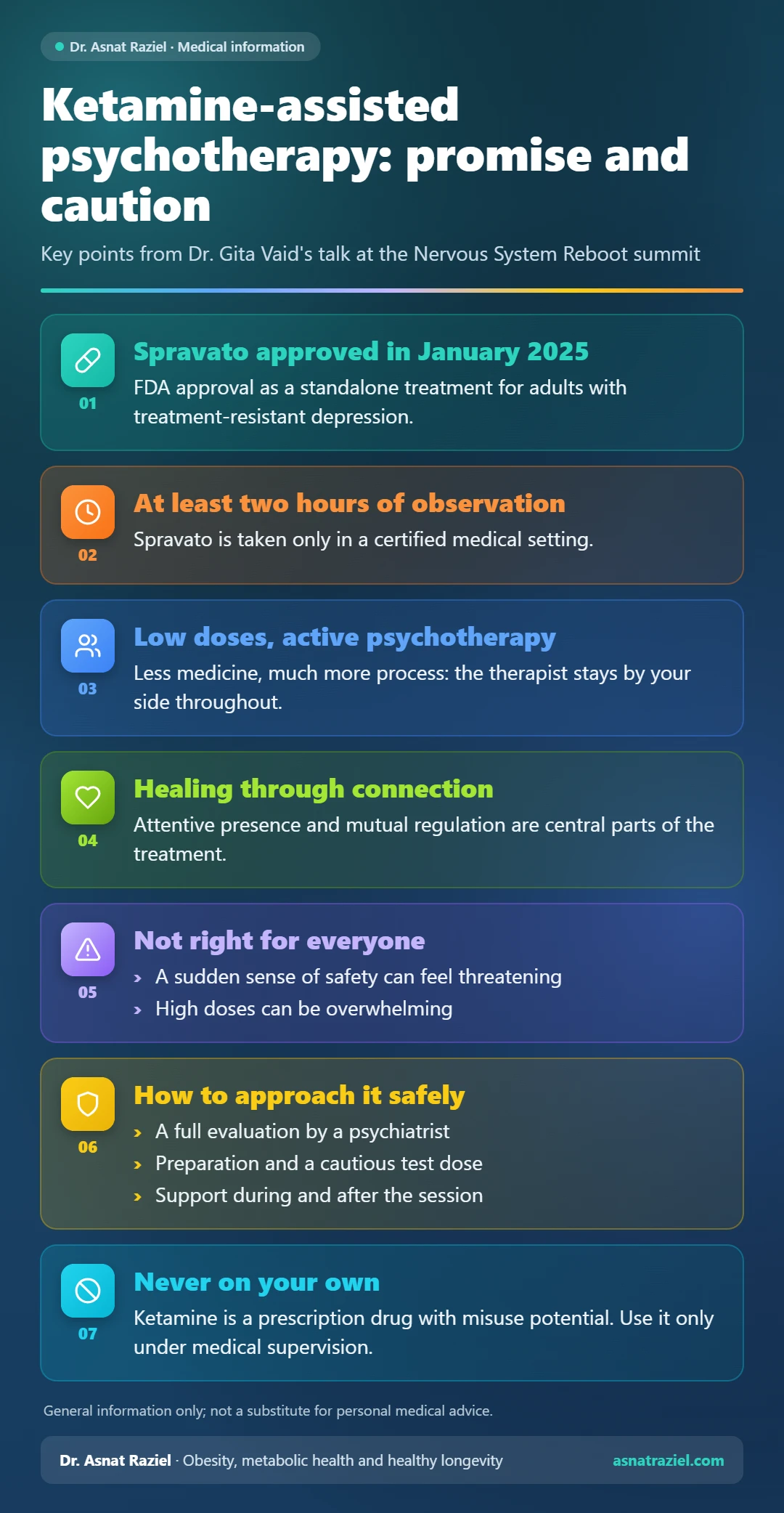
Ketamine is a long-established anesthetic that has been in medical use for decades. In recent years, doctors have also been using it to treat depression. For example, in January 2025 the FDA approved Spravato, an esketamine nasal spray, as a standalone treatment for adults with treatment-resistant depression. The approval covers patients who have not responded well enough to at least two antidepressants. Patients take the spray only in a certified medical setting, under observation for at least two hours.
Interest is growing in Israel as well. Ynetnews reported on a planned MDMA group-therapy trial for PTSD with Sheba Medical Center. In that report, a psychiatrist noted that ketamine also shows promise for trauma-related conditions.
Dr. Vaid works with a somewhat different approach. She combines low, individually tailored doses with active psychotherapy throughout the session. In her words, less medicine and much more process. The patient lies on a couch with an eye mask and a blanket, and she stays by their side the entire time.
An expert meditator within minutes
According to Dr. Vaid, a low dose of ketamine turns even a person with a very busy mind into an expert meditator. Within minutes, the muscles relax, the mental chatter quiets down, and the person observes themselves from the outside. Defenses come down, both the patient’s and the therapist’s. This opens up space for deep emotional work that usually takes months.
Ketamine-assisted psychotherapy and the nervous system: feeling safe for the first time
The whole summit focused on rebooting the nervous system. Dr. Vaid describes ketamine as a substance that leads to a feeling of safety and release. However, she stresses that the healing does not come from the drug alone. In her view, we heal each other. The therapist’s attentive presence, mutual regulation and the sense that someone feels you are central parts of the treatment.
For example, one patient told her he felt guilty for being silent for so long. Later, he realized that the pleasant tingling and the sense of safety in his body came precisely from feeling her listening. Another patient, a man who had lived his whole life in his head, discovered warm, tender body sensations toward his wife during a session. To her, it was a moment of returning to the body.
Dr. Vaid also compares the inner journey to a dream. As in a dream, there is a wise and creative scriptwriter inside us. That is why the same dose, in the same person, can lead to a meditative experience one time and a physical or visual experience the next.
Watch the full talk: Dr. Gita Vaid on ketamine-assisted psychotherapy
The interview is in English, from the Heart Mind Institute’s Nervous System Reboot 2026 summit. The conversation is hosted by Harvard psychologist Dr. Ronald Siegel.
The other side: why safety can actually feel frightening
In my opinion, the most important part of the talk deals with the risks. Dr. Vaid warns that this treatment is not right for everyone. Sometimes a sudden feeling of safety threatens a part of the psyche whose job is to protect. For some people, constant vigilance is the way they feel safe.
For instance, one patient with severe PTSD had very pleasant sessions. Yet at the end of each session she was filled with anger, and she found something the therapist had done wrong. According to Dr. Vaid, the protective part of her psyche felt violated. In another case, an older man went through an unsupervised session with a different psychedelic substance. He talked for six hours straight, and in the end he felt that his boundaries had been violated, because he had no control over it.
Moreover, she says that high doses can be overwhelming. She has seen people run into old trauma all at once, without the capacity to contain it. Afterward, they suffered panic attacks, and it took a long time to stabilize them. By contrast, processing in small doses makes it possible to digest the experience and gradually expand the capacity to contain it.
How to approach ketamine-assisted psychotherapy safely
Ketamine is a prescription drug with a potential for misuse. Do not use it on your own or in unsupervised settings. Based on the talk and on medical knowledge, these are the points to keep in mind:
First, a full medical evaluation. A psychiatrist should assess whether the treatment is right for you at all, and in what setting.
Second, preparation and an initial conversation. Dr. Vaid spends a lot of time explaining, and she starts with a cautious test dose.
Third, support throughout the session. The presence of a skilled therapist is part of the treatment itself, not just a safety measure.
Finally, processing after the session. The insights require ongoing work, and the good feeling usually lasts only hours to days.
The link to physical health
Depression, anxiety and chronic stress also affect weight, sleep and metabolic health. In addition, some psychiatric medications themselves cause weight gain. I wrote about this in my article on psychiatric medications and weight gain. If you are looking for drug-free approaches, you will find tools in my guide to meditation and stress relief. I also describe a creative option in my article on art therapy. The talk also reminds us how much human connection matters, a topic I covered in my article on social connections and longevity.
The bottom line
Ketamine-assisted psychotherapy is a new and interesting tool, and in the right cases it may open the door to deep emotional healing. However, it is not a magic solution, and it is not right for everyone. Dr. Vaid emphasizes that its power calls for caution, a tailored dose and an experienced therapist at your side.
The information in this article is general only and does not replace personal medical advice. Do not use ketamine without a prescription and medical supervision.