By Dr. Asnat Raziel, bariatric surgeon specializing in obesity treatment, metabolic health and healthy longevity; Director of the Multidisciplinary Center for Obesity Treatment, Assia Medical, Assuta Ramat HaChayal, Tel Aviv
Israel’s wartime health system: a snapshot from March 2026
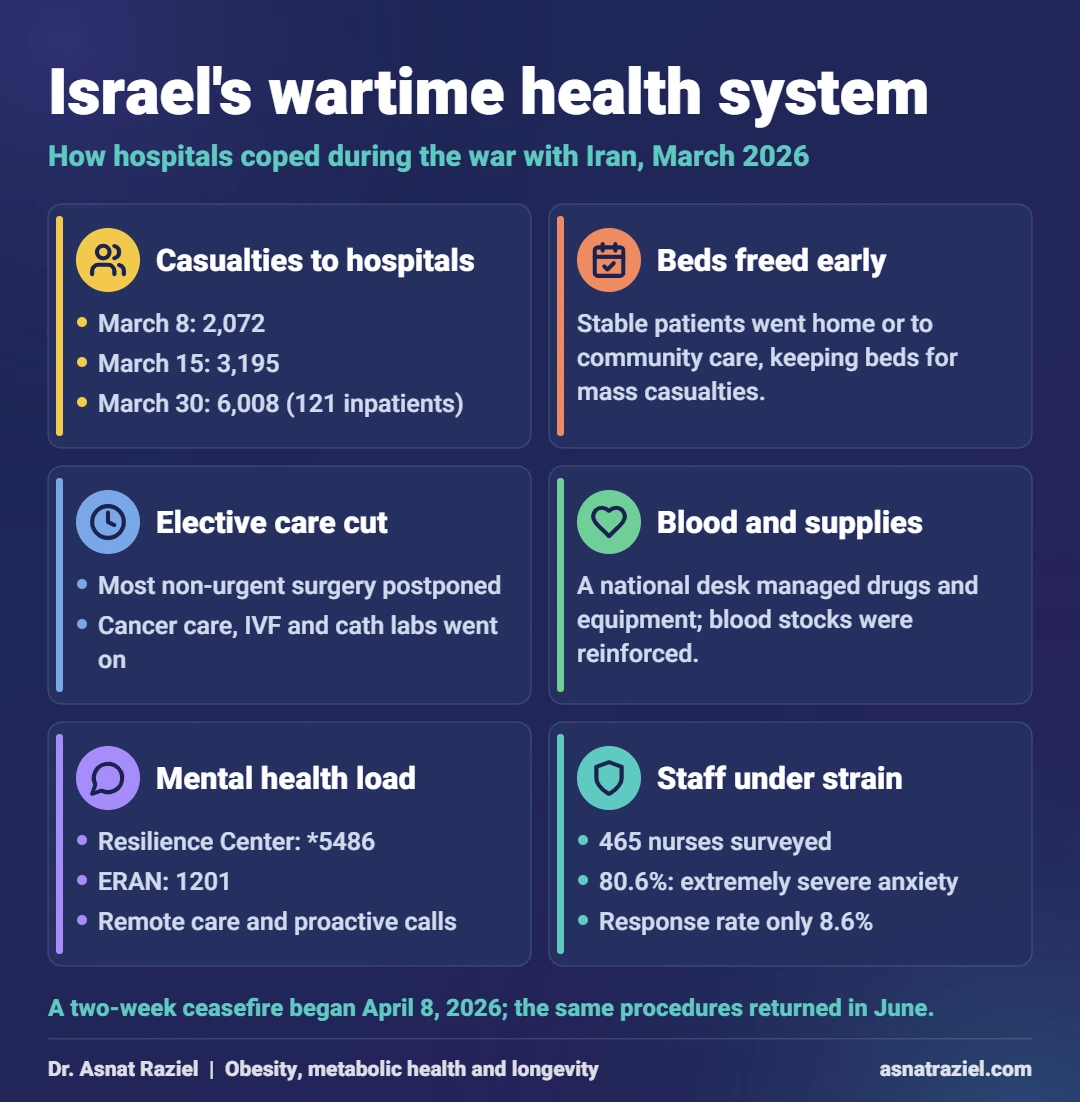
During the war with Iran, Israel’s wartime health system ran in full emergency mode for weeks. Operation “Roaring Lion” began on February 28, 2026. By March 8, the Ministry of Health had already reported 2,072 injured people brought to hospitals. By March 15, the number had climbed to 3,195 people. I wrote this article during those days and have now updated it in hindsight.
At the time, hospitals were on the highest level of alert. They thinned out admissions and redirected resources to receive new casualties. In other words, the system did not freeze. Instead, it reorganized itself every single day.
Proactive discharge: how the wartime health system freed up beds
General hospitals kept up a policy of proactive, rapid discharge. Stable patients moved to home care or to follow-up in the community. The goal was clear: to keep beds free for mass-casualty events.
These discharges were based on careful medical criteria. This was not an administrative decision but a full clinical assessment. In addition, for vulnerable groups, such as geriatric and psychiatric patients, the teams also looked at conditions at home and at continuity of medications.
At the same time, Israel’s health funds (HMOs) expanded their phone hotlines and telemedicine services. Hospital-at-home services were also reinforced. As a result, many patients kept receiving care without coming to the hospital.
Scaled-back elective care and priority for lifesaving treatment
Elective activity, meaning planned surgeries and treatments that are not urgent, dropped significantly. Most non-urgent operations were postponed. However, hospitals kept clear priority for cancer treatment, IVF and semi-urgent cardiac catheterizations. Treatments whose delay could cause irreversible harm also continued as usual.
Where needed, hospitals moved wards into protected and underground spaces. For example, Ichilov Hospital in Tel Aviv turned an underground parking garage into a working ward. Teams worked long shifts, sometimes for days on end.
Supply chain and blood stocks under national oversight
The Ministry of Health set up a dedicated desk to manage the supply chain for medicines and medical equipment. The focus was on prioritizing critical shipments, removing logistical barriers and maintaining emergency stocks. In addition, the blood supply was significantly reinforced. The system had prepared in advance for a scenario of prolonged fighting.
Mental health: a steady wave of calls for help
Alongside the physical injuries, mental health hotlines reported a steady rise in calls. Resilience centers and support lines worked under heavy load. Anxiety, sleep problems and stress reactions were very common in the general population. Therefore, the Ministry of Health published the active support lines: the National Resilience Center at *5486, the lines of all the health funds, and the ERAN emotional first aid association at 1201.
Mental health services moved to remote care whenever an in-person visit was not necessary. Teams also reached out proactively to chronic patients to prevent their condition from worsening. The professional message was clear: anxiety in an emergency is a normal reaction. Even so, it is important to identify risk situations in time. An Israeli study that followed 1,052 young adults in conflict areas showed this clearly. People who had experienced loss, displacement from their homes or a drop in income suffered from much more severe symptoms of anxiety, depression and post-traumatic stress. You can read about the link between ongoing stress and the body in my article on how stress affects the body and weight.
Dialysis and chronic disease: continuity of care no matter what
Dialysis units kept operating even under sirens and security uncertainty. This is lifesaving treatment that cannot be postponed. Patients with other chronic diseases, such as diabetes and obesity, also continued their drug treatment. Under stress, eating patterns change, so it is also worth reading my article on emotional eating during war.
The resilience of the people inside the wartime health system
Medical and nursing staff worked under a heavy emotional and physical load. First, a survey of 465 nurses from Israeli hospitals looked at the “Swords of Iron” war. Of them, 80.6% reported extremely severe anxiety and 35.4% reported extremely severe stress. Night shifts, working more than 180 hours a month and having a family member in military service all raised distress levels. On the other hand, high personal resilience went hand in hand with low burnout. The researchers noted that the survey’s response rate was low, only 8.6%.
The conclusion is clear: staff resilience cannot be taken for granted. It requires proactive support from the system, rest and attention to sleep. Simple tools can help both staff and the public. For example, you can use practical stress-relief techniques and ways of improving sleep quality.
What chronic patients can do in an emergency
A few simple steps emerge from the experience of those weeks. First, keep at least a two-week supply of your regular medications. Second, do not stop treatment on your own, even when it is hard to get to the clinic. Instead, use telemedicine and your health fund’s phone hotlines.
In addition, try to keep a basic routine of meals, movement and sleep. Even a few minutes of breathing or meditation for stress relief can lighten the load. Finally, if anxiety is affecting your daily functioning, call the support lines. This is not weakness; it is part of treatment.
What happened next: the ceasefire and the June round
The pressure continued after I wrote this article. By March 30, the number of people brought to hospitals had risen to 6,008, of whom 121 were still hospitalized. On April 1, the Ministry of Health reported 6,286 people treated and 100 still hospitalized. Finally, on April 8, 2026, a two-week ceasefire was announced.
However, the calm did not hold. In June 2026, missile fire from Iran resumed, and hospitals moved their operations back underground. Once again, they discharged patients who could go home and canceled elective surgeries. In other words, the procedures from March had proven themselves, and the system put them into action quickly.
Lessons from Israel’s wartime health system
In those days, Israel’s health system acted as a civilian arm of national security. It discharged in order to admit. It scaled back in order to preserve, and it reinforced in order to prevent collapse. This was a combination of advance planning, operational flexibility and day-to-day management under uncertainty.
Ultimately, in an emergency the system does more than treat the wounded. It holds up the home front. This wartime health system showed that advance preparation saves lives. It also reminded us that caregivers need care, too. For related reading, see my article on the quiet health toll of ongoing threat.
The information in this article is general and does not replace personal medical advice.
References
Over 2,000 taken to hospitals since beginning of Iran war – Health Ministry
3,195 to hospital in Israel since ‘Roaring Lion’ began
Over 6,000 People Injured in Israel From Missile Strikes in March – Health Ministry
Thousands of Israelis taken to hospitals: the Ministry of Health’s guidelines (ice.co.il, in Hebrew)
US, Israel and Iran agree to 2-week ceasefire as Trump pulls back on threats
Hospitals move operations underground as Iran fires missiles at Israel
Burnout, anxiety, and resilience among nurses during wartime: evidence from a cross-sectional study