By Dr. Asnat Raziel, bariatric surgeon specializing in obesity treatment, metabolic health and healthy longevity; Director of the Multidisciplinary Center for Obesity Treatment, Assia Medical, Assuta Ramat HaChayal, Tel Aviv
GLP-1 safety warnings: between headlines and data
GLP-1 safety warnings make the headlines almost every month. But what exactly did the drug regulators decide, and what does it mean for you as a patient? In this article, I focus on the rare side effects and on the decisions of the FDA, the European Medicines Agency and the UK regulator. If you are looking for the broader question of whether these drugs are safe overall, read my article is obesity medication safe?
As with any significant medical treatment, we need to balance benefit against risk. That balance must come from data and clinical context. Fear that comes from headlines or social media, on the other hand, is not a good basis for a decision. Here I review what we know today, in November 2026, and explain how to manage the risks wisely.
The common side effects: expected and mostly temporary
Most side effects of incretin-based drugs involve the digestive system. Incretins are gut hormones such as GLP-1, a satiety hormone the gut releases after a meal. Nausea, early fullness, vomiting, diarrhea and constipation appear mainly at the start of treatment or when the dose goes up.
In most cases these effects are mild to moderate, and the body adapts. A slow dose increase, small meals and mindful eating all reduce their intensity. It also helps to know the numbers. For example, in the SELECT trial, 16.6% of patients on semaglutide stopped treatment because of side effects, compared with 8.2% in the placebo group. That is why close follow-up in the first months makes such a difference. You will find practical tips in my article on GLP-1 side effects.
Pancreatitis and gallstones: the UK warning in context
Alongside the common effects, there are also reports of rare ones. These include pancreatitis, gallbladder problems, mood changes and vision problems. Here it is important to be precise: a single report does not prove cause and effect.
For mental health in particular, new data are reassuring. I review them in my article on GLP-1 and anxiety.
Some of these conditions are common anyway in people with obesity. For example, the risk of pancreatitis rises with gallstones, high blood fats and poorly controlled diabetes. In January 2026, the UK medicines regulator strengthened its warning on this topic. Therefore, severe and persistent abdominal pain calls for immediate medical attention.
Gallstones also appear with any rapid weight loss, whether from a diet, surgery or medication. Still, the weight loss itself is not the only explanation. A meta-analysis of 76 trials found a 37% higher risk of gallbladder and bile duct disease among patients on GLP-1 drugs. In the weight loss trials the risk was double, and it rose with higher doses and longer treatment. I wrote about prevention and early diagnosis in my article on gallstones with Wegovy and Mounjaro.
Vision problems and NAION: what the European agency decided
NAION is a non-inflammatory ischemic injury to the optic nerve. In other words, the nerve is damaged because its blood supply drops. It is a rare condition that appears mainly in people with diabetes, high blood pressure, high blood fats and sleep apnea. Patients treated for obesity and diabetes already have high rates of these risk factors.
In June 2025, the European Medicines Agency published a clear conclusion. According to the review by the European safety committee, NAION is a very rare side effect of semaglutide. It may affect up to 1 in 10,000 patients. Epidemiological studies in type 2 diabetes showed roughly double the risk, meaning one extra case per 10,000 years of treatment.
What does this mean in practice? A sudden drop in vision, or vision that gets worse quickly, needs immediate medical attention. If the diagnosis is confirmed, the European guidance is to stop semaglutide. In contrast, temporary blurred vision at the start of treatment is sometimes caused by rapid improvement in blood sugar. It also needs an eye check, but it is not NAION. For patients with a past episode of NAION, I do an individual risk assessment before any treatment. More on this in my article on NAION and GLP-1 drugs.
A GLP-1 safety warning that was removed: mood
Most patients report a better body image, more self-confidence and a better quality of life. Even so, the question of mental health has come up again and again. In January 2026, the FDA asked to remove the warning about suicidal thoughts and behavior from the labels of Wegovy, Zepbound and Saxenda. The agency analyzed 91 trials with 107,910 participants and found no increase in risk. So a mental health assessment remains part of care, but without needless fear. This is a good reminder that GLP-1 safety warnings can also be removed when the data are reassuring.
Cancer concerns: what the research says
A common concern is cancer risk. To date, clinical trials and large cohort studies have not shown a significant increase in overall cancer risk. The drugs must not be used by people who have, or whose family has, medullary thyroid cancer, because of findings in rodents. That is why I ask about it before every treatment.
Moreover, a cohort study of 1,651,452 patients with diabetes found a lower risk of 10 out of 13 obesity-related cancers. The comparison was with patients on insulin. Among others, the risk fell for colorectal, pancreatic, liver, esophageal, uterine and kidney cancer. However, the researchers found no drop in breast cancer after menopause.
Large studies like these help answer a frequent question. I go through the evidence in my article on GLP-1 drugs and cancer: myths and facts.
Muscle and bone: a risk you can manage
Rapid weight loss may also include a loss of muscle mass. Sometimes it also affects bone density, mainly without enough protein and physical activity. The conclusion is not to avoid treatment, but to manage it well. Strength training, a tailored diet and medical follow-up all reduce the risk.
GLP-1 safety warnings about unapproved products
One risk that gets little attention is non-original drugs. The FDA warns against unapproved GLP-1 products, including counterfeit products and products sold online. With such products, the dose, the purity and the actual ingredients are not guaranteed. So it is best to get your medication only with a prescription and from a licensed pharmacy.
GLP-1 safety warnings at a glance
To sum up, here is what the regulators actually decided, based on the data above:
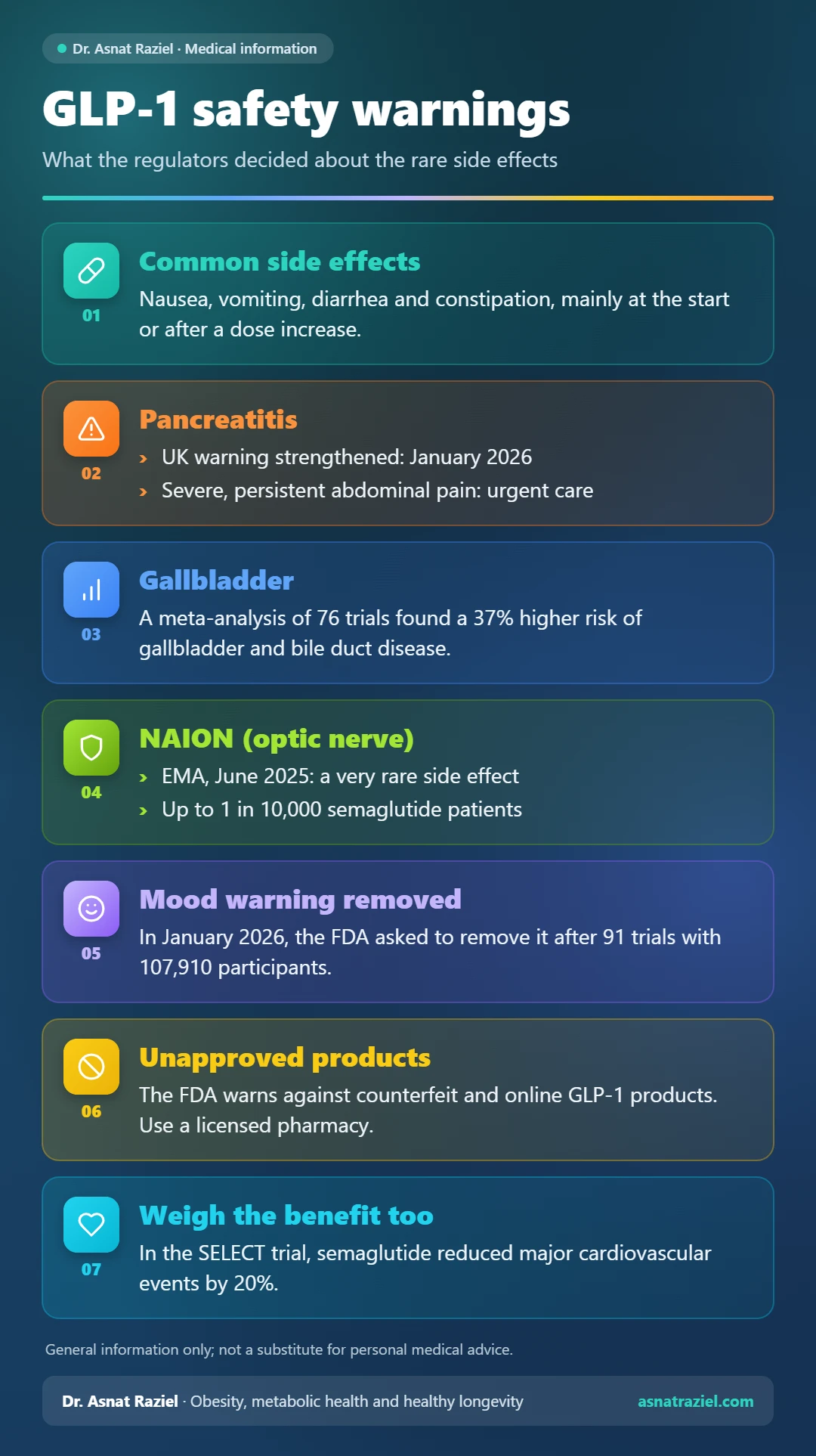
- Pancreatitis: in January 2026, the UK regulator strengthened the warning. Severe, persistent abdominal pain needs urgent care.
- NAION: in June 2025, the European agency classified it as a very rare side effect of semaglutide, in up to 1 in 10,000 patients.
- Mood: in January 2026, the FDA asked to remove the warning about suicidal thoughts, after 91 trials showed no added risk.
- Unapproved products: the FDA warns against counterfeit and online GLP-1 products.
In other words, a warning is a call for alertness, not a reason to stop a treatment that works.
The risk of not being treated
A common mistake is to read GLP-1 safety warnings without comparing them with the risk of no treatment. Untreated obesity raises the risk of diabetes, heart disease, stroke, cancer, sleep apnea and early death. In the SELECT trial, for example, semaglutide reduced major cardiovascular events by 20%. So the clinical question is not “are there side effects?” Rather, the question is what the balance of risk and benefit looks like for the specific patient.
What to know before you start
Drug treatment for obesity is not an off-the-shelf product. It starts with a proper diagnosis, a personal plan and a full explanation. In addition, it requires ongoing follow-up. Side effects are not a failure of treatment, but part of a process that needs professional management. That is also how I discuss GLP-1 safety warnings with my patients. Transparency, open communication and multidisciplinary support are the keys to success. For safety data over the years, see my article on long-term side effects.
The bottom line on GLP-1 safety warnings
The new drugs are not perfect, but they are a powerful medical tool against a serious chronic disease. Any discussion of safety must rest on science, clinical context and professional responsibility. Ultimately, when treatment is managed well, it brings real improvement in health and quality of life.
This article is general information and does not replace personal medical advice.
References
Semaglutide and Cardiovascular Outcomes in Obesity without Diabetes
FDA’s Concerns with Unapproved GLP-1 Drugs Used for Weight Loss
The SELECT trial was funded by Novo Nordisk.