By Dr. Asnat Raziel, bariatric surgeon specializing in obesity treatment, metabolic health and healthy longevity; Director of the Multidisciplinary Center for Obesity Treatment, Assia Medical, Assuta Ramat HaChayal, Tel Aviv
GLP-1 muscle loss: who needs to pay attention
GLP-1 muscle loss is a topic worth understanding from the very start of treatment with weight-loss injections. In this article, I focus on two practical questions: who is at higher risk, and which signs at home call for a talk with your doctor. Weight-loss injections and muscle loss come up in almost every conversation in my clinic. In recent years, GLP-1-based medications have revolutionized obesity treatment. Ozempic, Mounjaro and similar drugs make significant weight loss possible. In addition, they improve metabolic markers and ease related conditions. But as their use grows, one important question comes up: what price might your muscles pay?
How much of the weight you lose is muscle?
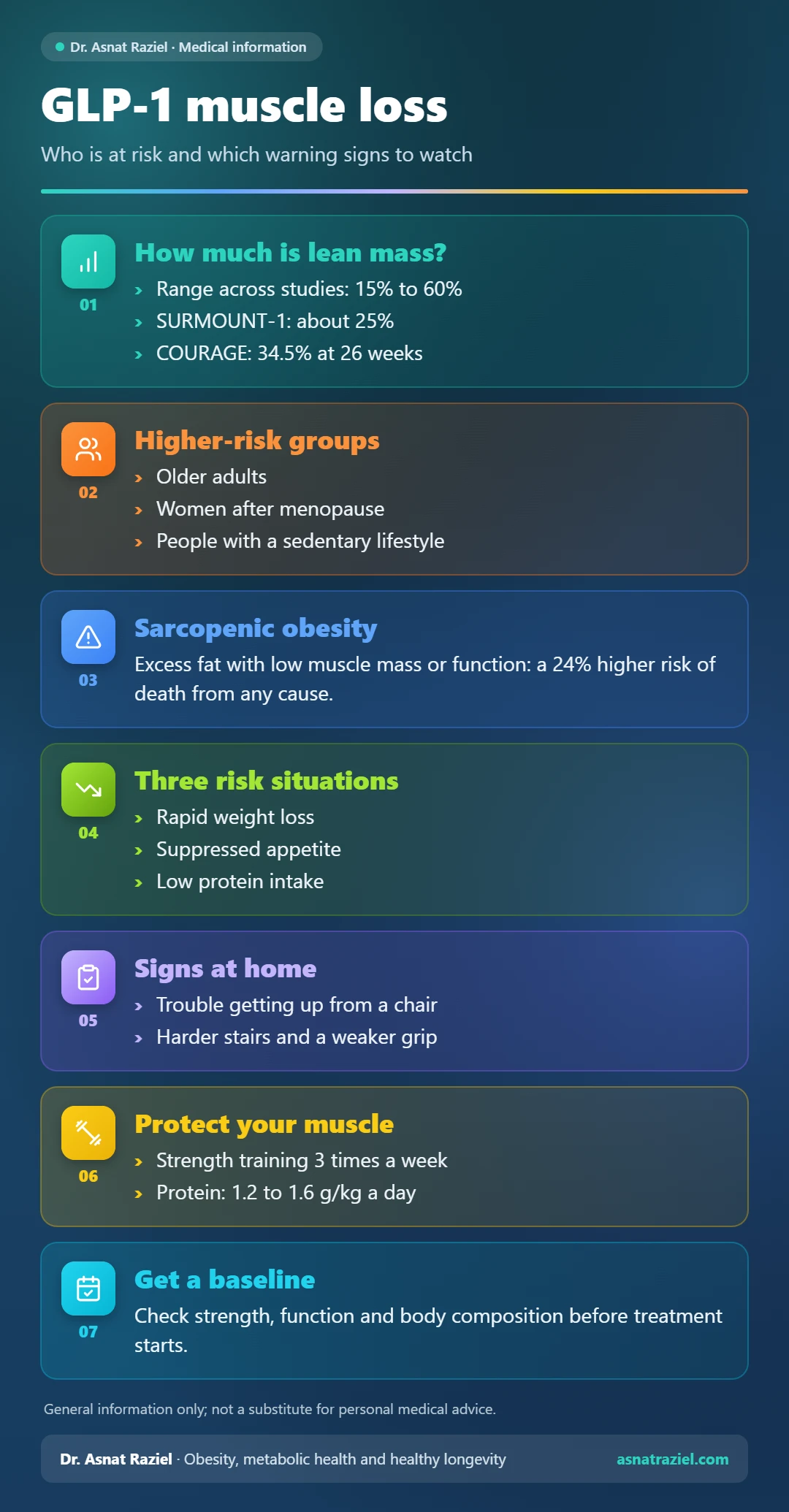
So how much GLP-1 muscle loss actually happens? The research paints a complex picture. Most of the weight lost comes from fat. However, some of it comes from lean mass. Lean mass means everything that is not fat: muscle, organs, bone and water. A comprehensive 2024 review found a very wide range. In some studies, lean mass made up 40% to 60% of the weight lost, while in others it was only about 15% or less.
For example, in a substudy of the SURMOUNT-1 trial of tirzepatide (Mounjaro/Zepbound), about 25% of the weight lost was lean mass. By contrast, in the COURAGE trial of semaglutide (Ozempic/Wegovy), that share reached 34.5% after 26 weeks. It’s important to be precise here: lean mass is not just muscle. Therefore, the actual loss of muscle is lower than these numbers.
Who is at higher risk of GLP-1 muscle loss
For young, active people, this kind of loss may be negligible. But in some groups, it matters much more. These include older adults, women after menopause and people with a sedentary lifestyle. Their muscle mass is low to begin with, so every kilogram counts. I wrote more about these challenges in my article on obesity in older adults and in my guide to weight gain in menopause.
Between healthy weight loss and silent sarcopenia
Losing muscle mass is not just a cosmetic issue. Muscle is an active metabolic organ. It supports stability, daily function, protection from falls and blood sugar control. When rapid weight loss is not paired with muscle protection, hidden sarcopenia can develop. Sarcopenia is the loss of muscle mass and strength.
Combined with excess fat, this leads to a condition called sarcopenic obesity. The ESPEN and EASO consensus defines it as excess fat combined with low muscle mass or low muscle function. What’s more, a meta-analysis of 12 cohort studies found that sarcopenic obesity is linked to a 24% higher risk of death from any cause.
Three situations that raise the risk
GLP-1 muscle loss stands out mainly in three situations: rapid weight loss, a suppressed appetite and low protein intake. Under these conditions, the body also turns to its muscle stores to meet its needs. As a result, you may notice weakness and a drop in strength and stamina. Sometimes even daily function declines, despite the lower weight.
Still, the picture is not all bleak. The same review notes that MRI studies point to a largely adaptive process. In other words, muscle volume falls roughly as expected for a person’s age and the amount of weight lost. In addition, muscle quality probably improves, because less fat infiltrates the muscle. I explain what changes in the face reveal about this process in my article on Ozempic face.
New studies looking for answers
New trials are, for the first time, systematically examining how GLP-1 treatments affect muscle and bone. They include advanced measurements of body composition. In addition, they test function, such as grip strength and walking speed, and follow patients over time. Some of them combine strategies to preserve muscle: protein supplements, strength training and experimental drugs that act on muscle-building pathways.
The early conclusion is clear: weight loss alone is not enough. The key question is how you lose the weight, and what you hold on to along the way. On the other hand, long-term studies are still lacking. They need to find out whether muscle loss is reversible, what happens after treatment stops and which groups need intensive protection.
Warning signs of GLP-1 muscle loss you can spot at home
How can you tell that your body is losing muscle and not just fat? The scale alone won’t tell you. So it’s worth watching for a few simple signs at home:
- New difficulty getting up from a chair without using your hands.
- Climbing stairs has become an effort, despite your lower weight.
- Weaker grip strength, for example when opening a jar or carrying bags.
- Ongoing fatigue and general weakness.
If one of these signs appears, be sure to tell your doctor. In most cases, the situation can be improved by adjusting your diet, your exercise plan and sometimes the pace of dose increases. In such cases, weight-loss injections and muscle loss don’t have to go hand in hand.
When GLP-1 muscle loss signs call for a doctor’s visit
Putting the two parts of this article together is the key. If you belong to one of the higher-risk groups, meaning older adults, women after menopause or people with a sedentary lifestyle, it pays to be especially alert. For this reason, ask for a check of your strength, function and body composition before you start treatment, as the four American organizations recommend. That way, you have a baseline for comparison. Later on, any warning sign, such as trouble getting up from a chair or a weaker grip, is a reason to contact your doctor. There is no need to wait for your next routine visit. That way, your diet, your exercise and the pace of dose increases can be adjusted in time. For a full, research-based plan to protect your muscle, see my article on how to lose fat, not muscle.
How to build a smart treatment, not just a slimming one
The clinical message is getting sharper: drug treatment for obesity must be part of a broader plan. A prescription alone is not enough. The joint recommendations of four American organizations suggest checking strength, function and body composition even before treatment begins. In addition, they recommend strength training at least three times a week and a protein target of 1.2 to 1.6 grams per kilogram per day during active weight loss.
In my clinic, we build in a high-protein diet, tailored strength training and body composition tracking from the start. That way, we don’t just look at the number on the scale. Measurements such as DXA, a low-dose X-ray scan that separates fat, muscle and bone, are becoming part of modern care. You will find the latest nutrition guidelines in my article on incretin drugs and muscle mass.
The bottom line on GLP-1 muscle loss
Weight-loss injections and muscle loss are not a fate you have to accept. These medications are highly effective, and with the right plan, damage to muscle can be greatly reduced. Ultimately, the future of obesity medicine is not just about shedding kilograms. It is about protecting health, function and quality of life. Smart weight loss leaves us strong, stable and healthy, not just lighter.
The information in this article is general and does not replace personal medical advice.
References
Changes in lean body mass with glucagon-like peptide-1-based therapies and mitigation strategies
Definition and diagnostic criteria for sarcopenic obesity: ESPEN and EASO consensus statement