By Dr. Asnat Raziel, bariatric surgeon specializing in obesity treatment, metabolic health and healthy longevity; Director of the Multidisciplinary Center for Obesity Treatment, Assia Medical, Assuta Ramat HaChayal, Tel Aviv
Incretin drugs for obesity: a new consensus statement
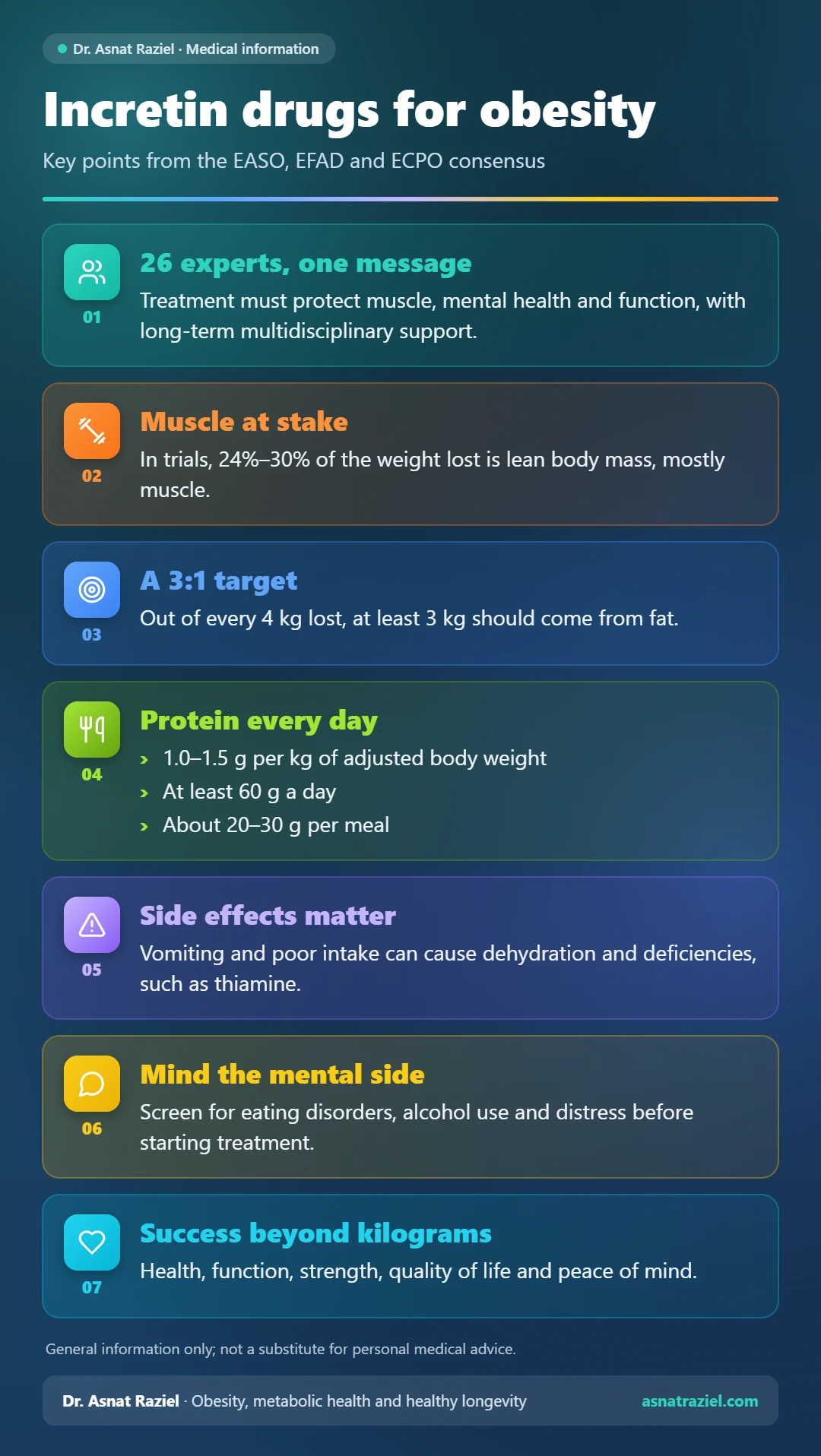
Incretin drugs for obesity, such as Wegovy and Mounjaro, are at the center of an important new European document. For the first time, Europe’s obesity experts, dietitians and patient representatives have written joint recommendations. Their message is clear: treatment must include protecting muscle, mental health and physical function. In addition, it must include tailored nutrition and long-term multidisciplinary support.
The authors presented the document at the European Congress on Obesity, ECO 2026. In July 2026, it appeared in The Lancet Diabetes & Endocrinology. Its authors are the European Association for the Study of Obesity (EASO), the European Federation of the Associations of Dietitians (EFAD) and the European Coalition for People living with Obesity (ECPO). The recommendations apply to patients receiving semaglutide or tirzepatide.
Not just about losing weight
The document’s main message is sharp: obesity treatment is not just a number on the scale. Weight loss is only part of the picture. The real goal is to protect muscle, function, mental health and metabolic health for years to come.
An international team of 26 experts wrote the document. The team included physicians, dietitians, psychologists and exercise physiology experts. As a result, the document marks a shift from thinking only about weight loss to a broad view of treatment.
Obesity drugs are changing the rules of the game
In recent years, drugs that act on GLP-1 and GIP have brought dramatic change to obesity medicine. They lead to significant weight loss and improve diabetes control. In addition, they lower the risk of heart disease, improve fatty liver and sleep apnea, and even improve quality of life.
According to the document, these drugs do more than suppress appetite. They act on hunger and satiety centers in the brain, slow stomach emptying and change the food-related reward system. Consequently, many patients describe less “food noise,” the intrusive, constant thoughts about food. Others are able, for the first time, to listen to their natural hunger and fullness cues. But alongside this success, the experts warn about risks that are not always discussed.
Incretin drugs and muscle mass
One of the key issues is the loss of muscle mass during weight loss. According to the document, in trials, 24% to 30% of the weight lost with incretin drugs is lean body mass, mostly muscle. However, the health meaning of this figure is still not fully clear.
The risk is especially high in older adults, people with frailty, patients after bariatric surgery and people prone to sarcopenia. Rapid weight loss without protecting muscle can lead to weakness and poorer balance. Moreover, it may raise the risk of fractures. I wrote about this in my article on body composition.
That is why the document proposes a practical target when body composition data are available: a ratio of at least 3:1 between fat loss and lean mass loss. In other words, out of every 4 kg lost, at least 3 kg should come from fat. A summary of the document notes that direct evidence for this target is still limited.
The authors recommend moving from follow-up based only on BMI to broader monitoring. This includes waist circumference, an assessment of muscle mass and simple function tests, such as handgrip strength and rising from a chair. For patients at risk, body composition tests can be added:
- DXA (dual-energy X-ray absorptiometry): a test of body composition and bone density that uses two X-ray beams.
- BIA (bioelectrical impedance analysis): an estimate of body composition based on resistance to a weak electrical current.
Protein and strength training are part of treatment
An important new point is that the document treats nutrition and exercise as part of drug therapy itself. According to the authors, clinical dietitians should be a core part of the team, not an add-on. They tailor nutrition, prevent deficiencies and reduce side effects. They also support the patient over the long term. You can read more about this in my article on nutrition during weight loss injection treatment.
According to the recommendations, during weight loss you should eat 1.0 to 1.5 grams of protein per kilogram of adjusted body weight per day. According to a summary of the recommendations, that means at least 60 grams a day. It is also a good idea to spread protein across the day, about 20 to 30 grams per meal. Walking and aerobic activity are important, but on their own they are not enough. To preserve muscle, you need personalized strength training, as I explained in my article on preserving muscle mass during weight loss.
Side effects are more than a nuisance
The document discusses digestive side effects in detail: nausea, vomiting, constipation, diarrhea and heartburn. According to the authors, these are not just a passing nuisance. They can cause dehydration, nutritional deficiencies and too sharp a drop in food intake. With prolonged vomiting, there is also a risk of deficiency in essential vitamins such as thiamine.
Therefore, the recommendations include gradual dose increases, enough fluids, dietary fiber and nutritional monitoring. There is more on this in my article on digestive side effects. In addition, it is sometimes better to tailor the dose to the individual rather than automatically reach the maximum dose.
For example, a real-world study from Denmark included 2,694 patients at an online clinic. The doctors did not raise the dose when weight loss was sufficient. After 64 weeks, the average weight loss was 16.7% of body weight, at an average dose of 1.08 mg of semaglutide per week. However, only some of the participants stayed in follow-up until the end. I wrote about this approach in my article on GLP-1 dosing.
The psychological impact of incretin drugs
One of the most innovative chapters in the document deals with the mental side of treatment. For many people, food is not just a source of energy. It is also a way to calm down, find comfort, feel a sense of belonging and cope with emotions. When the drugs reduce appetite, some patients lose an important coping mechanism.
Furthermore, major weight loss can change personal identity and social relationships. Some patients actually experience anxiety, confusion, a sense of loss or fear of stopping treatment at this point. That is why the document recommends a basic mental health screening before starting treatment. The screening covers eating disorders, alcohol use and psychological distress. Patients under psychiatric care should have a follow-up check one to two weeks after starting treatment.
At the same time, most studies have actually found improvements in mood, self-image and quality of life. There is more on this topic in my article on GLP-1 drugs and mental health.
Bottom line: incretin drugs and a new model of care
The most important message of the document is that incretin drugs for obesity are not “a shot and that’s it.” The authors describe a multidisciplinary model that includes physicians, dietitians and mental health professionals. It also includes exercise specialists, and sometimes physiotherapists and geriatricians. Obesity is a chronic biological, psychological and social disease, so treatment must also be personal and long term.
In the end, this is a new era in obesity medicine. We no longer measure success only in kilograms. Instead, we measure it in the health, function, strength, quality of life and peace of mind we preserve along the way.
The information in this article is general and does not replace personal medical advice.
References
New consensus outlines best practices for obesity medications
When weight loss drugs work, don’t let nutrition and muscle fall behind
16.7% average weight loss on GLP-1 micro-dosing of 1.08 mg semaglutide per week