By Dr. Asnat Raziel, bariatric surgeon specializing in obesity treatment, metabolic health and healthy longevity; Director of the Multidisciplinary Center for Obesity Treatment, Assia Medical, Assuta Ramat HaChayal, Tel Aviv
Body composition after sleeve gastrectomy: why the scale isn’t enough
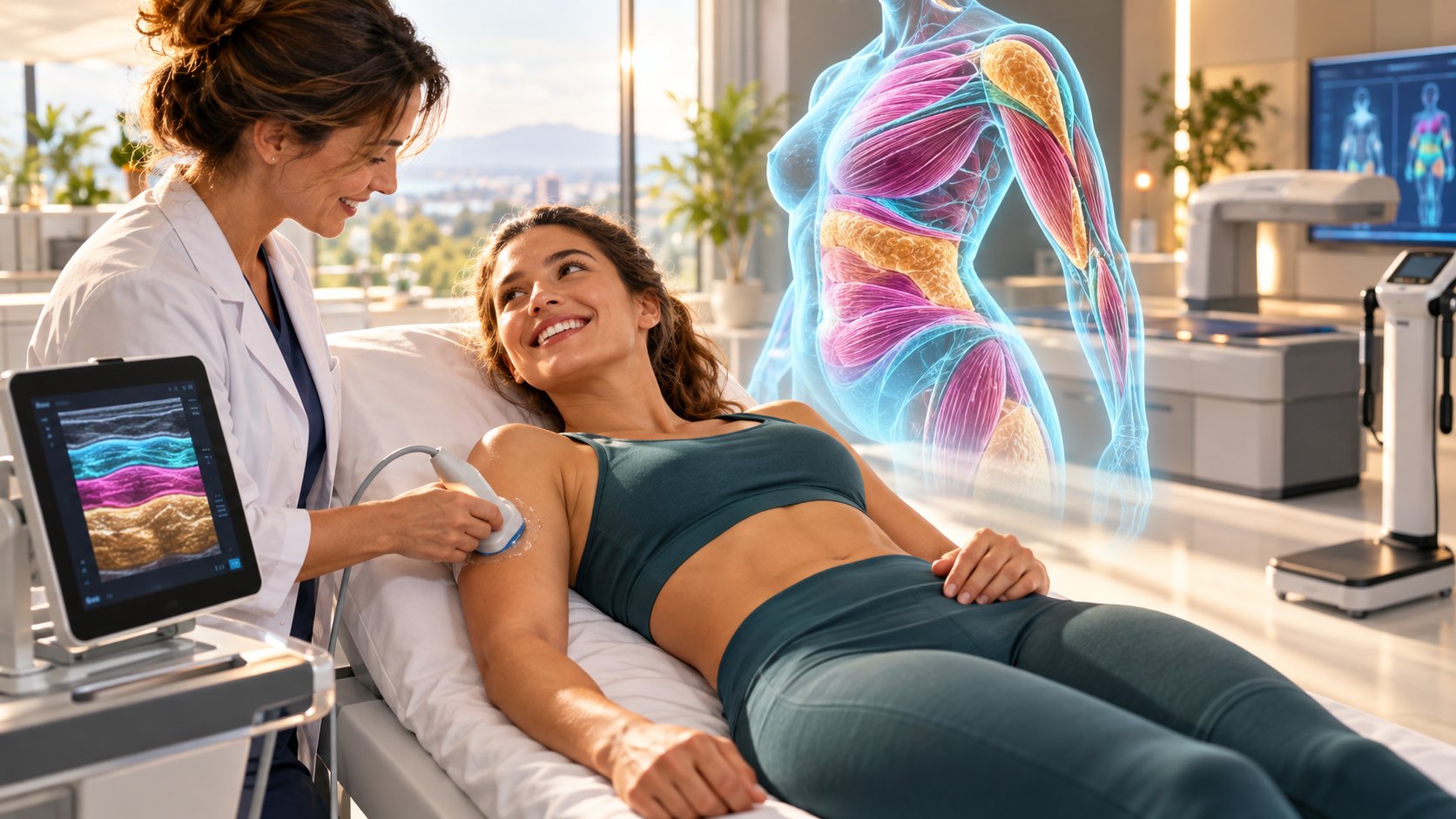
Measuring body composition after sleeve gastrectomy reveals what you are really losing: fat or muscle. The scale can’t tell the difference. That’s why researchers in Australia tested portable, accessible tools for this kind of follow-up. The result is interesting: portable ultrasound agreed far better than bioimpedance with DEXA, the reference method.
Why it matters what you lose
After bariatric surgery, weight comes off quickly. Most of it is fat, and that is exactly the goal. However, part of the loss also comes from lean tissue, including muscle. Muscle is an active metabolic organ. It burns energy, maintains strength and stability, and supports your bones.
As I’ve written before, what your body is made of matters more than the number on the scale. Excessive muscle loss can lead to sarcopenic obesity. In addition, it can slow your metabolism and make it harder to keep the weight off.
The same limitation applies to BMI. As a Ynetnews report on waist size and heart risk explains, BMI cannot distinguish fat from muscle, so the number alone can be misleading.
Tracking body composition after sleeve surgery: DEXA and the access problem
DEXA (dual-energy X-ray absorptiometry) is the accepted gold standard for measuring body composition. It is a low-radiation scan that maps the amount of fat, lean tissue and bone throughout the body. The catch is access. The test requires a dedicated machine, an appointment and a trip to an imaging center.
As a result, many clinics use bioimpedance devices. Bioimpedance spectroscopy (BIS) sends a very weak electrical current through the body. It then calculates body composition based on how strongly the tissues resist that current. Portable ultrasound, by contrast, uses sound waves to measure the thickness of the fat and muscle layers at several points on the body. The question was how accurately each one tracks change over time.
What the study looked at
The new study was published in October 2026 in the journal Clinical Nutrition ESPEN. It is a prospective cohort study, meaning it followed participants forward in time. The participants were women with obesity who underwent a primary sleeve gastrectomy at three hospitals in Melbourne.
Each participant had three tests: DEXA, bioimpedance and ultrasound using a five-site measurement protocol. The tests were done before surgery and again 12 months afterward. In addition, the researchers built equations that convert the ultrasound measurements into fat mass and lean mass, the way DEXA measures them. The study details are listed in the Australian clinical trials registry.
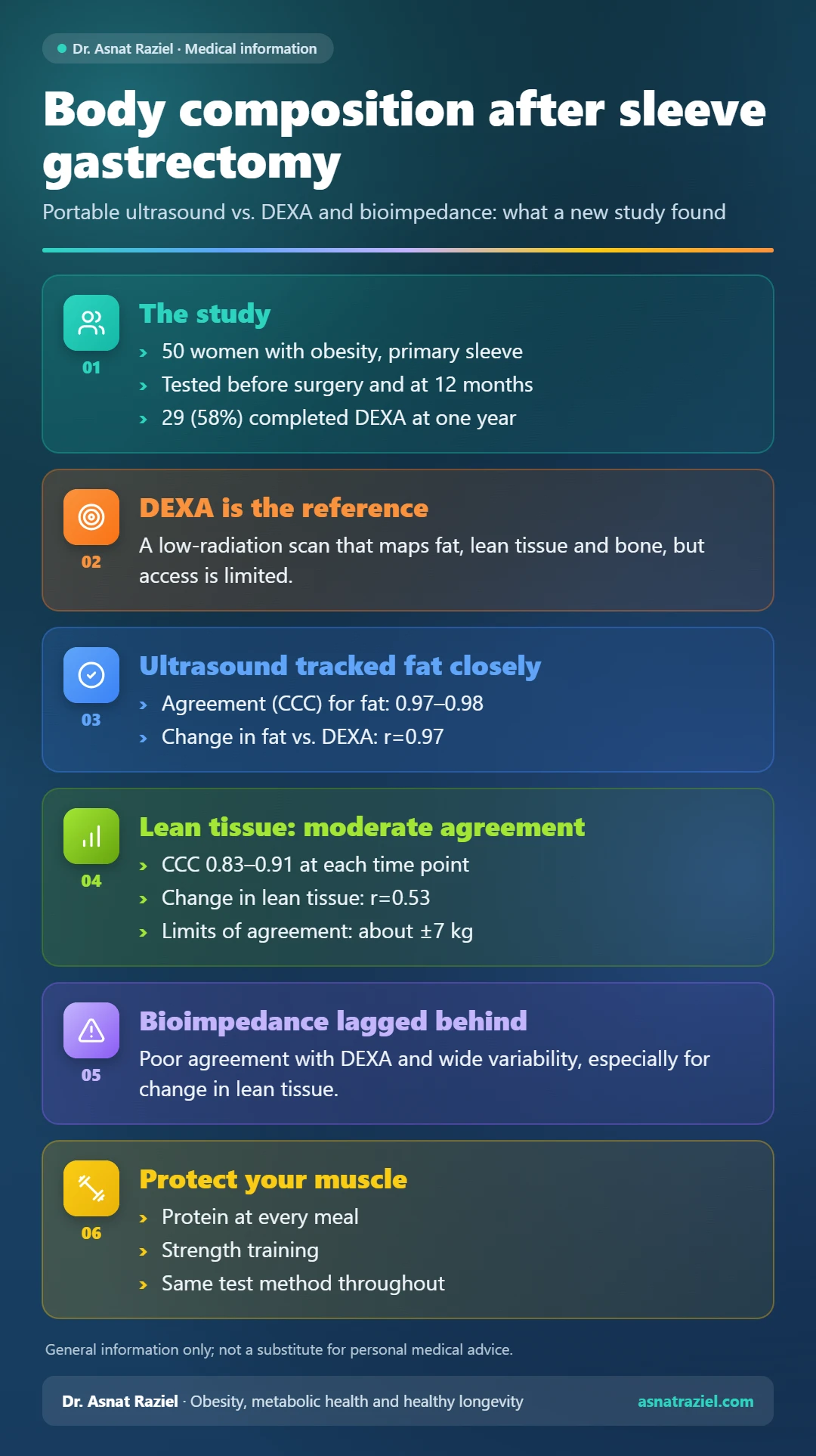
In total, 50 women enrolled. Of these, 29 (58%) also completed a DEXA scan after one year. After quality-control screening, bioimpedance data remained for 28 participants and ultrasound data for 27.
Ultrasound results for body composition after sleeve gastrectomy
First, the researchers looked at agreement at each time point separately. They used an agreement measure called the concordance correlation coefficient (CCC), which ranges from 0 to 1. A value of 1 means perfect agreement. For fat, ultrasound reached 0.97 to 0.98. For lean tissue, agreement reached 0.83 to 0.91.
Second, the researchers examined change over the year. This is the test that really counts, because change is what we care about during follow-up. For fat, the correlation between ultrasound and DEXA was very strong (r=0.97, p<0.001). In contrast, for lean tissue the correlation was moderate (r=0.53, p=0.006).
The average bias between the methods was small. However, the limits of agreement reached about ±7 kg. In other words, for an individual patient, the estimate could differ from DEXA by several kilograms.
What about bioimpedance devices?
Bioimpedance showed poor agreement with DEXA and wide variability between patients. The gap was especially striking when measuring change in lean tissue. Put differently, the very number we care most about after surgery, how much muscle was preserved, is the one bioimpedance struggled with. Does that mean we should give up on these devices? Not necessarily. But their numbers should be interpreted with caution.
Limitations worth knowing
The study is small, and it included only women. In addition, about 4 in 10 participants did not complete the DEXA scan at one year. Moreover, the researchers developed and tested the ultrasound equations in the same group of women, without internal validation. Variability at the level of the individual patient also remained substantial. Therefore, the researchers themselves state that the equations need to be tested in an independent study.
What body composition after sleeve surgery means for you
The main message is simple: weight alone doesn’t tell the whole story. After sleeve gastrectomy, it’s worth tracking both fat and muscle. For now, DEXA remains the reference method. In the future, portable ultrasound may make this kind of follow-up available right in the clinic, if further studies confirm the results.
How to protect your muscle starting now
In fact, a few simple steps help preserve muscle after surgery:
Protein at every meal. Protein is the building block of muscle. It’s worth reading my complete guide to protein during weight loss.
Strength training. Resistance exercise preserves both muscle and bone. Read more about exercise after bariatric surgery.
Regular professional follow-up. Ask your care team which method is available to you. It’s important to use the same method throughout, so that the comparison is fair.
Attention to your weight over the years. Preserving muscle also helps prevent weight regain after sleeve surgery. Incidentally, patients on medication also lose some lean tissue, as I showed in my article on GLP-1 medications and muscle.
The bottom line
A new study shows that portable ultrasound estimates the change in fat after sleeve gastrectomy in close agreement with DEXA. For lean tissue, agreement is moderate, and with bioimpedance the variability is much greater. Accurate measurement of body composition therefore still requires a careful choice of method. I hope follow-up studies will give us accurate, affordable and accessible monitoring in every clinic.
The information in this article is general and is not personal medical advice. Before making any change to your treatment, consult your physician.