By Dr. Asnat Raziel, bariatric surgeon specializing in obesity treatment, metabolic health and healthy longevity; Director of the Multidisciplinary Center for Obesity Treatment, Assia Medical, Assuta Ramat HaChayal, Tel Aviv
Amylin drugs in the pipeline: why everyone is talking about them
Amylin drugs are moving quickly from the lab toward the clinic, and my patients often ask which ones are real and which are still far away. In this article, I will go through the main candidates one by one, from CagriSema to zenagamtide and eloralintide, and explain where each one stands. If you want to understand how the hormone itself works, you will find that in my separate article on how amylin controls appetite and satiety.
Amylin drugs for obesity are one of the hottest directions in obesity medicine today. In recent years, GLP-1 drugs such as Ozempic, Wegovy and Mounjaro have changed our understanding of hunger, fullness and metabolism. Now a new stage is beginning. At the ECO 2026 congress in Istanbul, a whole symposium focused on one question: will combining amylin with GLP-1 bring greater weight loss, better muscle preservation and less “food noise”?
Below, I explain what amylin is, what the studies have shown so far and where these drugs stood as of October 2026.
The hormone that was overlooked for decades
Amylin is a natural hormone. The beta cells of the pancreas release it together with insulin after a meal. For many years, attention went mainly to insulin and GLP-1. Amylin, by contrast, stayed almost out of the spotlight. Today it is clear that this molecule has a deep effect on hunger, fullness, blood sugar control and eating behavior.
This is why most new amylin drugs are paired with a GLP-1 partner. Read more about why adding amylin to GLP-1 matters.
Amylin acts mainly in the brain. It affects both the centers of basic hunger and the areas involved in emotional eating and eating for pleasure. In addition, researchers presented evidence of amylin receptors in other organs. Therefore, its effect may be much broader than appetite suppression alone.
However, natural amylin has a drawback. It tends to form amyloid deposits, meaning clumps of protein. Such deposits are linked to the development of type 2 diabetes and perhaps also to damage to the kidneys, heart and nervous system. That is why developing stable and safe versions of the hormone was a major challenge for years.
Amylin drugs, step one: from cagrilintide to CagriSema
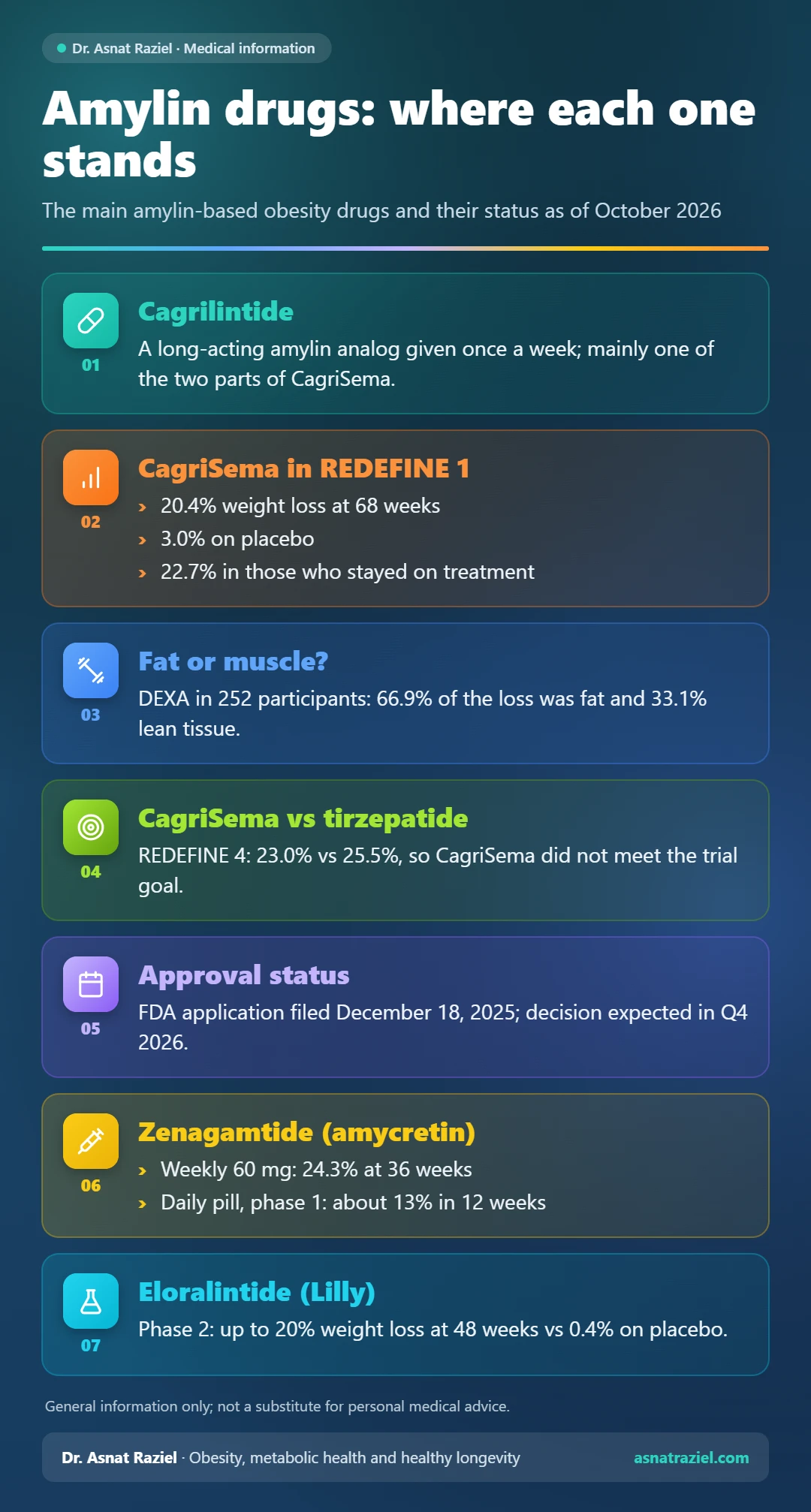
The new generation of amylin drugs for obesity includes engineered molecules. Scientists designed them so that they would not form deposits and would act in the body for a long time. The leading drug in the field is cagrilintide. It is a synthetic, long-acting amylin analog given as a once-weekly injection. In models of obesity, the drug reached the brain areas that regulate eating and reduced food intake and weight.
But the main interest lies in the CagriSema combination. It pairs cagrilintide with semaglutide, the active ingredient in Wegovy. The two hormones act on different nerve cells in the same brain areas. In other words, they complement each other. According to the data presented, the combination reduces hunger and food cravings. Moreover, it also reduces emotional eating and food noise, the intrusive thoughts about food that many patients describe.
Amylin drugs in the REDEFINE 1 trial
The REDEFINE 1 trial included 3,417 adults with obesity or overweight and without diabetes. After 68 weeks, patients on CagriSema lost an average of 20.4% of their body weight. In the placebo group, by contrast, the loss was 3.0%. Among those who stayed on treatment as planned, weight loss reached 22.7%. In the same analysis, semaglutide alone led to 16.1% weight loss, cagrilintide alone to 11.8%, and placebo to 2.3%.
In addition, the researchers noted that the weight-loss curve had not fully leveled off even after a year and a quarter. At the same time, metabolic markers improved: waist circumference, CRP (a marker of inflammation in the body), triglycerides, cholesterol and blood pressure. Many patients with prediabetes returned to normal blood sugar levels. Digestive side effects occurred in 79.6% of patients on CagriSema, compared with 39.9% on placebo. Most were mild to moderate and temporary. You can read about the whole research program in my article on the REDEFINE trials.
What happens to muscle on amylin drugs?
One of the key questions today is not only how much weight people lose, but what kind of weight they lose. At the congress, researchers presented DEXA data, a scan that measures fat and muscle, from 252 participants. In patients on CagriSema, 66.9% of the weight lost was fat and 33.1% was lean tissue. In other words, about two-thirds of the loss came from fat.
The researchers stressed that it is important to measure muscle function as well, not just muscle mass. This is especially true for women during and after menopause. Another hypothesis raised was that amylin, through calcitonin receptors, may benefit bone health. You can read why body composition matters as much as weight in my article on muscle mass and body composition.
CagriSema vs Mounjaro and approval status
In a head-to-head comparison in the REDEFINE 4 trial, CagriSema led to 23.0% weight loss, compared with 25.5% with tirzepatide. As a result, CagriSema did not meet the trial’s goal. The details of that trial appear in my article on CagriSema vs tirzepatide.
On the regulatory side, Novo Nordisk submitted an approval application to the FDA on December 18, 2025. In early November 2026, Novo Nordisk said it expects the FDA decision by the end of 2026 and a launch in early 2027. Until then, CagriSema is not approved in any country.
Zenagamtide: the next generation of amylin drugs
One of the most intriguing drugs presented is zenagamtide, formerly known as amycretin. It is a single molecule that acts on both the GLP-1 system and the amylin system. Researchers hope that combining both actions in one molecule will create an especially strong effect. For example, less food noise, fewer food cravings and preserved energy expenditure during weight loss.
The first data are generating a lot of interest. In the weekly injection study, participants on the 60 mg dose lost an average of 24.3% of their body weight after 36 weeks, compared with 1.1% on placebo. In the daily pill study, a small phase 1 trial, weight fell by about 13% within 12 weeks. Then, in June 2026, reports described a phase 2 study in people with type 2 diabetes, with a significant drop in HbA1c (average blood sugar over the past three months). Still, these are small, short studies. Only large, long-term trials will determine the drug’s place.
Other companies are also developing amylin drugs for obesity. For example, in a phase 2 study of eloralintide from Lilly, weight loss reached up to 20% after 48 weeks, compared with 0.4% on placebo.
Amylin drugs today: where each one stands
When patients ask me which amylin drugs they can actually get, I sort them by stage. CagriSema is the most advanced. It has full phase 3 data, a head-to-head trial against tirzepatide and an application at the FDA, with a decision expected by the end of 2026. Next comes zenagamtide, a single molecule tested both as a weekly injection and as a daily pill, so far in small, short studies. Eloralintide from Lilly has published phase 2 results. Cagrilintide on its own serves mainly as one of the two components of CagriSema. In short, as of October 2026, no country had approved any of them.
CagriSema has also been tested in people with type 2 diabetes. I cover those results in my article on CagriSema in diabetes and the REIMAGINE 2 trial.
Is the era of GLP-1 alone coming to an end?
The feeling at the congress was clear: obesity medicine is entering an era of personalized care. No more one drug for everyone. Instead, the doctor will choose treatment based on each patient’s metabolic profile, complications and biological characteristics. For example, in the future we may match one treatment to people with heart disease and another to people with sleep apnea. Patients with prominent emotional eating may receive a completely different treatment.
The bottom line
For years, amylin was a relatively marginal hormone. Today, amylin drugs for obesity may become one of the most important pathways in the next generation of treatment. Ultimately, the data are promising, but most of these drugs are still in development. That is why it is important to follow the approvals and to choose treatment together with an expert team.
The information in this article is general and does not replace personal medical advice.
References
Coadministered Cagrilintide and Semaglutide in Adults with Overweight or Obesity
ECO 2026: REDEFINE-1 demonstrates CagriSema’s improvement in body composition
Novo Nordisk’s zenagamtide shows significant HbA1C reductions
Novo Nordisk funded the CagriSema and zenagamtide studies, and Eli Lilly funded the eloralintide study.