By Dr. Asnat Raziel, bariatric surgeon specializing in obesity treatment, metabolic health and healthy longevity; Director of the Multidisciplinary Center for Obesity Treatment, Assia Medical, Assuta Ramat HaChayal, Tel Aviv
CagriSema vs. tirzepatide: the first head-to-head showdown
CagriSema vs. tirzepatide is one of the most intriguing matchups in the world of obesity medications. In recent years, the field has entered a new era. Instead of modest weight loss, we are seeing double-digit results, sometimes more than 20% of body weight. But when two breakthrough drugs meet in a direct comparison, the picture sharpens, and sometimes it surprises.
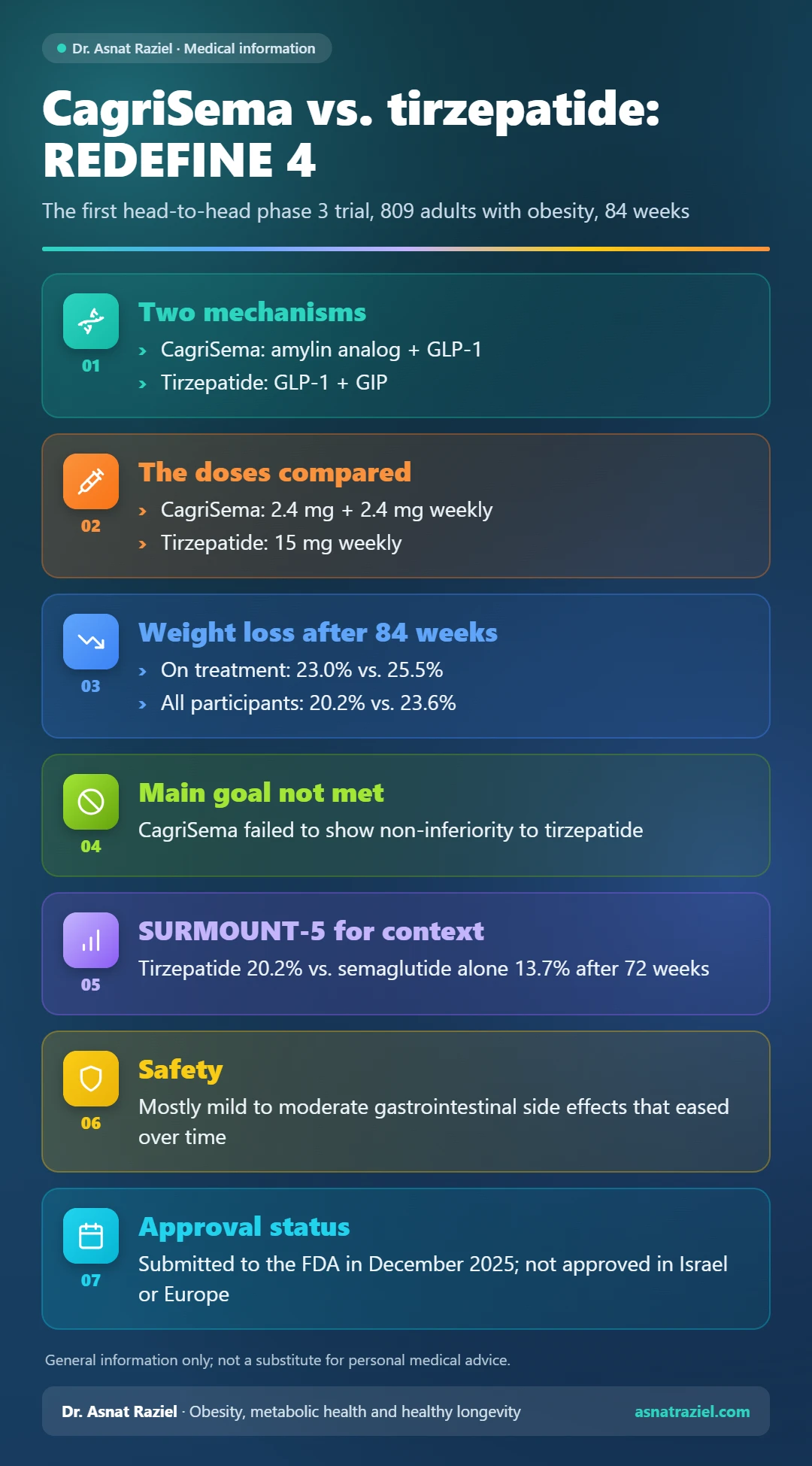
In a phase 3 trial called REDEFINE 4, Novo Nordisk compared CagriSema with tirzepatide, the active ingredient in Eli Lilly’s Mounjaro. According to the company’s announcement of February 23, 2026, CagriSema produced impressive weight loss. However, it failed to show non-inferiority to tirzepatide after 84 weeks.
The science: two different mechanisms
CagriSema combines two drugs in one weekly injection. The first is semaglutide, which mimics the satiety hormone GLP-1, as in Wegovy and Ozempic. The second is cagrilintide, an analog of the hormone amylin. Amylin is a hormone the pancreas releases together with insulin, and it increases the feeling of fullness. The idea is simple: two satiety pathways working together should have an additive effect. I wrote more about this mechanism in my article on amylin analogs.
Tirzepatide, on the other hand, acts on two receptors: GLP-1 and GIP. GIP is another gut hormone that affects insulin and fat tissue. In the SURMOUNT-1 trial, the 15 mg dose led to an average weight loss of 20.9% after 72 weeks. You can find more about this hormone in my article on the GIP hormone.
How the REDEFINE 4 trial was designed
The trial included 809 adults with obesity and at least one related health condition. Average weight at the start of the trial was 114.2 kg. The trial was open-label, meaning that patients and researchers knew which treatment each person was getting.
One group received CagriSema at a fixed dose: 2.4 mg cagrilintide and 2.4 mg semaglutide, once a week. The other group received tirzepatide 15 mg once a week. The main goal was to show that CagriSema is not inferior to tirzepatide for weight loss.
The results: CagriSema vs. tirzepatide after 84 weeks
The researchers analyzed the results in two ways. Among those who stayed on treatment, average weight loss was 23.0% with CagriSema, compared with 25.5% with tirzepatide. Among all participants, regardless of whether they stayed on treatment, the loss was 20.2% versus 23.6%.
In other words, CagriSema did not meet the trial’s main goal. Still, it is important to keep things in proportion. Losing 23% of body weight is a dramatic result. It has profound effects on insulin resistance, fatty liver, sleep apnea and high blood pressure. But in a competitive market, where an existing treatment reaches 25% or more, even a two-point gap carries clinical and commercial weight.
Another head-to-head comparison: SURMOUNT-5
REDEFINE 4 is not tirzepatide’s first head-to-head contest. The SURMOUNT-5 trial compared tirzepatide with semaglutide alone in 751 adults with obesity and without diabetes. After 72 weeks, patients on tirzepatide had lost 20.2% of their body weight, compared with 13.7% on semaglutide. So adding amylin to semaglutide narrowed the gap, but did not close it. A comparison of the two established drugs appears in my article on Mounjaro vs. Wegovy.
Safety and tolerability
According to the company, CagriSema appeared safe and well tolerated. The most common side effects were gastrointestinal, mostly mild to moderate. In addition, they eased over time, as with the rest of the GLP-1 family.
Even so, the full data have not yet been published in a journal. Doctors in the field are waiting for answers on treatment discontinuation rates, body composition and long-term tolerability. The question of muscle is especially important, and I wrote about it in my article on weight-loss injections and muscle loss.
What it means for approval
Novo Nordisk submitted CagriSema to the FDA in December 2025. The application relied mainly on the REDEFINE 1 and REDEFINE 2 trials, which compared the drug with placebo. For example, in the REDEFINE 1 trial, weight loss was 20.4% with CagriSema, compared with 3.0% on placebo. Therefore, missing the REDEFINE 4 goal does not necessarily rule out approval.
As of early November 2026, the FDA has still not approved CagriSema, and Novo Nordisk expects a US decision by the end of 2026. It is not approved in Israel or Europe. Meanwhile, the head-to-head results will shape its position in the market and doctors’ expectations. In addition, the company has said it plans a high-dose phase 3 trial, with 2.4 mg cagrilintide and 7.2 mg semaglutide, in the second half of 2026; as of early November, the company has not announced a start. Results of the REDEFINE 11 trial are expected in the first half of 2027. An overview of the entire trial program appears in my article on the CagriSema trials.
CagriSema vs. tirzepatide: what it means for patients
Many patients ask me in the clinic about CagriSema vs. tirzepatide, and which one to choose. For now, the answer is simple: of the two, only tirzepatide is available in Israel. If you are on it and responding well, there is no need to wait for a new drug. For patients and doctors, the question is not just who leads by a percentage point or two. Rather, the question is which patient will benefit most from which mechanism. In the future, we may identify groups that respond especially well to the combination of amylin and GLP-1. Moreover, data on muscle preservation, heart outcomes and quality of life may tip the balance.
For now, tirzepatide is strengthening its position as the leading treatment for the magnitude of weight loss in a direct comparison. But the race is far from over. For instance, new data are also emerging on CagriSema in type 2 diabetes, as I have described in a separate article on CagriSema in diabetes. I also looked at how women in menopause fared on CagriSema.
Bottom line on CagriSema vs. tirzepatide
The comparison of CagriSema vs. tirzepatide showed that both drugs are highly effective, but tirzepatide led by a few percentage points. The contest between them is not just a rivalry between drug companies. It is also a test of how deeply we understand the physiology of chronic obesity, and of the most precise way to intervene. Ultimately, the right treatment is decided together with your care team, based on each person’s goals, other health conditions and tolerability.
The information in this article is general information and is not a substitute for personal medical advice.
References
Tirzepatide Once Weekly for the Treatment of Obesity
Tirzepatide as Compared with Semaglutide for the Treatment of Obesity
Coadministered Cagrilintide and Semaglutide in Adults with Overweight or Obesity
The REDEFINE trials were funded by Novo Nordisk, and the SURMOUNT trials by Eli Lilly.




