By Dr. Asnat Raziel, bariatric surgeon specializing in obesity treatment, metabolic health and healthy longevity; Director of the Multidisciplinary Center for Obesity Treatment, Assia Medical, Assuta Ramat HaChayal, Tel Aviv
Amylin and GLP-1: why everyone is talking about the combination
Amylin analogs, and especially amylin and GLP-1 used together, are the hottest direction in obesity medicine today. Indeed, over the past decade, GLP-1 drugs have changed the rules of the game. They led to significant weight loss, improved blood sugar control and reduced heart risk. However, growing experience has taught us that obesity is not the product of a single mechanism. Rather, it is a disease governed by a delicate network of hormones, nerve pathways and habits. This is where the hormone amylin comes in, a key part of satiety that until recently received almost no attention as a treatment.
In this article, I focus on one question: what amylin adds to GLP-1 treatment, and who the combination may suit. For a review of every amylin drug in development and where each one stands, see my article on the amylin drugs in the pipeline.
What is amylin and why does it matter?
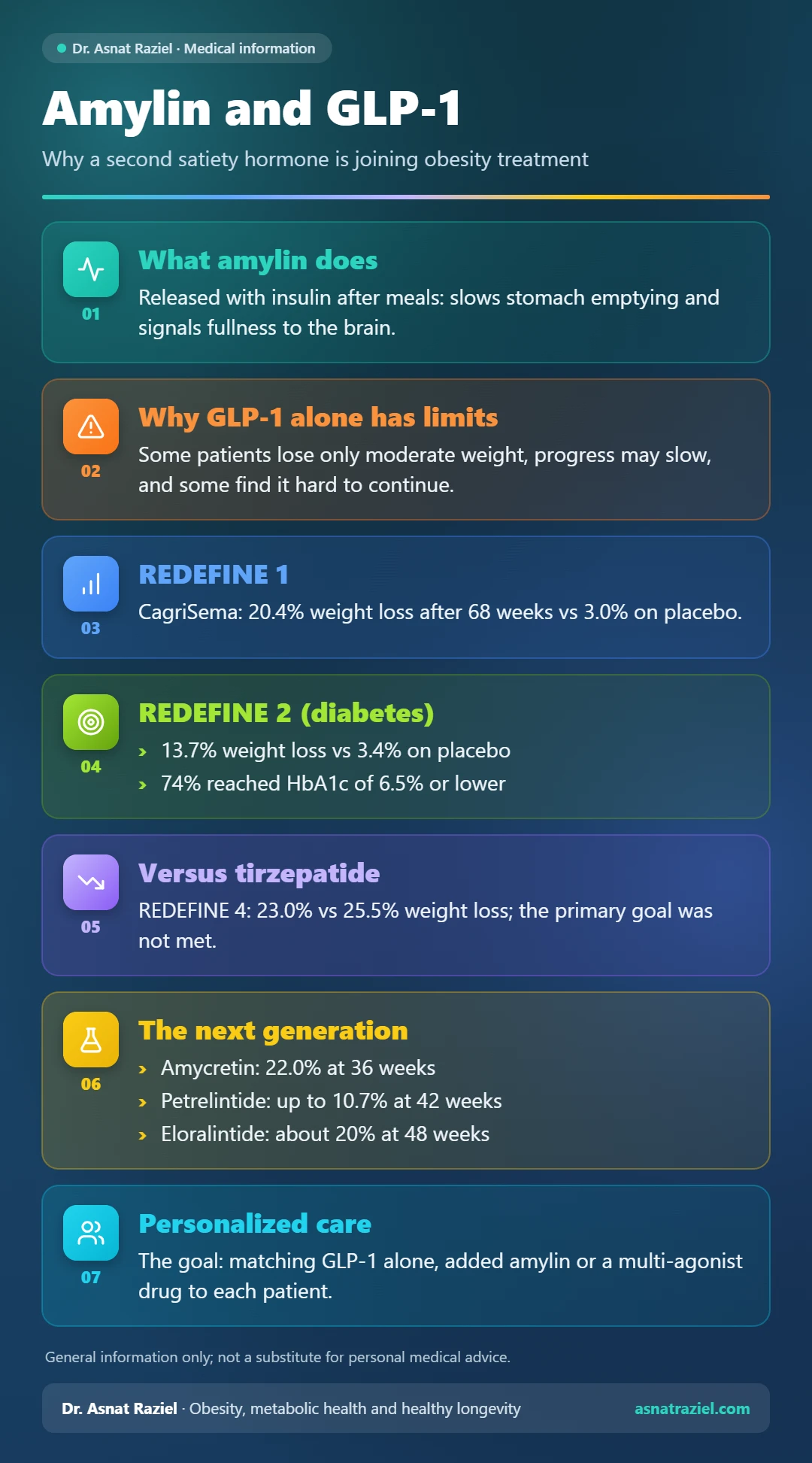
Amylin is a hormone that the beta cells of the pancreas release together with insulin, mainly after a meal. Specifically, its role is to complement insulin and regulate how much we eat. It slows stomach emptying, suppresses the release of glucagon and sends satiety signals to the brain. As a result, a person feels full quickly, and the feeling lasts a long time. I explain the mechanism in depth in my article on how amylin works.
Normally, amylin helps us stop eating at the right time. However, in obesity and diabetes, the hormone’s activity drops, and there is also evidence of resistance to it. Therefore, the result is weak satiety, eating beyond the body’s needs and difficulty controlling portions. This difficulty stands out especially with energy-dense food. You can read about the whole system in my article on the physiology of satiety.
Why isn’t GLP-1 alone always enough?
GLP-1 drugs work on several levels. They act on the satiety centers in the brain, slow stomach emptying and reduce appetite. For many people, this is indeed a breakthrough. Still, even the most effective treatments have limits. For example, some patients lose only a moderate amount of weight. Others see their progress slow over time, and some find it hard to stay on treatment.
Research shows that treating a single hormone does not always fully address a disease with many mechanisms. That is why the multi-agonist approach emerged. In short, it aims to mimic the body’s natural hormonal system much more closely.
Amylin and GLP-1 together: what the trials showed
The leading approach today combines amylin analogs with GLP-1 drugs. The best-known example is CagriSema, a combination of cagrilintide and semaglutide in one weekly injection. The REDEFINE 1 trial included 3,417 adults without diabetes. After 68 weeks, they lost an average of 20.4% of their weight, compared with 3.0% in the placebo group.
The REDEFINE 2 trial included 1,206 adults with type 2 diabetes. Weight loss reached 13.7%, compared with 3.4% on placebo. In addition, 74% of patients reached an HbA1c (average blood sugar over three months) of 6.5% or lower. You will find a broad review of the program in my article on the CagriSema trials.
Against tirzepatide: a surprising result
In February 2026, Novo Nordisk released the results of REDEFINE 4, a head-to-head comparison with tirzepatide, the active ingredient in Mounjaro. After 84 weeks, patients on CagriSema lost 23.0% of their weight, compared with 25.5% on tirzepatide. In other words, the trial did not meet its primary goal. I analyzed it fully in my article on how CagriSema and tirzepatide compared.
Where approval stands
Novo Nordisk submitted an application for approval to the FDA, the US Food and Drug Administration, in December 2025. As of early November 2026, the drug has not yet been approved, and a decision is expected later this year. In Israel, it is not yet available.
Amylin and GLP-1 in numbers: what the combination adds
What does the addition look like in practice? First, in REDEFINE 1 the combination led to 20.4% weight loss after 68 weeks, compared with 3.0% on placebo. Second, in REDEFINE 2, in people with diabetes, weight loss reached 13.7%, and 74% reached an HbA1c of 6.5% or lower. However, against tirzepatide the combination missed its goal: 23.0% versus 25.5%. In addition, digestive side effects are common, at 79.6% versus 39.9% on placebo. So the combination is not right for everyone. The choice depends on the response to GLP-1 alone, on tolerability and on personal goals.
The next generation: amycretin, petrelintide and eloralintide
Amycretin is a single molecule that activates both the GLP-1 receptor and the amylin receptors. In a phase 1b/2a trial published in The Lancet, participants on the 20 mg dose lost 22.0% of their weight after 36 weeks. By contrast, in the placebo group, weight rose by 1.9%. Following these results, the company moved the drug into phase 3 in 2026, as both an injection and a pill.
Petrelintide, from Zealand and Roche, is an amylin analog on its own. Its phase 2 trial included 493 adults. After 42 weeks, weight loss reached up to 10.7%, compared with 1.7% on placebo. Moreover, the rate of stopping because of side effects was 4.8%, almost the same as placebo. In September 2026, the companies started phase 3 trials.
Lilly has also entered the field with eloralintide, a selective amylin analog. In a phase 2 trial with 263 participants, the high dose led to about 20% weight loss after 48 weeks. In the placebo group, weight loss was only 0.4%.
Can an old hormone be “tamed”?
The first attempt to use amylin as a treatment was pramlintide, approved for diabetes in 2005. Yet the drug required several injections a day and caused a lot of nausea. By contrast, the new generation relies on long-acting molecules, a weekly injection and a gradual increase in dose. However, digestive side effects are still common with the combinations. For example, in REDEFINE 1, 79.6% of patients on CagriSema reported such side effects, compared with 39.9% on placebo.
This approach does more than suppress appetite. It aims to restore natural satiety. In this sense, amylin treatment “teaches” the body again to recognize fullness and stop eating at the right time.
Amylin and GLP-1: who may benefit?
The arrival of amylin treatments marks a new stage in obesity medicine. Treatment is moving away from a one-size-fits-all solution and toward personalized medicine. In the future, we will tailor treatment to eating patterns, biological response, metabolic features and personal needs. We will likely be able to identify who will benefit from GLP-1 alone, who will need added amylin and who will suit a multi-agonist treatment. A broad picture of the drugs on the way appears in my overview of new obesity drugs.
The bottom line on amylin and GLP-1
Amylin is not “just another hormone.” Instead, it is a central piece of the puzzle of eating and weight regulation. Amylin analogs open new, more precise options for treating a chronic disease with many faces. Some of them are already in phase 3, and the first may be approved soon. Ultimately, this is progress that brings us closer to a better understanding of human biology and to effective solutions.
The information in this article is general and does not replace personal medical advice.
References
Coadministered Cagrilintide and Semaglutide in Adults with Overweight or Obesity
Cagrilintide-Semaglutide in Adults with Overweight or Obesity and Type 2 Diabetes
Novo Nordisk plots phase 3 trials for next-gen obesity asset amycretin
The trials were funded by the companies developing the drugs: Novo Nordisk, Zealand and Roche, and Lilly.