By Dr. Asnat Raziel, bariatric surgeon specializing in obesity treatment, metabolic health and healthy longevity; Director of the Multidisciplinary Center for Obesity Treatment, Assia Medical, Assuta Ramat HaChayal, Tel Aviv
AI and a healthy lifestyle: it all starts with curiosity
AI and a healthy lifestyle seem like two distant worlds. Artificial intelligence is now entering almost every area of our lives. Even so, many people think of it as a technical world that belongs only to engineers and programmers. In practice, the way in can start somewhere else entirely: with a hobby, with curiosity or with creative work.
When you connect this approach to health, a fascinating opportunity opens up. You can use the new tools to learn, to create and to understand your body more deeply. In this article, I share how this happened for me, and what is worth knowing before you start.
Curiosity and creativity as a way in
Most people who enter the world of artificial intelligence don’t start with code. Instead, they start with curiosity. That was true for me as well. My first contact with AI tools did not come from a professional goal. Rather, it came from a wish to create: to make images, edit videos, play with visual ideas and discover new ways to tell a story. Merav Shavit guided my first steps and opened the door to this new world for me.
Through creative experimenting, I discovered something much deeper. Above all, artificial intelligence is a new language of thinking. It is a way to put ideas into words, ask questions and sharpen our understanding.
Why curiosity helps the brain learn
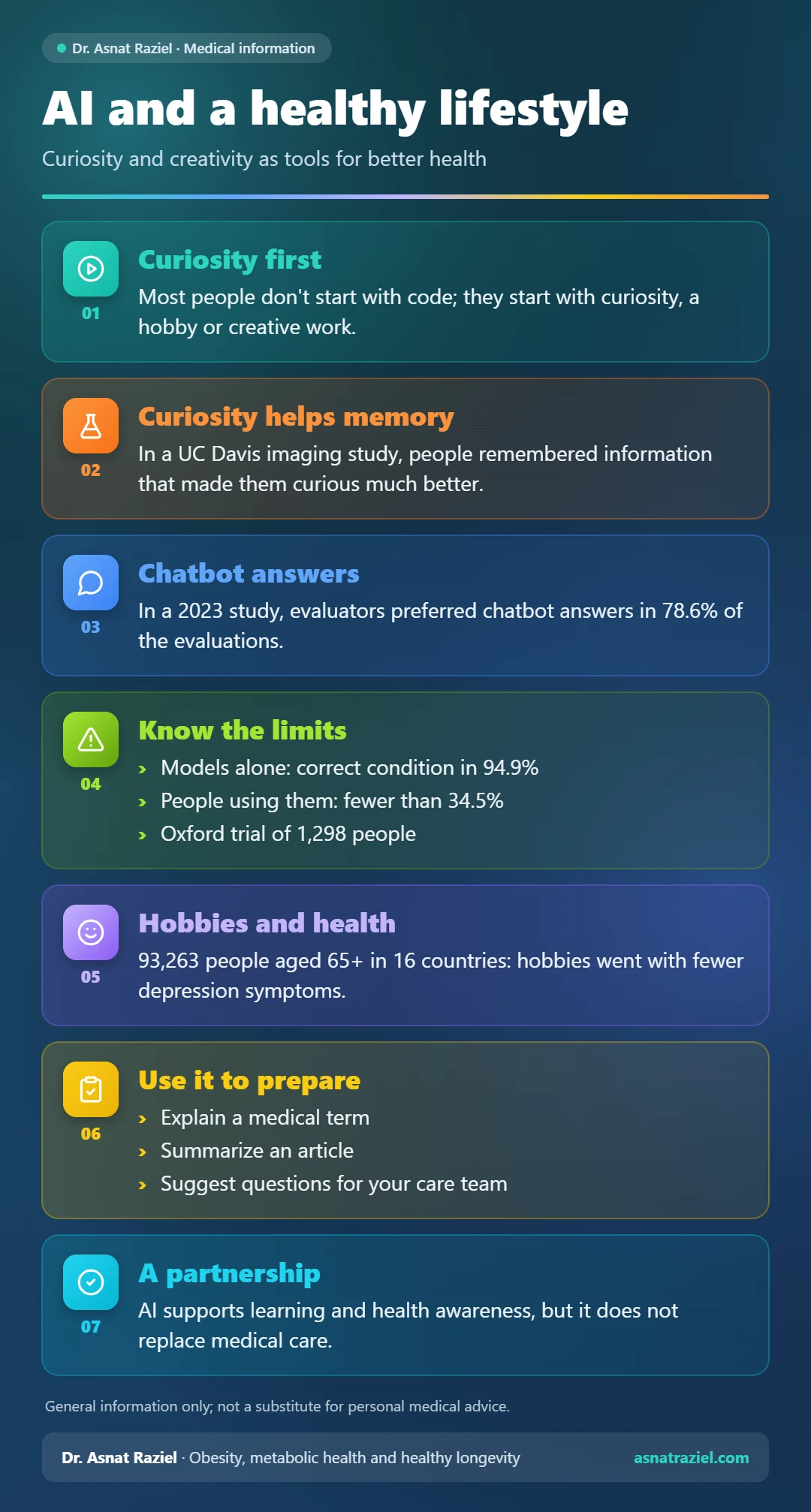
This feeling has a scientific basis. In a brain imaging study from the University of California, Davis, researchers examined how curiosity affects memory. Participants remembered information that made them curious much better. Moreover, they also remembered side details that appeared during moments of high curiosity. On the scans, the researchers saw increased activity in the brain’s reward system and in the hippocampus, the memory region.
In other words, when something interests us, the brain is open to learning. That is true for technology, and it is true for health.
From creative work to health
Anyone who starts playing with these tools quickly finds that they are not limited to art. The same tools help create medical materials and explain health information. In addition, they help plan a menu, organize a workout program or build a course on healthy living.
For health professionals, artificial intelligence is an important tool for making knowledge accessible. It translates complex research into clear language and makes it possible to illustrate processes in the body. Interestingly, a 2023 study compared chatbot answers with answers from medical professionals to questions from the public. The evaluators preferred the chatbot’s answers in 78.6% of the evaluations. In this way, a tool that first looks like a game gradually becomes a professional tool. I wrote about the use of AI in obesity care in my article on apps, digital monitoring and personalized obesity treatment.
Clinical uses are also growing. I describe what is already possible in my article on AI and metabolic health.
AI and lifestyle: knowing the limits
Alongside the excitement, it is important to remember the limits. A University of Oxford trial published in February 2026 included 1,298 people. They received ten medical scenarios and used either a language model or another source of their choice. When the models solved the scenarios on their own, they identified the correct condition in 94.9% of cases. However, when people used the same models, they identified a relevant condition in fewer than 34.5% of cases. The result was no better than that of the control group.
That is why artificial intelligence is a tool for learning and preparation, not a substitute for diagnosis. The World Health Organization has also published guidance on the responsible use of such tools in medicine. It is wise to check any medical information with a professional, and not to share sensitive personal details without thinking.
In my experience, the right way is to come to the appointment with good questions. For example, you can ask the tool to explain a medical term, summarize an article or suggest questions for a talk with your care team. In this way, artificial intelligence strengthens the relationship with your care team and does not replace it. It is also worth asking the tool for sources and checking them.
AI and lifestyle: learning by trial and error
One of the freeing things about this world is that you don’t need to understand everything in advance. Learning happens through experience. You open an app, try a tool, experiment and improve your question. Each attempt teaches you something small: how to phrase an idea, how to make a request more precise and how to communicate with a smart system.
This is where AI and a healthy lifestyle meet, because this process is very similar to changing habits. Here, too, there are no shortcuts and no magic solution. Instead, there is trial, personal adjustment and ongoing learning. That is exactly how we work in lifestyle medicine: a small step, a check, and then another step.
Hobbies are a health tool
One of the best ways to learn something new is through a hobby. And hobbies have health value of their own. A multinational study in 16 countries included 93,263 people aged 65 and older. Those who had a hobby reported fewer symptoms of depression, better health, more happiness and greater life satisfaction.
Photography lovers can create images with AI. Writing lovers can develop ideas for articles. And anyone interested in health can build guides or educational programs. Gradually, the hobby becomes a work tool. For example, dietitians build nutrition content, and fitness coaches illustrate workout plans. Educators, too, develop lessons on physical and mental health. And when a hobby calms you and brings you joy, it is also an effective way to reduce stress.
AI and a healthy lifestyle: a partnership, not a replacement
The key message is that artificial intelligence does not replace people. Rather, it expands what they can do. Used correctly, it helps spread high-quality medical knowledge and encourages health awareness. In addition, it makes information accessible, which helps people make good decisions about their bodies. Seen this way, it is an educational, creative and medical tool all at once. In surgery, for example, it already supports surgical teams, as I described in my article on artificial intelligence in bariatric surgery.
Just start
The best way into this world is not to be afraid. Don’t wait until you understand everything, and don’t feel that this is a field only for tech people. Start with something that interests you: a small hobby, a creative idea or a health question you are curious about.
Sometimes great discoveries are born out of play and curiosity. And today, AI and a healthy lifestyle can go hand in hand. These tools help us not only to create, but also to understand our health and the path to a balanced life. Finally, you will find more ideas for a long and healthy life in my article on healthy aging.
The information in this article is general information and does not replace personal medical advice.
References
States of curiosity modulate hippocampus-dependent learning via the dopaminergic circuit
Reliability of LLMs as medical assistants for the general public: a randomized preregistered study
WHO releases AI ethics and governance guidance for large multi-modal models
Hobby engagement and mental wellbeing among people aged 65 years and older in 16 countries