By Dr. Asnat Raziel, bariatric surgeon specializing in obesity treatment, metabolic health and healthy longevity; Director of the Multidisciplinary Center for Obesity Treatment, Assia Medical, Assuta Ramat HaChayal, Tel Aviv
Retatrutide in clinical practice: the results presented at the meeting
Retatrutide in clinical practice, not just in trials, was the big question today. It came up at a special session of ObesityWeek 2026 in Washington, D.C. The researchers presented the entire TRIUMPH research program. The investigational drug cut sleep apnea severity by about half or more. It also eased knee pain and lowered body weight by about 28%. Heart and blood sugar measures improved too. I sat in on the session, and this is my summary.
What is retatrutide?
Simply put, retatrutide is a once-weekly injection from Eli Lilly. It activates three hormone receptors: GLP-1, GIP and glucagon. That is why it is called a “triple agonist.” The first two boost fullness, while glucagon increases energy use and fat breakdown in the liver. I covered it in depth in my complete guide to the investigational drug. Keep in mind that the drug is not yet approved. The company plans to apply to the FDA in the first quarter of 2027.
Weight loss and risk factors
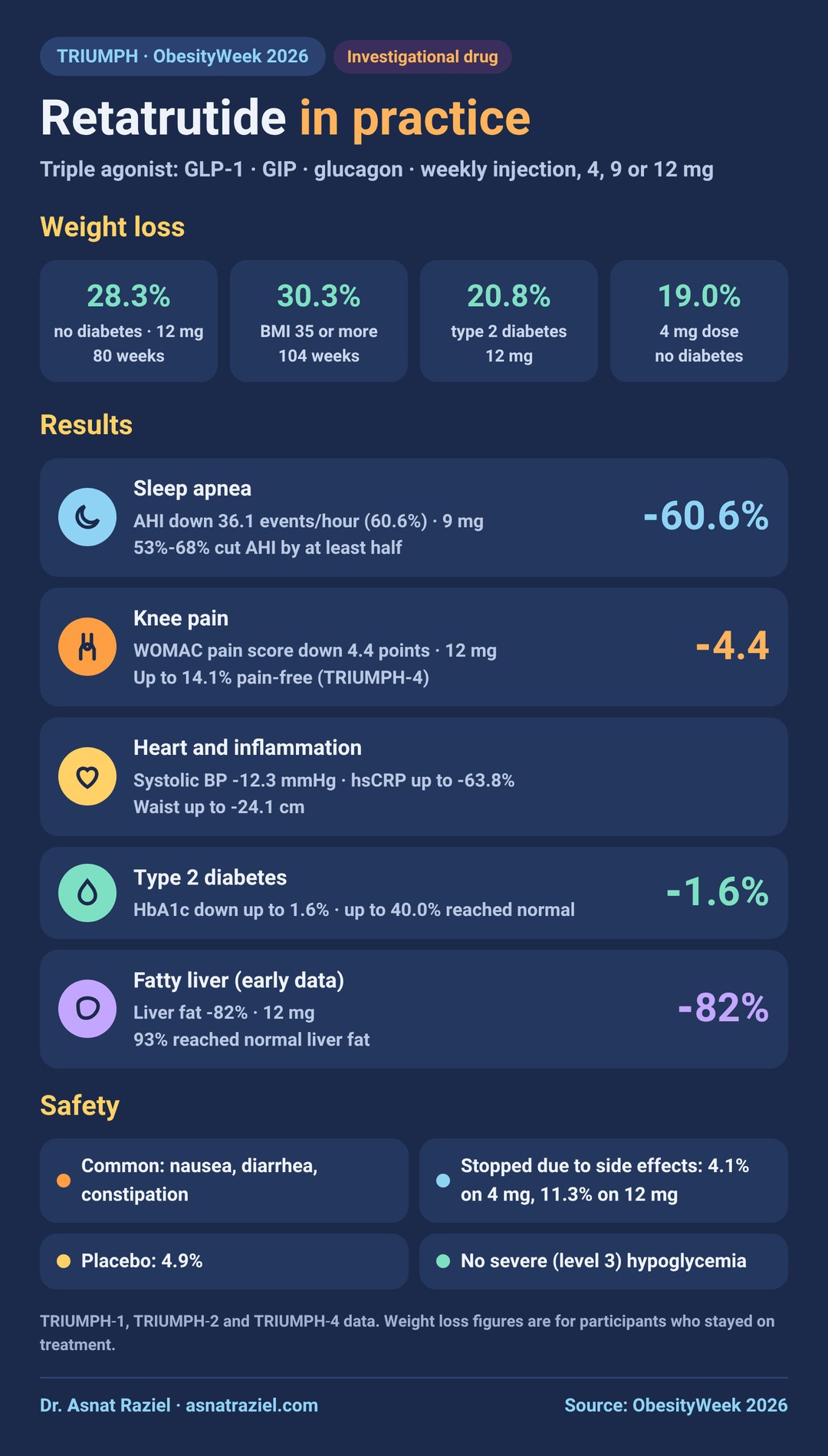
Dr. Jaime Almandoz opened with the weight data. TRIUMPH-1 enrolled adults with obesity or overweight without diabetes. After 80 weeks, weight fell by 19.0%, 25.9% and 28.3% on the 4, 9 and 12 mg doses. In contrast, the placebo group lost only 2.2%. On 12 mg, participants lost about 31.9 kg on average, and 65.3% reached a BMI under 30. In the extension, participants with a BMI of 35 or more reached a 30.3% loss at 104 weeks.
At the same time, risk factors improved. Waist circumference shrank by up to 24.1 cm, and systolic blood pressure fell by 12.3 mmHg. The inflammation marker hsCRP, a blood test that reflects chronic inflammation, fell by up to 63.8%. LDL cholesterol also dropped by about 20% on the higher doses.
TRIUMPH-2 enrolled people with type 2 diabetes. There, weight fell by 12.7%, 19.1% and 20.8%, depending on the dose. In addition, HbA1c, the three-month average of blood sugar, fell by up to 1.6%. Up to 40.0% of participants reached a normal value below 5.7%. This broke the old “glass ceiling” of about 15% weight loss in people with diabetes.
Sleep apnea: new data from TRIUMPH-2
Dr. Jeremy McConnell, a sleep medicine specialist, presented two separate trials in obstructive sleep apnea. Specifically, severity is measured by the AHI. It counts breathing pauses and shallow-breathing episodes per hour of sleep. A value of 5 to 15 is mild, and over 30 is severe. At baseline, the average was 58.6 in TRIUMPH-1 and 55.9 in TRIUMPH-2. In other words, most participants had severe sleep apnea.
Overall, the results stood out. In TRIUMPH-1, the 9 mg dose lowered AHI by 36.1 events per hour, a 60.6% drop. In TRIUMPH-2, among people with diabetes, the drop was about 20 to 29 events per hour. On placebo, it was about 10. What’s more, the improvement was already visible at the week-24 check.
- 53% to 68% of TRIUMPH-1 participants cut their AHI by at least half.
- 14% to 26%, depending on the dose, reached a normal AHI below 5.
- According to the speaker’s summary, about 42% to 45% reached remission.
- Sleep and quality-of-life questionnaires (PROMIS) improved at every dose, compared with placebo.
This is a real advance. Until now, sleep apnea treatment relied mainly on a CPAP machine. I reviewed the sleep apnea trials published in NEJM in my article on retatrutide for sleep apnea. I have also written about the dangers of sleep apnea and about medication for sleep apnea.
Relief from knee pain
Dr. Beverly Tchang presented the knee osteoarthritis data. For context, average pain at baseline was about 6 out of 10. In TRIUMPH-4, weight fell by 26.4% and 28.7% on the 9 and 12 mg doses after 68 weeks. Accordingly, the WOMAC pain score fell by 4.4 points on the higher dose. A 4-point drop is considered a substantial improvement.
What’s more, many participants cut their pain at least in half. On 4 mg, this happened in two out of three. In TRIUMPH-4, up to 14.1% of participants were completely pain-free by the end of the trial. Physical function improved as well. More on this in my article on the drug and knee pain.
Safety and side effects
As with similar drugs, the most common side effects were digestive: nausea, diarrhea and constipation. In TRIUMPH-1, 11.3% stopped treatment on 12 mg because of side effects. By comparison, the rate was 4.1% on 4 mg and 4.9% on placebo. In TRIUMPH-2, discontinuation rates were 3.8%, 11.6% and 7.7%, compared with 4.9% on placebo. The speaker noted there were no severe (level 3) hypoglycemia events. More details in my article on retatrutide side effects.
Retatrutide in clinical practice: from trial to patient
Dr. Deborah Horn closed the session with the question of how to bring retatrutide into clinical practice. She painted a worrying picture of where things stand today. Only 2.3% of people eligible for obesity medications are taking them. In addition, 20% to 50% of patients don’t reach 15% weight loss. And 65% stop treatment within a year. Men are undertreated: 9%, compared with about 15% of women. Finally, in real-world practice about 80% of patients stay on a low dose.
In her view, the 4 mg dose may actually help. It led to about 19% weight loss with just one dose-escalation step. So it may suit people with overweight or class 1 obesity. On the other hand, people with severe obesity need high efficacy. Take patients with a BMI of 35 or more. Their weight loss reached 26% on 9 mg and 28.8% on 12 mg. Almost half of them lost more than 30% on the higher dose. For comparison, Roux-en-Y gastric bypass leads to about 32% weight loss.
Horn also showed early data on fatty liver. In TRIUMPH-1, liver fat fell by 82% on 12 mg. Also, 93% of participants reached normal liver fat below 5%. This is only a first look, but a very encouraging one. I wrote separately about treating fatty liver through weight loss.
What doctors should check
In addition, Horn gave several practical tips. First, monitor blood pressure and reduce blood pressure medications as readings fall. After all, dizziness can raise the risk of falls. Second, in people with diabetes, review insulin and sulfonylurea doses. She herself sometimes halves insulin in well-controlled patients and asks them to check their blood sugar. Finally, she stressed close coordination with the family doctor and other specialists.
Retatrutide in clinical practice: what it means for you
For now, the drug is not yet available, but the data point in a clear direction. Large weight loss improves sleep, knees, liver and heart. So it’s worth checking today whether you snore or wake up tired, and getting a sleep study. In addition, existing medications, alongside nutrition, movement and good sleep, already allow meaningful improvement. Work with your doctor to choose the treatment and dose that fit you, and stick with it.
Bottom line on retatrutide in clinical practice
Retatrutide in clinical practice could fundamentally change obesity care. In the TRIUMPH program, the drug lowered weight by up to about 28%. It also reduced sleep apnea and eased knee pain. However, it is still investigational, and long-term follow-up is needed to see whether the results last. Meanwhile, existing treatments can already help many people.
This article provides general information and does not replace personal medical advice.
Sources
The trials are funded by Eli Lilly and Company.