By Dr. Asnat Raziel, bariatric surgeon specializing in obesity treatment, metabolic health and healthy longevity; Director of the Multidisciplinary Center for Obesity Treatment, Assia Medical, Assuta Ramat HaChayal, Tel Aviv
GLP-1 and anxiety: a new picture from Sweden
Most of the conversation about these drugs and mental health focuses on depression. However, a large national study from Sweden also has a less familiar side: anxiety and addiction. In this article, I focus on GLP-1 and anxiety, and on what the data show about substance use. I reviewed the depression findings separately, in my article on GLP-1 drugs and depression, which focuses on mood and self-harm.
The link between GLP-1 drugs and mental health is becoming clearer, and this study offers a new and intriguing picture. Beyond weight loss and blood sugar control, these medications may reduce the worsening of depression, anxiety and even self-harm. Moreover, the study looked at people who already live with depression or anxiety, which makes it especially important.
Anxiety, depression and metabolism: a two-way link
Obesity and diabetes are systemic diseases. They affect many organs in the body, including the brain. People with diabetes have high rates of depression, anxiety and even suicidality. The link works in both directions. On one hand, the metabolic disorder affects mood. On the other hand, depression and anxiety harm metabolic control and health habits. I discussed this connection in more detail in my article on obesity and depression.
In recent years, GLP-1 drugs such as semaglutide and liraglutide have come into wide use. They mimic the body’s natural satiety hormone. As a result, they reduce hunger, increase fullness and improve blood sugar control. That said, a growing body of evidence points to a much broader effect, including on the brain.
GLP-1 and anxiety: what the Swedish study examined
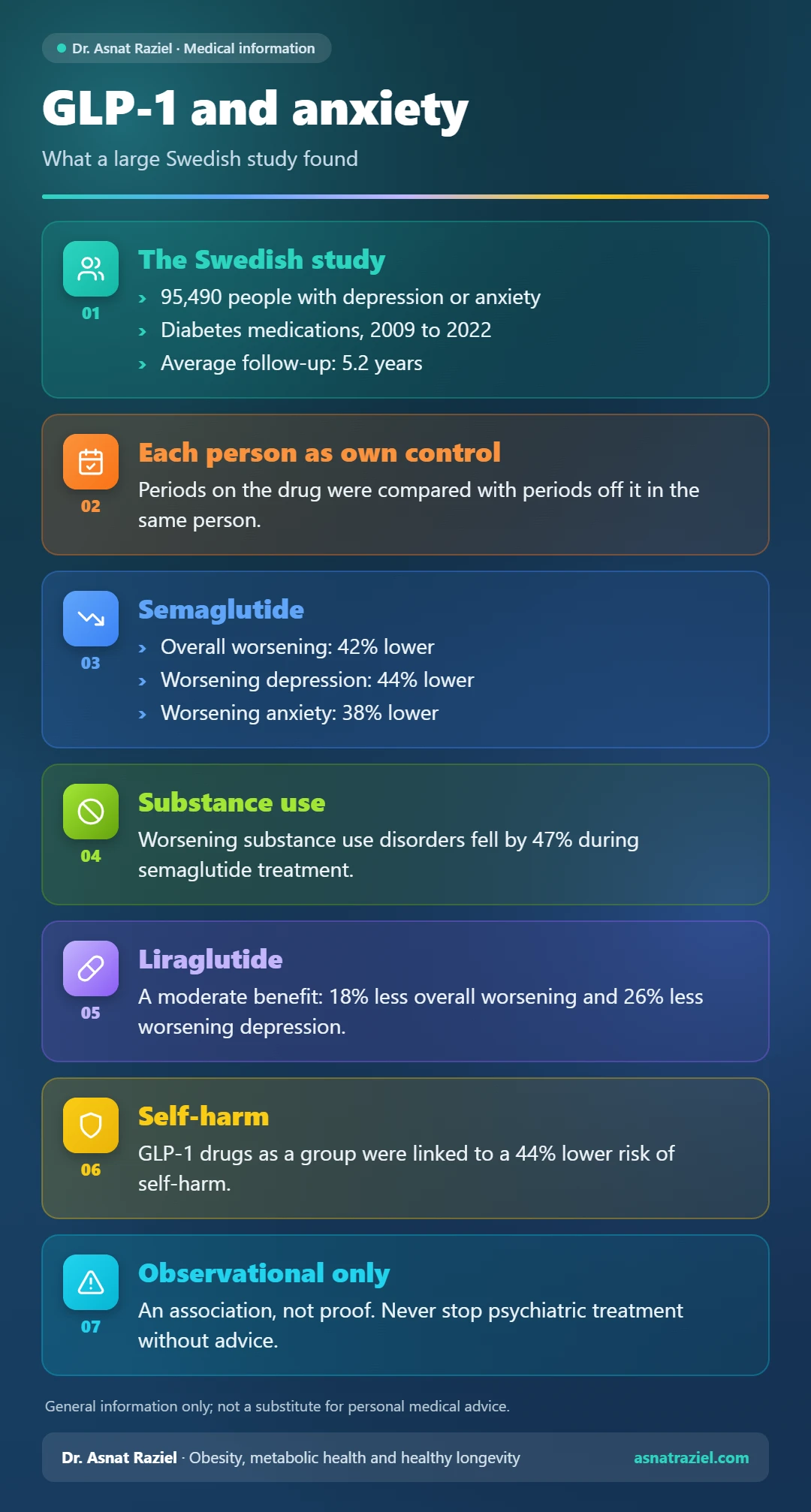
The study was published in The Lancet Psychiatry in April 2026. The researchers used Sweden’s national health registers. They included 95,490 people diagnosed with depression or anxiety who took diabetes medications between 2009 and 2022. The average age was 50.6, and about 60% were women. During follow-up, 22,480 participants, or about 23.5%, received GLP-1 drugs. The average follow-up was 5.2 years.
What makes the study unique is its method. Each participant served as their own control. In other words, the researchers compared periods when the same person took the drug with periods when they did not. This way, they reduced the effect of differences between people. In addition, they compared GLP-1 drugs directly with other diabetes medications.
The researchers defined worsening mental illness as one of four events: psychiatric hospitalization, sick leave of more than 14 days for a mental health reason, hospitalization for self-harm, or death by suicide. These are real-world events, not just self-reports.
The main result: less worsening of anxiety and depression
Semaglutide stood out. During treatment periods, the risk of worsening mental illness was 42% lower. In addition, the risk of worsening depression fell by 44%, and the risk of worsening anxiety by 38%. The risk of worsening substance use disorders also fell, by 47%.
Liraglutide showed a moderate benefit: an 18% reduction in overall worsening and 26% in worsening depression. In contrast, exenatide and dulaglutide showed no effect. The researchers noted that few people used them, so statistical power was limited. Finally, GLP-1 drugs as a group were linked to a 44% lower risk of self-harm. According to the University of Eastern Finland’s announcement, the researchers do not yet know why or how these drugs affect mood.
GLP-1 and anxiety: what the numbers say about anxiety and addiction
When you look at the link between GLP-1 and anxiety on its own, the data are especially interesting. During semaglutide treatment, the risk of worsening anxiety was 38% lower. Keep in mind that this figure applies to people who already live with anxiety or depression, not to the general population. In addition, the risk of worsening substance use disorders fell by 47%. This finding fits one of the proposed mechanisms, because these drugs act on the brain’s reward centers and addiction circuits. However, this is an observational study. Therefore, we cannot conclude that the drug treats anxiety, and it should not replace anxiety treatment.
How might it work? Possible mechanisms
The effect probably does not come from weight loss alone. These drugs act directly on the satiety and reward centers in the brain. They change dopamine activity and addiction circuits. They also reduce systemic inflammation. In some patients, they improve sleep and energy as well. At the same time, weight loss improves self-image and daily functioning. Together, these mechanisms create a broad effect on both body and mind. You can read about the link with emotional eating in my article on GLP-1 drugs and binge eating.
What about the fear of suicidality?
In the past, concerns were raised that these drugs might worsen depression or increase the risk of suicidality. However, regulators’ reviews did not support this concern. As early as April 2024, the European Medicines Agency’s safety committee concluded that the evidence does not support a causal link. In January 2026, the FDA asked to remove the warning about suicidal thoughts from the labels of Wegovy, Saxenda and Zepbound. The decision was based on an analysis of 91 trials with 107,910 participants. This analysis showed no increased risk of suicidality, anxiety or depression. You can find more details in my article on the FDA’s removal of the suicidality warning.
Still, the Swedish study is observational. Therefore, it shows an association and does not prove cause and effect. Controlled trials are needed to confirm the findings. In addition, every person responds differently. That is why it is important to keep up mental health monitoring during weight loss injections, especially for people living with depression or anxiety.
Many people on these drugs also take psychiatric medication. On Camoni, I wrote about psychiatric drugs, weight gain and GLP-1 treatment (in Hebrew). There I explain why the prescribing doctor and the psychiatrist should work closely together.
GLP-1 and anxiety: what it means in the clinic
These findings change the treatment approach. A single treatment may work on body and mind at the same time. It can improve metabolic markers alongside emotional stability. This matters most for patients with obesity or diabetes who also live with depression or anxiety. The right treatment plan can improve weight and blood sugar, as well as quality of life and mental functioning. However, these drugs do not replace mental health care, and you should never stop psychiatric treatment without medical advice.
Looking ahead
This study on GLP-1 and anxiety opens a new direction in medicine. It connects metabolism with mental health and shifts the focus from one organ to the whole body. The next step is randomized controlled trials. First, they will test whether the link is causal. In addition, they will identify which patients benefit most. Finally, they will deepen our understanding of the biological mechanisms.
The bottom line on GLP-1 and anxiety
GLP-1 drugs are changing the world of obesity treatment. They may also be changing how we understand the connection between body and mind. They treat obesity as a systemic disease rather than an isolated problem. Accordingly, care should be holistic, personalized and attentive to both body and mind. In Israel, anyone experiencing emotional distress can call ERAN, the national emotional first aid hotline, at any hour on 1201.
The information in this article is general and does not replace personal medical advice.
Questions and answers
Do GLP-1 drugs improve depression and anxiety?
The Swedish study found less worsening of depression and anxiety during treatment periods, especially with semaglutide. However, this is an observational study, so there is no proof of cause and effect yet.
Is there a mental health risk with treatment?
Analyses by the FDA and the European Medicines Agency did not show an increased risk of suicidality. There may even be a protective effect. Still, any change in mood is a reason to talk to your doctor.
Are all the drugs the same?
No. In the study, semaglutide showed the strongest link, liraglutide a moderate link, and two other drugs showed no effect.
Who is this relevant for?
Mainly for patients with obesity or diabetes who also live with depression or anxiety. It is best to make treatment decisions together with your doctor.
References
Semaglutide & liraglutide lower risk of worsening mental illness
Meeting highlights from the Pharmacovigilance Risk Assessment Committee (PRAC) 8-11 April 2024
The Swedish study was funded by the Sigrid Jusélius Foundation, the Jane and Aatos Erkko Foundation and the Finnish Ministry of Social Affairs and Health.