By Dr. Asnat Raziel, bariatric surgeon specializing in obesity treatment, metabolic health and healthy longevity; Director of the Multidisciplinary Center for Obesity Treatment, Assia Medical, Assuta Ramat HaChayal, Tel Aviv
Diet after 65: what the new study found
Is it too late to change your diet after 65? A new study from the University of Sydney suggests it is not. The researchers studied people aged 65 to 75 and changed the protein source and the ratio of fat to carbohydrates in their menu. After just four weeks, biological markers associated with aging fell. In this article, I focus on what the findings mean for older adults, and how to apply them safely. For a broader look at eating patterns that slow aging, see my article on ten healthy eating patterns that slow biological aging.
Even so, the researchers stress that it is too early to say the change extends life. This is a preliminary but encouraging indication. It suggests that a dietary change is worthwhile even in older age. The study was published in May 2026 in the journal Aging Cell.
What is “biological age”?
Chronological age is the number of years since we were born. Biological age, by contrast, tries to reflect the actual state of the body. Two people of the same age can differ greatly in their biological age. The difference depends on lifestyle and health status.
In this study, the researchers calculated biological age from twenty blood markers. They included cholesterol, insulin and C-reactive protein (CRP), a common marker of inflammation. I wrote about other ways to estimate this measure in my article on biological age versus the age on your ID card.
The KDM method: turning blood tests into an age
The researchers used a method called the Klemera-Doubal Method, or KDM. It is a formula that combines many markers into a single biological age score. They then calculated the difference between this age and chronological age. A positive difference suggests faster aging, while a negative difference suggests slower aging.
The method is not new. For example, a 2012 study of 9,389 Americans compared five methods of calculating biological age. KDM predicted mortality better than chronological age and better than the other methods.
How the study was conducted
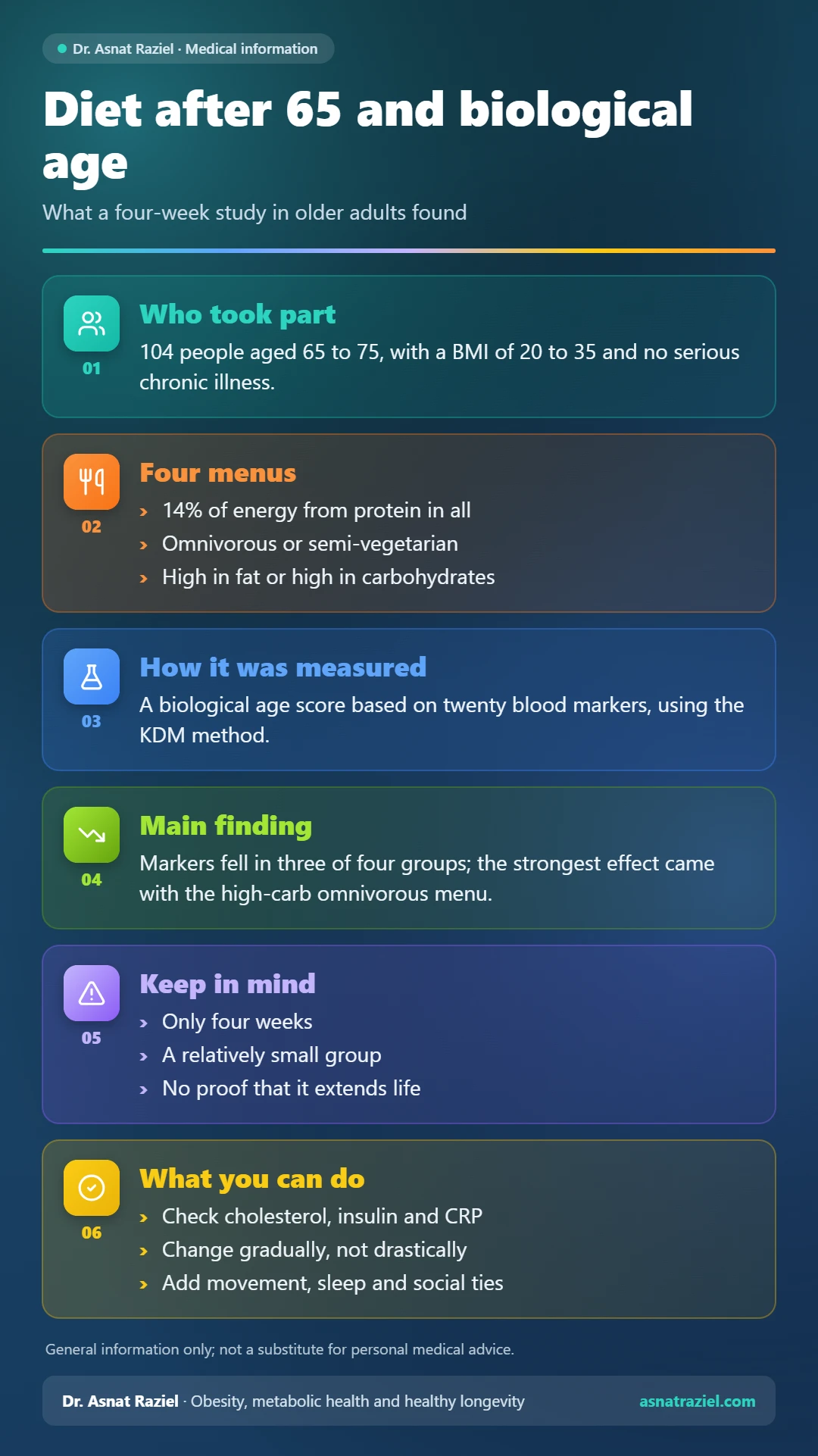
The study is called Nutrition for Healthy Living. The researchers conducted it at the Charles Perkins Centre at the University of Sydney. It included 104 people aged 65 to 75, with a body mass index (BMI) between 20 and 35.
All participants were non-smokers and non-vegetarians. In addition, according to the university’s announcement, none of them had serious underlying conditions such as type 2 diabetes, cancer or kidney disease. Food allergies and sensitivities were also grounds for exclusion.
Omnivorous vs. semi-vegetarian: what’s the difference?
An “omnivorous” diet simply means eating everything. It includes foods from both animals and plants, such as meat, fish, eggs and dairy alongside vegetables, fruit, grains and legumes. This is how most people eat. The word comes from Latin: omni (all) and vorare (to eat).
A “semi-vegetarian” diet, by contrast, cuts back on animal foods but does not eliminate them entirely. In the study, half of the protein in the omnivorous menu came from animal sources and half from plants. In the semi-vegetarian menu, 70% of the protein came from plants.
Four menus, the same amount of protein
The researchers randomly assigned the participants to one of four menus. In all of them, 14% of energy came from protein. I discussed the debate over how much protein is right for longevity in another article.
- A high-fat omnivorous diet (OHF).
- The same omnivorous diet, but high in carbohydrates (OHC).
- A high-fat semi-vegetarian diet (VHF).
- The same semi-vegetarian diet, but high in carbohydrates (VHC).
The researchers measured the twenty markers at the start of the study and again after four weeks. Based on these markers, they calculated the biological age score.
Diet after 65: what the researchers found
In three of the four groups, the biological age markers fell compared with the high-fat omnivorous group. The strongest finding appeared in the high-carbohydrate omnivorous group. Its menu included 14% protein, 28% to 29% fat and 53% carbohydrates.
The semi-vegetarian groups also showed a similar decrease. However, according to the scientific paper, not all of their results reached statistical significance.
In the high-fat omnivorous group, on the other hand, there was no significant change. This menu probably resembled what the participants were already eating before the study.
What the researchers say
Dr. Caitlin Andrews led the study. In her view, it is too early to say for certain that specific dietary changes will extend your life. Still, she says, the study offers a first indication of a possible benefit from changing your diet in older age.
Associate Professor Alistair Senior supervised the study. He added that much longer dietary changes are needed. Only then can researchers test whether they change the risk of age-related diseases.
Keep in mind: these are preliminary findings
The study was short, only four weeks. In addition, it included a relatively small number of participants. It also focused on relatively healthy people aged 65 to 75.
So we do not yet know whether the improvement lasts over time. Nor do we know whether it actually lowers the risk of disease. Moreover, it is unclear whether it applies to younger people or to other populations.
The researchers themselves warn against over-interpretation. In their view, the change may reflect a quick response of the body to the diet, rather than a change in the course of aging. As noted in ScienceDaily, a lower calculated biological age does not mean that the aging process has been permanently reversed. A review of epigenetic clocks also shows how important it is to choose the right measure. I wrote about the differences between the clocks in my article on aging clocks.
Another short trial points in a similar direction. As Camoni reported (in Hebrew), 48 healthy adults were randomly assigned to a vegan diet or a meat-rich diet for one month, with calories kept equal. Two epigenetic clocks showed slower aging in the vegan group. However, that trial was also small and short, and it measured blood markers only.
Why diet after 65 deserves its own attention
This study is especially relevant for people over 65, because that is exactly the group it tested. The participants were 65 to 75 years old, with a BMI between 20 and 35, and without serious conditions such as type 2 diabetes, cancer or kidney disease. In this group, a change of only four weeks was enough to lower a biological age score based on twenty blood markers. At the same time, older age is exactly when a dietary change should be planned with care. That is why I recommend a gradual change and coordination with your medical team, especially if you have underlying conditions.
Diet and biological age in everyday life
This study joins a growing body of evidence suggesting that the composition of the diet, not just the amount, may affect markers of aging. If you want to plan your diet after 65 today, I recommend reading my guide to longevity nutrition and supplements. It is also worth knowing the everyday habits that speed up aging.
Any significant change to your diet after 65 should be coordinated with your medical team. This is especially important for people with underlying conditions.
Diet after 65: what you can do now
The study did not test a single recommendation for everyone. Still, it reinforces a simple principle: the link between the menu and markers of aging persists even after age 65. So it is never too late to take a fresh look at what you eat.
First, it is worth checking basic blood markers at the clinic, such as cholesterol, insulin and CRP. In addition, a gradual, planned change is better than a drastic overhaul. Finally, good nutrition works together with movement, sleep and social connections.
The bottom line on diet after 65
A short change in diet composition improved markers of biological age in older adults after just four weeks. In other words, the link between the menu and markers of aging exists in the short term as well. However, long-term studies are needed to know whether the change extends life or reduces disease.
The information in this article is general and does not replace personal medical advice.
Sources
Short-Term Dietary Intervention Alters Physiological Profiles Relevant to Ageing
Dietary changes in older people can improve ‘biological age’
Scientists reversed biological age in older adults in just 4 weeks
DNA methylation aging clocks: challenges and recommendations
The researchers declared no conflicts of interest.