By Dr. Asnat Raziel, bariatric surgeon specializing in obesity treatment, metabolic health and healthy longevity; Director of the Multidisciplinary Center for Obesity Treatment, Assia Medical, Assuta Ramat HaChayal, Tel Aviv
How to get a prescription for weight loss injections: a practical checklist
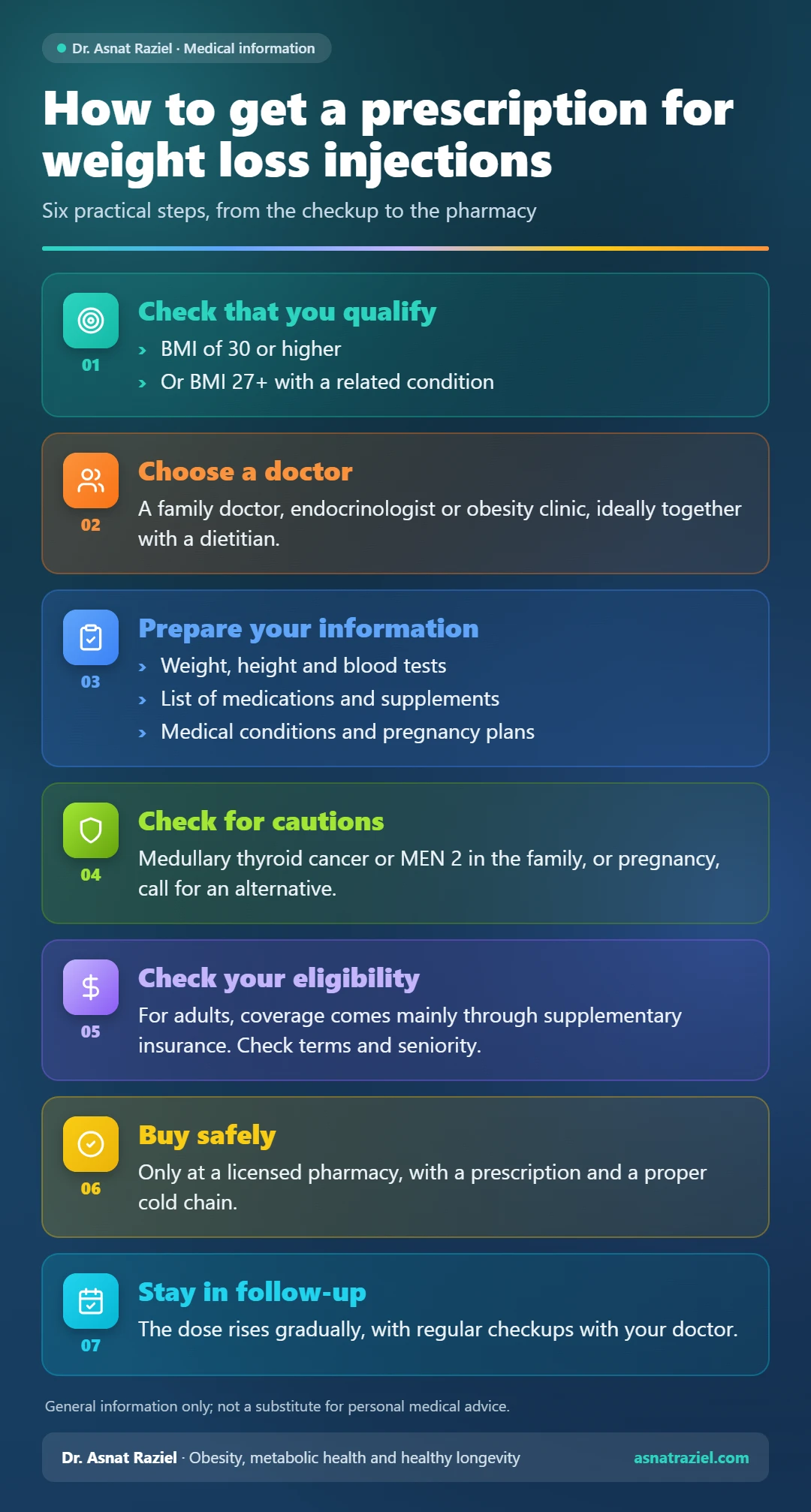
How do you get a prescription for weight loss injections without getting lost between the doctor, the health fund and the pharmacy? Patients ask me this almost every day. The short answer: you need a medical assessment, a prescription from a doctor and an eligibility check with your health fund (HMO). In this article, I have laid out the path as a clear list of steps, so you can arrive at your appointment prepared.
If you are looking for a broader explanation of the drugs themselves, read my guide to starting weight loss medication. Here, we will focus on the practical side: what gets checked, what to bring and what to ask.
Step 1: Check whether you meet the criteria
The basic criterion is body mass index, or BMI (your weight divided by your height squared). According to the U.S. National Institute of Diabetes and Digestive and Kidney Diseases (NIDDK), candidates for treatment are adults with a BMI of 30 or higher. Alternatively, a BMI of 27 or higher also qualifies when there is a weight-related condition. Examples include high blood pressure, type 2 diabetes or high blood lipids.
These are also the criteria behind the official approvals. For example, the FDA approval of Zepbound for chronic weight management (Zepbound is a brand name of tirzepatide) was granted in November 2023 using the same thresholds. You can work out your number with a BMI calculator before your appointment.
Step 2: Choose the right doctor for your prescription
A family doctor, an endocrinologist or a doctor at a dedicated obesity clinic can write the prescription. However, the decision is about much more than signing a prescription, so it is important to choose well. A doctor who knows the field will pick the right drug, plan a gradual dose increase and monitor side effects. In addition, it is a good idea to bring in a dietitian, because nutrition during treatment affects both success and muscle preservation. I compare the options in my article on who prescribes these injections in Israel.
Keep in mind that health funds sometimes have special rules. At Maccabi, for example, the supplementary insurance plan requires a referral from your treating doctor at the fund. So find out ahead of time who needs to write the prescription for you to get the subsidy.
Step 3: Prepare your medical information for the appointment
A good appointment starts with good preparation. So bring the following details with you:
- Your current weight and height, and your weight history over the past few years.
- Recent blood tests, including glucose, HbA1c (your average blood sugar over the past three months), lipids, and liver and kidney function.
- A complete list of the medications, vitamins and supplements you take.
- Medical conditions, past surgeries and previous attempts to lose weight.
- Plans for pregnancy in the coming year, or breastfeeding.
Also, tell your doctor about any family history of disease. You can find more about what to expect in my article on what a medical weight loss consultation includes.
Step 4: Check for conditions that call for caution
In some situations, the injections are not suitable. First, a personal or family history of medullary thyroid cancer, or of MEN 2 syndrome (an inherited tendency to tumors in hormone-producing glands). Second, pregnancy or planning a pregnancy, because the drugs may harm the fetus. In these cases, your doctor will suggest an alternative.
Other conditions do not rule out treatment, but they do require an in-depth conversation. Examples include past pancreatitis, gallbladder disease, an eating disorder or kidney disease. I have written in detail about one of these in my article on weight loss drugs and pancreatitis. The more detail you share, the safer the decision will be.
Step 5: Get a prescription for weight loss injections with health fund coverage
Once you have a prescription, the question of price comes up. In Israel, coverage varies by health fund, age and drug. For adults, coverage comes mainly through supplementary insurance, not through the national health basket. For example, according to Maccabi’s eligibility page, members of Maccabi Zahav (Gold) and Maccabi Sheli get a subsidy for Wegovy and Mounjaro based on the BMI thresholds I described. However, the benefit is available only after three months of membership in the supplementary plan.
Maccabi usually grants approval automatically when the doctor writes the prescription. If the request is turned down, the doctor can file an appeal, which takes up to 7 working days to process. The co-payment for Wegovy is 51% of the drug’s price, and for Mounjaro it ranges from 442 to 927 shekels, depending on the dose. Likewise, Clalit, Leumit and Meuhedet now offer Wegovy and Mounjaro through their supplementary plans at a discount of about 50%. The health funds publish current prices on their websites.
For teens, the rules are different. At Maccabi, Wegovy is included in the basket for ages 12 to 17, with a BMI of 30 or higher and a weight of at least 60 kg, on the recommendation of an endocrinologist or an obesity clinic doctor. Because the rules are updated, always check your personal eligibility. I have also written about the financial side in my article on insurance coverage for obesity drugs, and about the approval process in my guide to obesity medication approval.
Step 6: Fill your prescription safely
Buy the drug only at a licensed pharmacy, with a valid prescription. The FDA warns about unapproved GLP-1 drugs sold online. Following its guidance, do not use an injection pen that arrived warm or without refrigeration. Likewise, stay away from products labeled “for research purposes” and from prices that look too good to be true.
By the way, keeping your paperwork organized saves time. Keep the prescription, the health fund’s approval and your test results in one folder, and set a reminder to renew the prescription before the pen runs out.
What to expect once treatment begins
Treatment starts at a low dose and goes up gradually every four weeks. That way, your body adapts, and digestive side effects are much milder. The large trials showed substantial results. In the STEP 1 trial, semaglutide-based weight loss injections led to an average weight loss of 14.9% over 68 weeks, compared with 2.4% in the placebo group. Similarly, in the SURMOUNT-1 trial, tirzepatide at 15 mg led to a 20.9% weight loss over 72 weeks.
Beyond weight, there is also heart protection. In March 2024, the FDA approved Wegovy to reduce the risk of heart attack and stroke in adults with heart disease and obesity or overweight. In the SELECT trial, which included more than 17,600 participants, a major cardiac event occurred in 6.5% of patients on Wegovy, compared with 8% in the placebo group.
How to stay on treatment for the long term
The prescription is only the starting point. Obesity is a chronic disease, so treatment usually lasts a long time. Schedule a checkup after one to three months, and then at regular intervals. At each visit, your doctor reviews your weight, side effects, nutrition and physical activity. At the same time, strength training and protein at every meal help preserve muscle mass.
The bottom line
The road to weight loss injections has six steps: checking the criteria, choosing a doctor, preparing your medical information, checking for special conditions, confirming eligibility with your health fund and buying safely. A patient who arrives prepared saves time, money and frustration. In the end, the success of treatment depends on close medical follow-up and a change in habits, not just on a prescription for weight loss injections.
This article is general information and is not a substitute for personal medical advice.
Questions and answers
Can my family doctor write a prescription for weight loss injections?
Yes, a family doctor may write the prescription. However, to get a supplementary insurance subsidy, there are sometimes rules about which doctor writes it. So check with your health fund in advance.
Is a BMI of 28 enough to get a prescription for weight loss injections?
Only if you also have a weight-related condition, such as high blood pressure, prediabetes or fatty liver. Without such a condition, the threshold is a BMI of 30.
Are weight loss injections covered by the health basket?
For adults, coverage comes mainly through supplementary insurance. For teens, there is basket coverage under defined conditions.
Can I buy weight loss injections online?
It is not recommended. Buy only at a licensed pharmacy and with a prescription, to avoid counterfeit drugs or a drug that was not kept refrigerated.
Sources
Prescription Medications to Treat Overweight & Obesity
FDA Approves New Medication for Chronic Weight Management
Once-Weekly Semaglutide in Adults with Overweight or Obesity
Tirzepatide Once Weekly for the Treatment of Obesity
FDA’s Concerns with Unapproved GLP-1 Drugs Used for Weight Loss
Additional sources (in Hebrew): Maccabi Healthcare Services eligibility page for obesity and diabetes injections; a Maariv report on Mounjaro coverage at Clalit.