By Dr. Asnat Raziel, bariatric surgeon specializing in obesity treatment, metabolic health and healthy longevity; Director of the Multidisciplinary Center for Obesity Treatment, Assia Medical, Assuta Ramat HaChayal, Tel Aviv
Shaking after trauma: a reflex our body already knows
Shaking after trauma is something many people know from personal experience. After an accident, surgery, a bad argument or a difficult birth, the body suddenly starts to tremble. Usually we get scared, feel embarrassed and try to make it stop. But what if this shaking is exactly what the body needs?
That question was at the heart of Nkem Ndefo’s session at the Nervous System Reboot summit. Ndefo is a nurse and certified nurse-midwife, the founder of Lumos Transforms and the creator of The Resilience Toolkit. In the session, she explained the reflex and even guided participants to experience it for themselves.
Some therapists are also exploring medication-supported approaches, such as ketamine-assisted psychotherapy.
Survival responses are not a disease
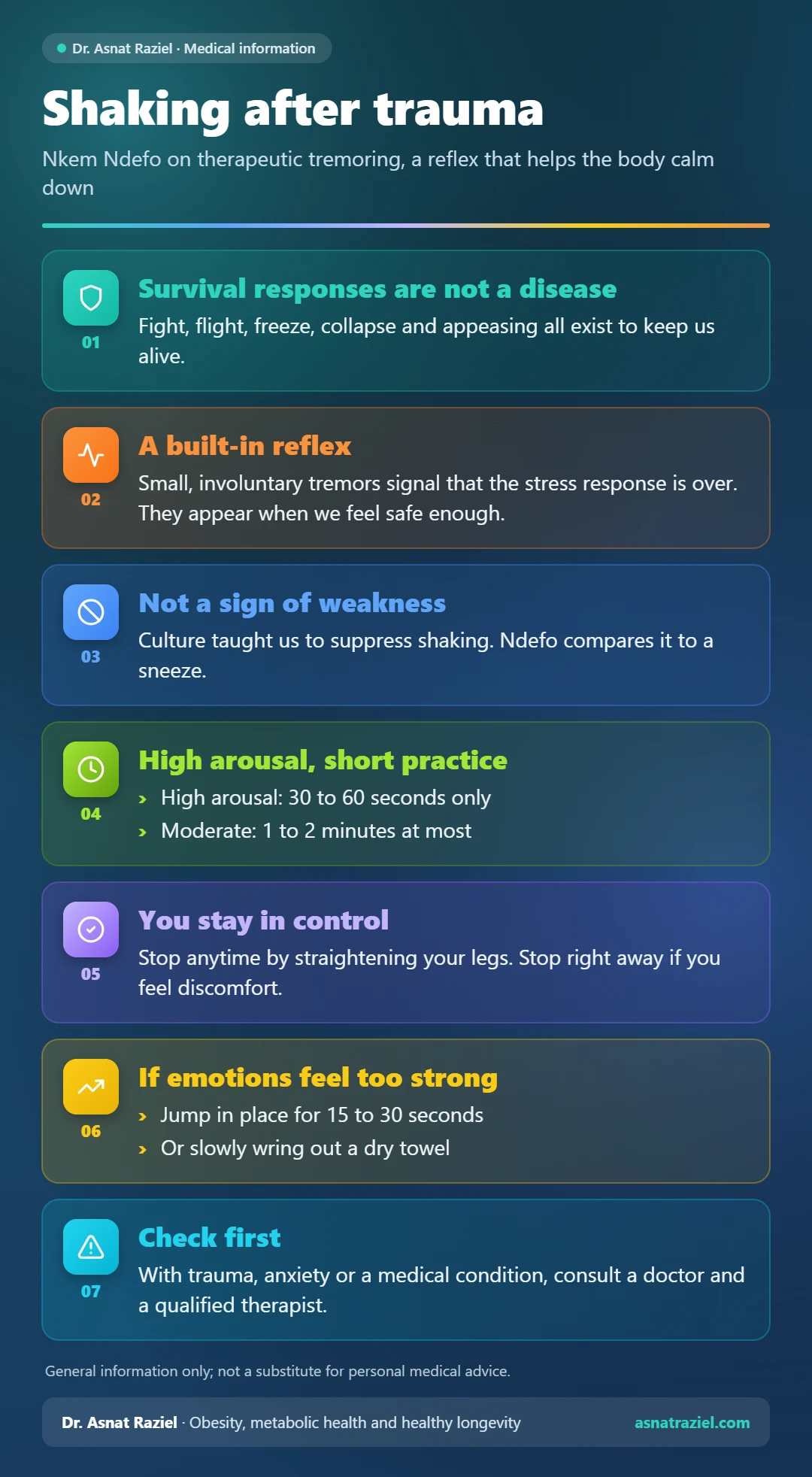
Ndefo opens with an important message. In her view, our survival responses are not pathology. Fight, flight, freeze, collapse and appeasing are natural mammalian responses. All of them exist to keep us alive.
The problem starts when we cannot get out of one of them. For example, the event ended long ago, but the body is still frozen. Alternatively, a small reminder of an old event instantly throws us back into the same response. In other words, the response itself is not wrong. Its timing simply no longer fits the present.
This is not a rare problem. In Israel, for example, a Ynetnews report on trauma care after October 7 cited estimates that up to 3 million of the country’s 10 million citizens could be affected by PTSD.
What is therapeutic tremoring?
According to Ndefo, all mammals have a reflex of small, involuntary vibration. She calls it therapeutic tremoring. In her view, the reflex signals to the body that the stress response is over. It starts in the brain and spinal cord, and it appears only when we feel safe enough.
The tremor can be very subtle: a hum, a tingle or a sense of flow. Sometimes it is clearly visible. It also tends to travel through the body toward the tensest areas. Ndefo distinguishes it from the shaking of a tired muscle at the gym, which stays local. She also distinguishes it from the tremor of diseases such as Parkinson’s.
Why shaking after trauma looks frightening to us
In her view, Western culture has taught us that shaking is a sign of weakness or illness. So we suppress it from a young age. Ndefo compares this to sneezing: if a whole culture said sneezing was shameful, it would seem strange to us too.
Watch the full session: shaking after trauma, with practice led by Nkem Ndefo
The session is in English and lasts about an hour. It took place at the Nervous System Reboot 2026 summit of the Heart Mind Institute.
The surprising rule: high arousal, short practice
This may be the most important idea in the session. The stronger the stress or trauma, the shorter the practice should be. That is the opposite of what intuition says, right?
Ndefo explains the logic. When the load is very high, we go numb and disconnect from our feelings. As soon as the body starts to feel safe, there is room to feel again. Then everything that has built up can flood us all at once. In her words, too much, too fast is itself a definition of trauma. So in a state of high arousal she recommends only 30 to 60 seconds. In a moderate state, one to two minutes at most.
How to practice: the steps of the exercise
Ndefo starts with gentle warm-up movements. First, slowly move your wrists and fingers. Next, place one hand on the opposite shoulder and slide it down to the wrist, alternating sides. After that, you can circle your pelvis while standing with your feet wide apart.
For the exercise itself, sit in a semi-reclined position with the soles of your feet together and your knees open to the sides. Squeeze your buttock muscles once until they feel slightly tired, then let go. Next, bring your knees a few centimeters closer together, wait for mild fatigue, and close them a little more. When a vibration appears, place your feet flat on the floor and let it flow.
Most important of all, you can stop whenever you want, simply by straightening your legs. If you feel any discomfort, stop right away. And if the practice stirs up emotions that feel too strong, Ndefo suggests jumping in place for about 15 to 30 seconds. Another option is to slowly wring out a dry towel, as if it were wet.
What if the shaking doesn’t come?
Some participants felt nothing. According to Ndefo, this is not a technical failure. The tremor comes only when the body feels safe enough, and that takes time, the right setting and practice.
What participants asked
One participant described a bicycle accident. While she waited for the ambulance, her whole body shook, even though she was not cold. Ndefo confirmed that this was exactly the reflex. In her view, when the body gets to shake all the way through, the event feels closed and is less likely to remain as trauma. She adds that hospitals sometimes give medication to stop shaking after surgery, even though it is part of how the body calms down.
Another participant asked why she had never shaken, despite difficult events and high anxiety. Ndefo answered that the body remembers. In her view, a charge that was never released can show up as anxiety, and recovery comes in small steps over time. She also explained that even during a panic attack, trembling is the body’s attempt to lower arousal.
Shaking after trauma, stress and health
The session made me think about my own patients. Chronic stress harms sleep quality, eating and metabolic balance. In addition, when we are stuck on high alert, we waste a lot of energy. Ndefo, who lives with long COVID herself, says the practice helps her save that kind of energy.
For anyone looking for more tools, I wrote a practical guide to stress relief techniques. I have also written about physical and mental fatigue and about the link between stress and weight.
The bottom line
According to Nkem Ndefo, shaking after trauma is not a sign of weakness. It is an ancient reflex that helps the body close a cycle of stress. The key is to approach it slowly, in small doses and by choice. As she puts it, we are not learning something new; we are remembering what already exists inside us.
This idea connects closely to the window of tolerance, which I explain in another article.
The information in this article is general and does not replace personal medical or therapeutic advice. If you are coping with trauma, anxiety or a medical condition, consult a doctor and a qualified therapist before trying this kind of physical practice.