By Dr. Asnat Raziel, bariatric surgeon specializing in obesity treatment, metabolic health and healthy longevity; Director of the Multidisciplinary Center for Obesity Treatment, Assia Medical, Assuta Ramat HaChayal, Tel Aviv
Trauma healing: slow is fast
Trauma healing often begins, surprisingly, by slowing down. That is the view of Katja Cahoon, a clinical social worker, therapist and meditation teacher. For years, Cahoon led trauma therapy groups, and today she guides therapy sessions in clinical trials of psychedelic substances. As she puts it, we live in a culture of moving on, next in line, fix me fast. But trauma asks for something else.
Cahoon spoke with Angie Height at the Heart Mind Institute’s Nervous System Reboot 2026 summit. Here are the highlights of their conversation, along with what the research says.
Cahoon’s path into the body
About 15 years ago, Cahoon went through a difficult divorce. To cope, she started training in kung fu and kickboxing. She says it was the first time that she, as a woman, had been encouraged to be strong and aggressive. Suddenly she understood, not just in her head but in her body, what her body was capable of.
At the same time, her professional work showed her that therapy that relies on the head alone is not enough. In the trauma groups she led, she brought in physical work: hitting a punching bag and even throwing clay. She describes these physical experiences as very powerful. I describe related creative tools in my article on art therapy.
A heavy backpack
Cahoon compares trauma to a heavy backpack that we carry into every situation in life. It holds memories, beliefs and body reactions. Sometimes it comes from a single event, such as an assault. Sometimes it builds up through “death by a thousand cuts,” as in developmental trauma. And sometimes no event happened at all; instead, something was missing, such as warmth, emotional support or nurturing.
The Silicon Valley engineers she works with relate to a different metaphor. To her, it is like old software running in the background all the time. It overrides anything new. That is why people try mantras and positive affirmations, and then discover that they don’t work.
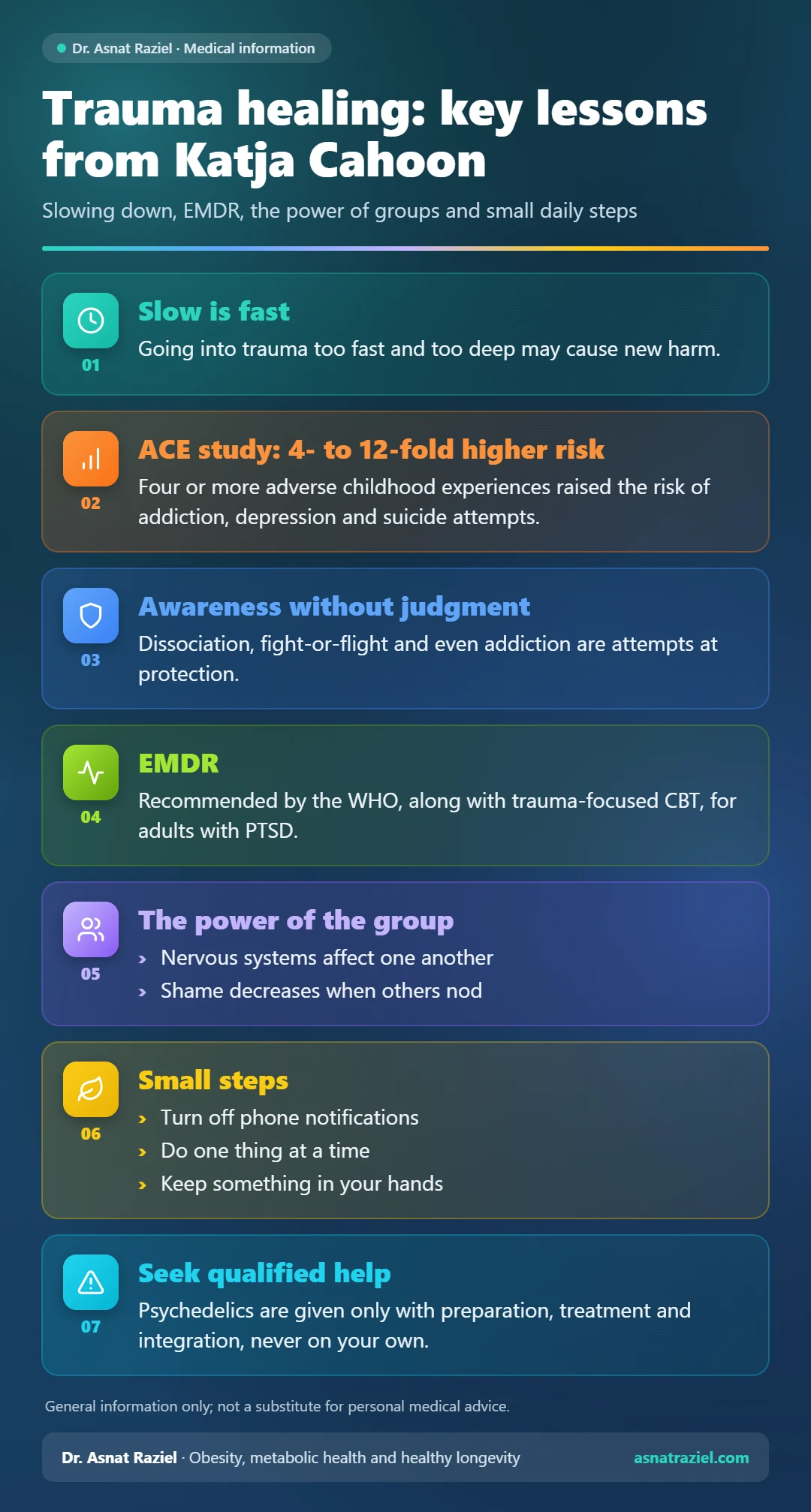
Research shows that this backpack has a physical cost. The classic ACE study found that people who had experienced four or more categories of adverse childhood experiences had a 4- to 12-fold higher risk of alcoholism, drug abuse, depression and suicide attempts.
Trauma healing begins with awareness without judgment
According to Cahoon, the first step is to slow down and notice, without judging. She asks her clients to appreciate their nervous system for protecting them. In her view, dissociation, fight-or-flight and even addiction are all attempts at protection. Your nervous system does not care whether you are happy. It cares that you survive.
She also mentions the special forces saying “slow is smooth, and smooth is fast.” In her experience, someone who goes into trauma too fast and too deep may be hurt again. So in the middle of a session she might ask a client to pause for a moment, notice where they feel it in the body, and see whether they can breathe with it.
What is EMDR?
Cahoon uses EMDR (Eye Movement Desensitization and Reprocessing) in her work. According to this method, a traumatic memory has four components: a belief, a body sensation, an emotion and an image. When something in the present triggers the memory, the reaction is bigger than the situation. For example, you might feel enormous rage at a driver who cut you off.
During treatment, side-to-side eye movements or alternating sounds help reprocess the memory. For instance, the belief “I am not safe” can turn into “I am safe now,” and that can be felt in the body, too. The World Health Organization guidelines on conditions related to stress recommend EMDR and trauma-focused cognitive behavioral therapy for adults with PTSD. For another approach that works with the eyes, see my article on brainspotting therapy.
Mayo Clinic’s overview of PTSD diagnosis and treatment also describes psychotherapies such as exposure therapy and cognitive therapy, as well as medications.
The power of the group
For Cahoon, there is a special magic in healing as a group. First, our nervous systems affect one another. Second, when someone shares and sees others nodding, shame decreases. Finally, when a fellow group member tells you that they see you, it is different from hearing it from a therapist who is paid to be there. In addition, the person who gives support benefits from it too.
And what do you do when the group ends? Cahoon cites Stephen Porges: find another mammal. That could be a person, but it could also be a dog, a cat or a horse. She also recommends a practice that connects you with yourself, such as prayer, meditation, walking in nature or anything else that suits you.
Flow: don’t chase it
Cahoon and her husband go on long cycling trips of hundreds of kilometers. On one trip, during a long climb in Germany in heavy heat, there came a moment when she was only a body. No thoughts, no effort, just breath and movement. She says the experience was so intense that she cried. But every time she tried to recreate it on purpose, it didn’t come.
So, in her view, you can’t chase flow. You can only create the conditions for it, keep showing up, and not cling to it when it arrives.
Small steps for everyday life
Cahoon suggests a few simple steps:
Less noise: Turn off phone notifications, and declutter your surroundings.
One thing at a time: Cook without a podcast in the background, and walk without earbuds.
Instead of scrolling: She herself downloaded a library app, and she reads a book in the waiting room.
Something in your hands: If sitting quietly is hard for you, knitting or a stress ball can be calming.
The zoom exercise: from space back to the body
At the end of the conversation, Cahoon led a short exercise. Close your eyes and notice your breath and your heartbeat. Next, imagine that you are in space, looking down at Earth. Slowly zoom in: to the continent, the country, the region, the building and the room you are sitting in. Listen to the sounds in the room. Finally, come back to your body: feel your feet, the support of the chair and your breath. Notice what has changed.
Watch the full conversation: Katja Cahoon on trauma healing
The conversation is in English and runs about 54 minutes. It was recorded at the Heart Mind Institute’s Nervous System Reboot 2026 summit.
Trauma healing and its link to the body and weight
In my clinic, I meet quite a few patients for whom food has served as protection. That is why our obesity treatment also addresses the mind, with referrals to psychologists as needed. I wrote about this in my article on overcoming emotional eating. I have also written about ketamine treatment combined with psychotherapy and about somatic experiencing.
As for psychedelic substances, Cahoon stresses that they are given within a framework of preparation, treatment and integration. Outside clinical trials, the only one currently permitted in the United States is ketamine. So they should never be used without professional guidance.
The bottom line
Trauma healing is not a race. According to Katja Cahoon, it begins with slowing down, with awareness without judgment and with respect for the nervous system that tried to protect us. It is also helped along by connection with others and by established methods such as EMDR. If you are dealing with trauma, please reach out to a qualified professional.
The information in this article is general and does not replace personal medical or therapeutic advice.