By Dr. Asnat Raziel, bariatric surgeon specializing in obesity treatment, metabolic health and healthy longevity; Director of the Multidisciplinary Center for Obesity Treatment, Assia Medical, Assuta Ramat HaChayal, Tel Aviv
A longevity clinic starts with a medical philosophy
A longevity clinic is a practical expression of an interesting shift in medical thinking. The aim is to get ahead of disease as early as possible and to spot risk factors at an early stage. In addition, it seeks to preserve physical and cognitive abilities. Ultimately, the goal is to extend the years in which we are healthy, independent and functioning well.
The vision sounds simple, but it is hard to carry out over many years. Alongside medical knowledge, you need a follow-up model, the right team, information systems and technology. Above all, you need the ability to turn a lot of data into a personal plan that the patient can actually follow.
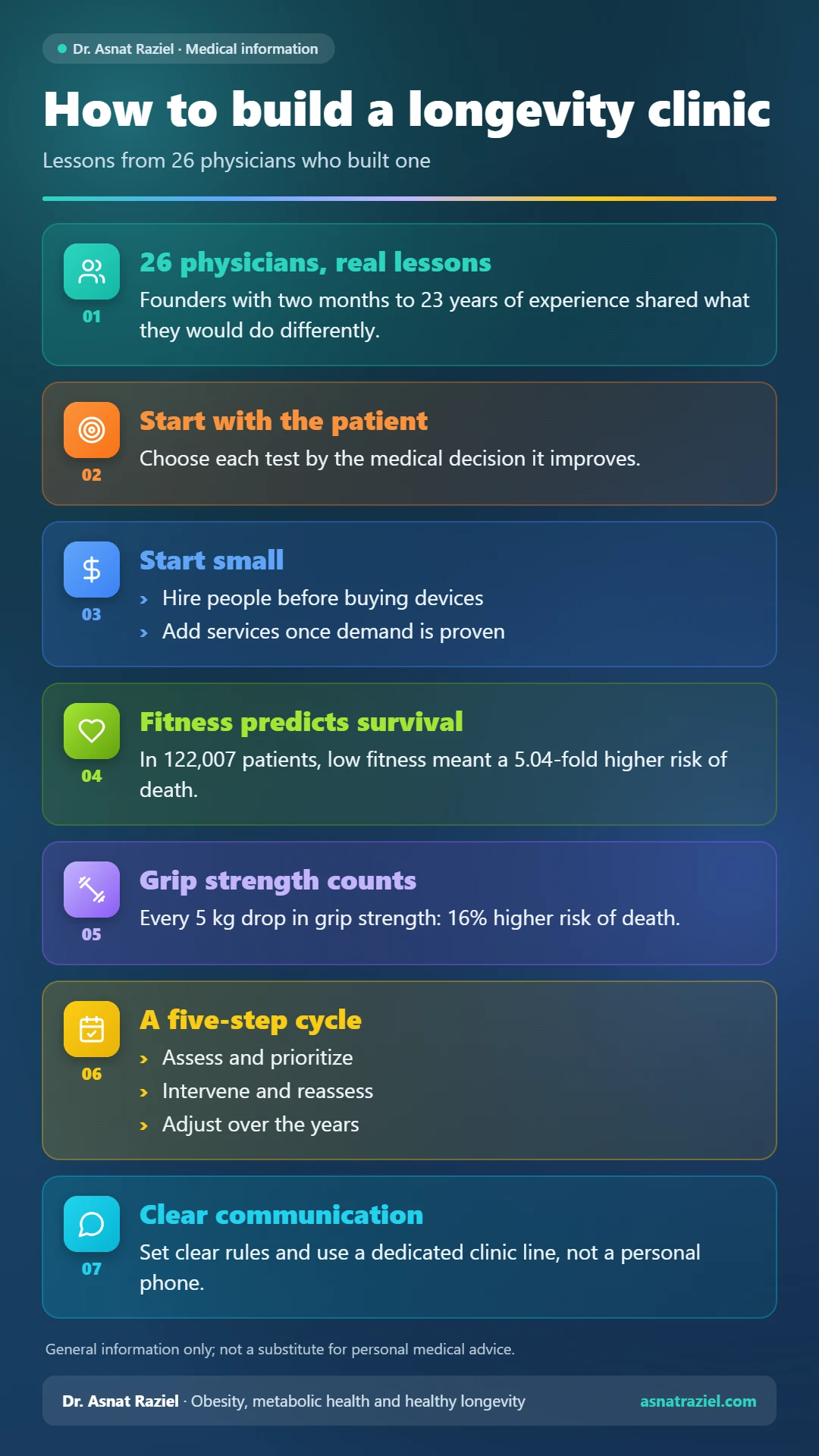
In August 2026, Dr. David Luu, founder of LongevityDocs, published a field report on mistakes to avoid when building a longevity practice. The report draws on answers from 26 physicians from various specialties who have already opened such clinics. Their experience ranged from two months to 23 years. He asked them what they had learned along the way and what they would do differently today. Their answers offer a glimpse of how the field is starting to mature.
In a longevity clinic, the patient defines the technology
The longevity world offers an impressive range of tools. For example, there is DEXA for measuring body composition and bone density, continuous glucose monitoring and ultrasound. There are also genetic tests, smartwatches and smart rings, cardiorespiratory fitness tests and biological age markers.
The key question about any technology is which medical decision it improves. I review the wider landscape in my article on biotech, devices and apps in longevity medicine. When you start from the patient, their risk factors and the clinical questions, it is easy to choose tests that truly add information. This was also one of the insights from the physicians in the report. They advised starting small and hiring people before buying equipment. Only after demand is proven does it make sense to add technologies and services.
Data becomes medicine when it leads to action
Our ability to measure the body has changed dramatically. We can track blood sugar around the clock and measure muscle and belly fat. In addition, we can estimate aerobic fitness, sleep and heart rate, and check many biomarkers. This abundance creates an opportunity, but also a responsibility. The value of a test is not in the number itself. Rather, it lies in understanding what the number says about this specific person and turning it into action.
A patient at a longevity clinic needs a clear picture. What are their main risk factors? Which abilities are worth preserving? What can be improved right now? And how will we know, a few months from now, that the intervention worked?
Some measures have strong evidence behind them. For example, a study of 122,007 patients found that low cardiorespiratory fitness was linked to a 5.04-fold higher risk of death compared with the highest fitness level. Likewise, the PURE study showed that every 5 kg drop in grip strength was linked to a 16% higher risk of death. So DEXA, VO₂max (maximal oxygen uptake) and CGM (continuous glucose monitoring) are excellent tools. But real medicine comes from connecting them to the patient’s medical history, lifestyle and personal goals.
A strong clinical foundation makes growth possible
The longevity field is very broad. It covers metabolic health, nutrition, exercise, sleep and bone health. It also includes heart disease prevention, cognition, hormones and genetics. Precisely because there are so many options, it is wise to start with areas where change is meaningful and measurable. The physicians in the report also warned against building every service at once.
Obesity and metabolic health, blood pressure and blood lipids, muscle and strength, fitness, bone, nutrition and sleep can form a broad foundation. I explained why body composition matters in my article on muscle mass and body composition. Similarly, the European definition of sarcopenia rests on simple measures: muscle strength, muscle quantity and physical performance. Once the clinic knows how to assess, treat and monitor the basics well, it can expand step by step.
Follow-up turns advice into a treatment process
Longevity medicine is especially suited to ongoing care. Say we found a drop in muscle mass, built a strength-training plan and changed the patient’s protein intake. Next, we will want to know whether muscle and strength actually improved. The same principle applies to weight, blood pressure, blood sugar control, blood lipids, fitness and sleep. The report also showed that the payment model shapes follow-up. A membership model supports continuity, while pay-per-visit may encourage patients to skip follow-up visits.
That is why follow-up is part of the treatment itself. You can describe it in five stages:
- Assessment
- Prioritization
- Intervention
- Reassessment
- Adjustment
This cycle repeats over the years, according to age, health status and goals. In this way, medicine shifts from a one-time visit to a long-term relationship.
Prioritizing in a longevity clinic creates real change
Many measurements can also lead to many recommendations. Yet lifestyle change usually succeeds when the patient understands what to focus on right now. This is a central role for the physician: to identify the three or four goals with the biggest impact on the future.
For one person, the goal will be to reduce belly fat and improve metabolic health. For another, the focus should be blood pressure and heart risk. A third patient will benefit most from building muscle and improving fitness. And for someone with chronic sleep deprivation, sleep will take priority. Good longevity medicine therefore also requires the ability to choose.
A multidisciplinary team in a longevity clinic
Longevity medicine combines many fields, so it lends itself to teamwork. The physician assesses risk, connects the data and spots conditions that need further workup. In addition, the physician sets the medical priorities. Alongside them work a dietitian, a nurse, an exercise physiologist and other professionals. The physicians in the report stressed the same principle. They advised delegating and hiring a good team from the start, so the clinic does not depend only on the doctor’s time. The result is comprehensive care, along with smart use of medical time.
Smart information systems will connect the picture
Oddly enough, one of the field’s challenges is the sheer amount of data. Lab tests sit in one system and imaging in another. Activity and sleep data come from a watch, body composition from another device and glucose data from yet another system. According to the report, there is still no electronic medical record that brings the whole longevity world together. So the physicians recommended keeping data in a portable format. I explain why this matters in my article on building a personal health system.
This is where artificial intelligence may help a great deal. AI systems will be able to spot trends, compare measurements over time and present the big picture. I have seen this in obesity care as well, as I described in my article on artificial intelligence in obesity treatment. Even so, medical judgment will stay at the center.
Clear communication strengthens the relationship
One advantage of a longevity clinic is a long-term medical relationship. Patients change habits, have tests and face questions between visits too. For this relationship to work, it is important to set clear rules in advance. Which questions suit a written message? When does follow-up take place? Who on the team answers? And when is an appointment needed? The physicians in the report recommended a dedicated clinic line instead of a personal phone. A framework like this combines availability and a personal touch with an orderly workflow.
The true value of a longevity clinic: changing the trajectory
A patient who comes to a longevity clinic is not looking for just another test. They want to reach the coming decades in good health and good shape. So the big question is which factors could harm them over the next ten or twenty years. And what can be done today to change that trajectory?
This is where preventive medicine and longevity medicine meet. Spotting risks in time, preserving muscle and fitness, and caring for metabolic and heart health all matter. Together with nutrition, sleep and bone health, they build a health reserve. The goal is to turn information into actions that extend life, and above all the years of good health.
A simple model for longevity medicine
You can sum up the whole approach in stages: assessment, prioritization, intervention, follow-up, reassessment and adjustment. First, we assess health and function and prioritize the most important factors. Then we build a personal plan, follow it and measure the results. Finally, we update the plan as needs change. In this way, year after year, a dynamic picture of health takes shape.
Perhaps this is the difference between a package of tests and longevity medicine. Test results are not the end of the process. Instead, they are the starting point for a long-term health plan. For readers who want to go deeper, I have also written about what longevity medicine offers in the clinic today.
The information in this article is general and does not replace personal medical advice.
Questions and answers
Which areas should a longevity assessment include?
The assessment should be personal, based on age, sex, medical history and risk factors. Key areas include metabolic and heart health, body composition, muscle and strength, fitness, bone, sleep, nutrition and physical activity.
What role do advanced technologies play?
Technology adds important information when it answers a defined medical question. It is also useful when it allows you to track an outcome over time. That is why tools are chosen according to the patient’s needs and risks.
What about biological age tests?
This is a fascinating, fast-moving field of research. Experts in the field stress that there is still no agreed standard for these markers. So it is best to interpret them as part of a broad picture, alongside established measures. You can read more in my article on biological age.
What is the central element of longevity medicine?
It is the ability to connect medical information, function and lifestyle. In addition, it means setting priorities, building a personal plan and tracking results over time.
References
Mistakes to Avoid When Building a Longevity Practice
Sarcopenia: revised European consensus on definition and diagnosis
Biomarkers of aging for the identification and evaluation of longevity interventions




