By Dr. Asnat Raziel, bariatric surgeon specializing in obesity treatment, metabolic health and healthy longevity; Director of the Multidisciplinary Center for Obesity Treatment, Assia Medical, Assuta Ramat HaChayal, Tel Aviv
A personal health system instead of a magic product
A personal health system that supports you continuously is the new direction in longevity. In the past, the conversation focused on a particular supplement, an innovative blood test or a one-off treatment. Today, a much broader view is taking shape. To extend our healthy years, we need to connect physical function, technology, personalization and ongoing support.
That is the conclusion of the market research firm Euromonitor International. According to a September 2026 report on NutraIngredients, the company presented the growth drivers of the field at the Vitafoods Asia 2026 conference. Its conclusion fits well with medical research from recent years. That research shows what is truly worth measuring, and what to be careful about.
Longer lives, but not necessarily healthier ones
A Mayo Clinic study in JAMA Network Open analyzed data from the 183 member states of the World Health Organization (WHO). The researchers measured the gap between life expectancy and healthy life expectancy. In other words, they counted the years a person lives with disease.
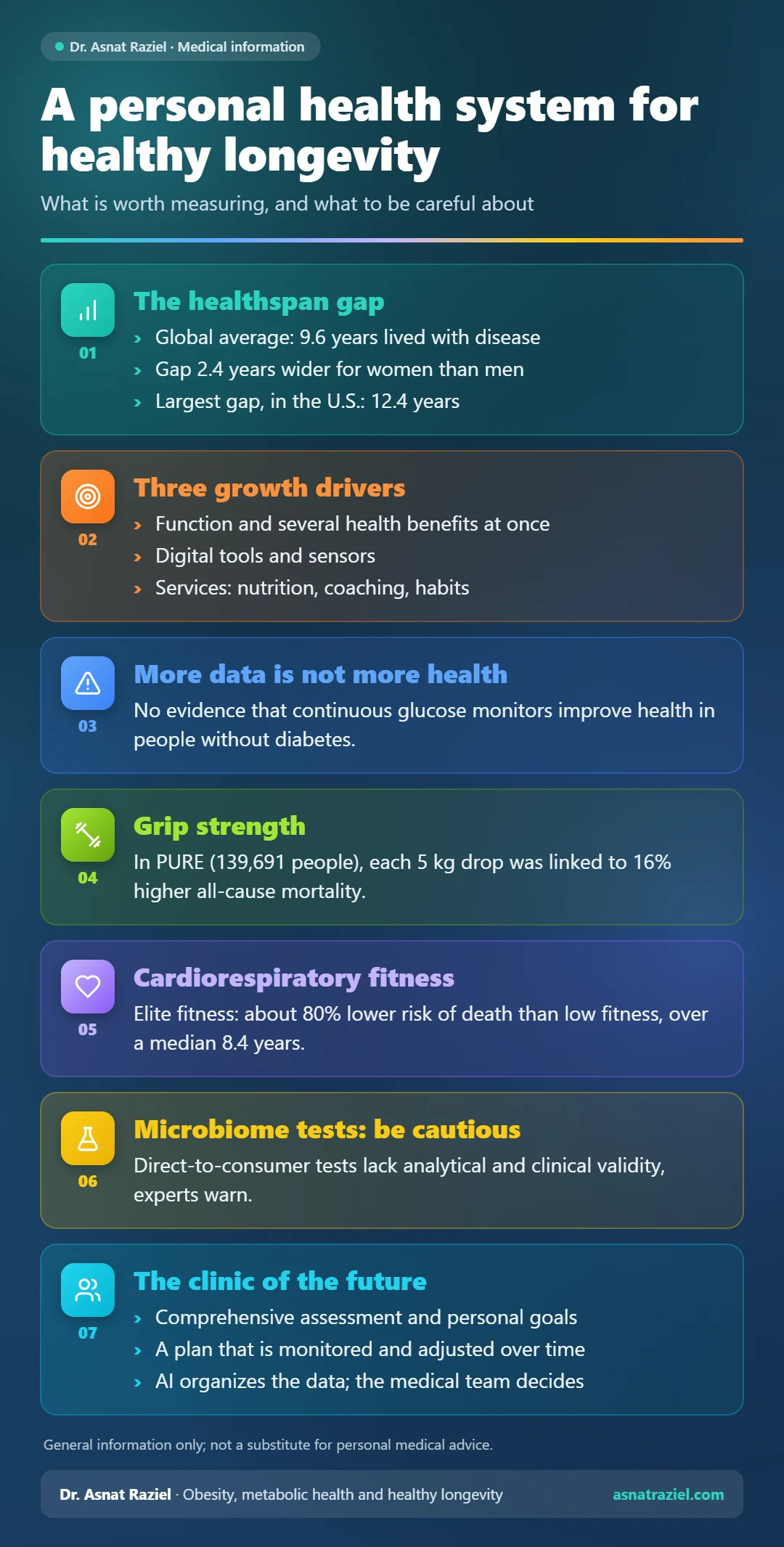
Worldwide, this gap widened over the past two decades and reached an average of 9.6 years. For women, it was on average 2.4 years wider than for men. The researchers found the largest gap in the United States: 12.4 years. They also linked these gaps to the burden of chronic noncommunicable diseases.
In other words, the challenge is not just to add years to life. The challenge is to add health to those years. This is exactly where longevity medicine needs to prove itself.
Three drivers that will shape the field
Jing Yong is a senior consultant at Euromonitor. In her talk at the conference, she said consumers no longer think only in terms of categories or products. According to her, three growth drivers will shape the field in the coming years:
- First, solutions that target function and several health benefits at once.
- Second, digital tools and sensors that track sleep, heart rate, blood sugar and blood pressure.
- Third, a layer of services: nutrition plans, counseling, personal training and habit-building tools.
The key message is that the future does not lie in a single magic product. According to Euromonitor, the long-term winners will be those who connect all of these elements into one system. Such a personal health system then supports the person in everyday life.
From a product that promises an ingredient to a solution that delivers results
Consumers are no longer looking only for a particular vitamin, mineral or supplement. Instead, they want tangible results: more energy, better sleep and efficient recovery. They also want to preserve their muscles, their mental sharpness and their metabolic balance.
According to Euromonitor, “functionality” is not just adding an active ingredient or raising the dose. Rather, it means delivering several health benefits in a variety of formats. For example, the same person may need tailored nutrition, strength training and good sleep. They may also need stress reduction, treatment of medical risk factors and tracking of objective measures.
The format matters too. A health solution can come as a functional food, a drink, a powder, a capsule or a personal program. However, a variety of formats is not enough. You also need a scientific basis, a defined goal and a way to measure whether things have improved.
A personal health system relies on continuous measurement
Smartwatches and home blood pressure monitors now collect information that used to be available mainly in the clinic. The same goes for heart rate tracking, glucose sensors and sleep-assessment systems. I wrote about the benefits and limits of such devices in my article on smart rings and health. However, the real value is not in collecting data. It lies in the ability to turn that data into practical decisions. For example:
- How does changing the time of a meal affect blood sugar and sleep quality?
- Does the training program improve aerobic fitness and recovery?
- Is the body losing muscle mass during weight loss?
- How does mental stress show up in heart rate, sleep and eating habits?
- Finally, is the medical plan improving blood pressure, blood lipids and metabolic health?
This is how a personal health system moves longevity medicine from a periodic visit, based on a single snapshot, to dynamic monitoring. As a result, we can spot trends and adjust the recommendations along the way.
More data does not necessarily mean more health
Without proper medical interpretation, an excess of metrics can create confusion, anxiety or unnecessary testing. A prominent example is continuous glucose monitoring (CGM). This is a sensor that measures blood sugar levels around the clock.
A review in JAMA Internal Medicine, published in August 2026, examined the evidence. According to a press release from the University of Gothenburg, there is currently no evidence that the sensor improves health in people without diabetes. The researchers warned that it is easy to over-interpret normal fluctuations in blood sugar. This can lead to unnecessary dietary restrictions or to anxiety.
By contrast, in people with type 2 diabetes the sensor can make it easier to adjust treatment. It also reduces the need for finger pricks, especially when the risk of low blood sugar (hypoglycemia) is high. Therefore, technology should be used where it has proven value, and not just because it is available.
What is worth measuring: muscle strength and physical fitness
Longevity is about the number of years a person stays independent, strong, active, sharp and socially engaged. That is why the important measures are not just chronological age, or a “biological age” generated by an app. Two relatively simple measures stand out in the research.
Grip strength. The PURE study was published in The Lancet. It included 139,691 participants aged 35 to 70 from 17 countries. Each 5 kg drop in grip strength was linked to a 16% higher risk of death from any cause, and a 17% higher risk of cardiovascular death. Moreover, grip strength predicted mortality better than systolic blood pressure. You can read more in my article on grip strength and longevity.
Cardiorespiratory fitness. A Cleveland Clinic study followed 122,007 patients who underwent a treadmill exercise test. The median follow-up lasted 8.4 years. As fitness rose, the risk of death fell, and the researchers found no “ceiling” to the benefit. People with elite fitness had about an 80% lower risk of death than those with low fitness. Also read about combining aerobic and strength training.
Association is not necessarily causation
It is important to remember that these are observational studies. They show an association, not necessarily cause and effect. In fact, the PURE researchers themselves noted that further research is needed to test whether improving muscle strength actually reduces mortality.
Still, these measures are cheap, reliable and can be improved. That makes them natural building blocks of a personal health system. Alongside them, the ability to rise from a chair and balance also matter. In addition, sleep quality, metabolic health, cognitive function and a sense of meaning all carry weight.
The third link: a personal health system and ongoing support
Today, people are asking for something broader than a product or a one-time test. According to Euromonitor, people are taking up strength training, tracking health metrics and managing stress. As a result, they are looking for ongoing guidance and support. They want a plan that connects diagnosis, nutrition, physical activity, sleep, mental health, medical treatment and habit change.
The report gives one example: a partnership between the food maker Calbee and the microbiome company AMILI. A person’s microbiome profile is used to tailor a granola blend with prebiotic ingredients. The idea is not just to sell a product. Instead, it links testing, personalization and nutritional guidance.
Microbiome tests: an intriguing direction that calls for caution
This is an intriguing direction, but caution is warranted. A 2024 position paper in the journal Science argued that microbiome tests sold directly to consumers lack analytical and clinical validity. A legal and regulatory analysis from late 2025 reached a similar conclusion and called for tighter oversight. I wrote about the link between gut bacteria and aging in my article on the microbiome and biological age. The bottom line is clear: innovation should be judged by the quality of the evidence, its safety and its benefit to the patient.
A personal health system: the clinic of the future
The advanced clinic will not be a collection of expensive tests or wellness treatments. Instead, it will work as a continuous system, in several stages:
- A comprehensive assessment of medical, metabolic and functional status.
- Identifying the most important risk factors for each person.
- Measuring body composition, muscle mass, strength, cardiorespiratory fitness, balance, sleep and cognitive health.
- Setting personal, measurable and realistic goals.
- A plan that includes nutrition, physical activity, sleep, stress management and medical treatment when needed.
- Monitoring over time and adjusting the plan based on the results.
Artificial intelligence can connect blood tests, imaging, wearable devices and functional measures. Even so, it does not replace medical judgment. Its role is to organize the information, identify patterns and make monitoring easier. The physician and the multidisciplinary team are responsible for interpretation, priorities and safety. I wrote about this in my article on preventive medicine and artificial intelligence.
Bottom line: a personal health system is the real innovation
The direction Euromonitor points to reflects a broad shift in preventive medicine: a move from isolated products to a continuous personal health system. The test of longevity medicine will not be how many tests, devices and supplements it offers. Instead, the test will be whether it can connect science, data, a professional team and everyday life.
Technology gives us an unprecedented amount of information. The next challenge is to use it wisely and to choose the interventions with the highest value. That way, we can help each person live not only many years, but good years.
The information in this article is general and does not replace personal medical advice.
References
What’s next for longevity? Connect the dots between functionality, tech and ecosystem
Global Healthspan-Lifespan Gaps Among 183 World Health Organization Member States
No evidence that continuous glucose monitors improve health in people without diabetes
Calbee, AMILI bring personalized nutrition to Singapore




