By Dr. Asnat Raziel, bariatric surgeon specializing in obesity treatment, metabolic health and healthy longevity; Director of the Multidisciplinary Center for Obesity Treatment, Assia Medical, Assuta Ramat HaChayal, Tel Aviv
Smart ring: not just counting steps
A smart ring, like a smartwatch or fitness band, no longer just counts steps. Until a few years ago, these devices mainly measured distance and calories. Today they work like tiny laboratories that stay on the body 24 hours a day. As a result, they offer a deep picture of our physiological state.
Smart rings are gaining popularity because they are so comfortable. You can wear them nonstop, day and night. During sleep in particular, they collect some of the most reliable data about the body. For longevity medicine, this is a fascinating field. Instead of relying only on a periodic checkup at the clinic, we can follow trends every day, sometimes even before symptoms appear.
What do these devices actually measure?
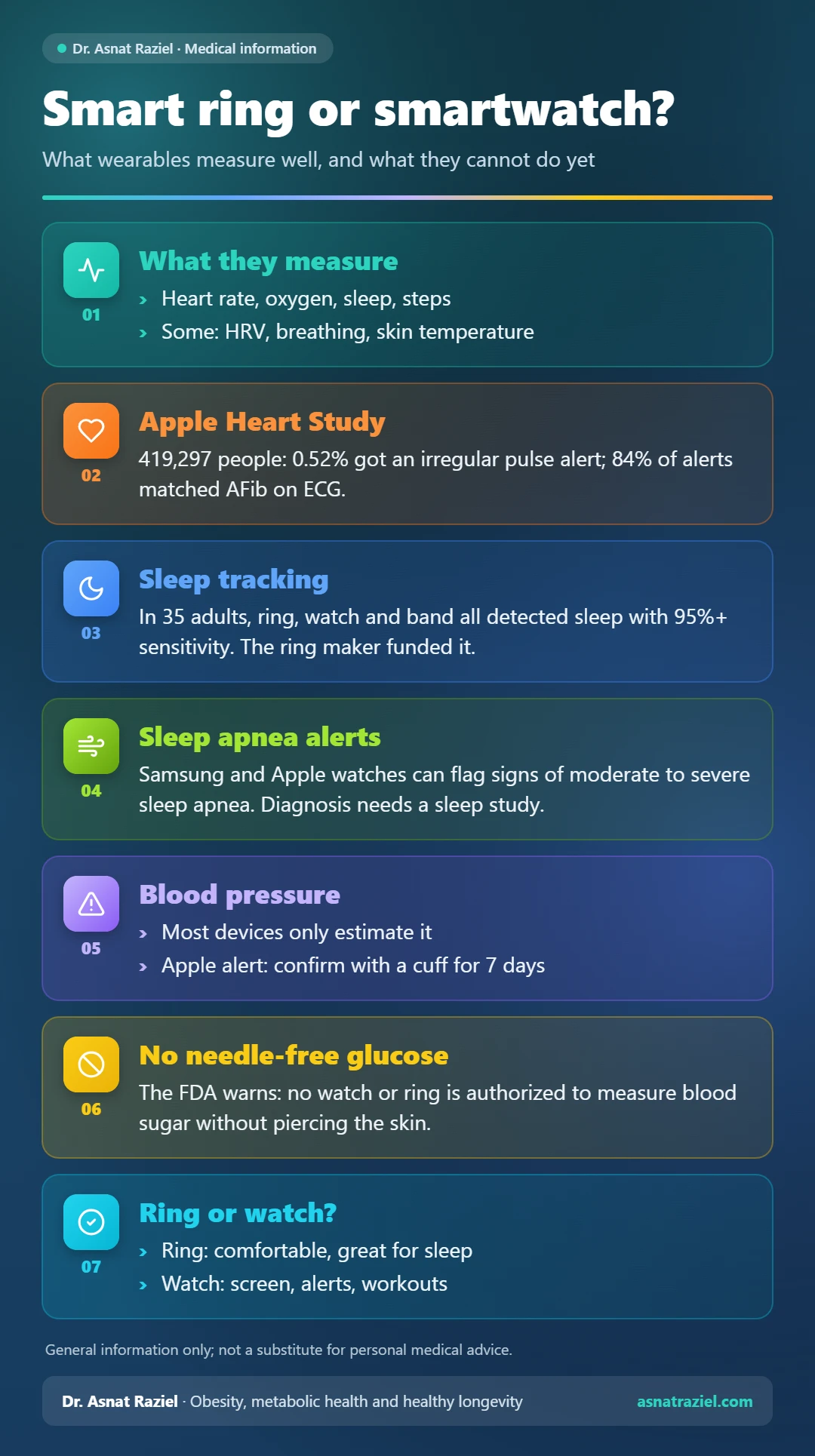
Most advanced bands and rings measure continuous heart rate and blood oxygen saturation (SpO₂). In addition, they track sleep duration and stages, steps, distance, calories burned and active time.
Advanced models also offer heart rate variability, breathing rate and skin temperature. Some display stress, recovery and training readiness scores (Readiness Score). Others estimate aerobic fitness, or VO₂max (the maximum amount of oxygen the body uses during exertion), with algorithms. I wrote about how digital tools and AI support physical activity in my article on AI in obesity treatment.
Some models have an ECG sensor, a single-lead electrocardiogram, that detects certain arrhythmias such as atrial fibrillation. The Apple Heart Study included 419,297 people. Only 0.52% of them received an irregular pulse notification. Among those who got a notification, 84% of the alerts matched atrial fibrillation on a simultaneous ECG. Still, an alert like this is a reason to see a doctor, not a diagnosis.
HRV: the metric that became a star
One of the most talked-about metrics today is heart rate variability (HRV). Unlike heart rate, HRV looks at the tiny differences in time between one beat and the next. High variability usually points to a flexible nervous system. In other words, the body copes well with stress and recovers well from exertion.
On the other hand, a prolonged drop in HRV sometimes appears during periods of mental strain, illness, poor sleep or overtraining. That is why the metric has become a key tool for athletes, sleep researchers and longevity experts. If you see a persistent drop, practical stress relief techniques can help.
Smart ring and sleep: the most important test
It is precisely while we sleep that these devices work hardest. They track sleep stages, deep sleep, REM sleep, awakenings, heart rate and breathing rate. Some also check temperature and oxygen saturation.
How accurate is this? A 2024 study compared a smart ring, a smartwatch and a fitness band with a lab sleep study (polysomnography) in 35 healthy adults. All three devices detected sleep with a sensitivity of at least 95%. However, in telling sleep stages apart, the ring was especially consistent. It is worth knowing that the ring’s manufacturer funded the study.
These data help identify sleep deprivation and poor recovery. In addition, two smartwatches, the Samsung Galaxy Watch and the Apple Watch, now have FDA authorization to flag signs of moderate to severe sleep apnea. But the diagnosis itself requires a medical sleep study. I wrote about the risks in my article on obesity and sleep apnea, and about the effects of short sleep in my article on sleep deprivation and health.
Smart ring or band: which is better?
Each device has its own advantages. Bands and watches have a large screen, notifications, calls, workout tracking and navigation. So they suit people who want a multipurpose device.
A smart ring, by contrast, is small, light and comfortable to wear around the clock. You barely feel it while you sleep. For this reason, it often provides high-quality sleep and HRV data. Many people prefer to wear a ring all day and night without taking it off. On the downside, it has no screen, and some of the information is available only through the app.
What about blood pressure?
This is probably the most common question. Despite the ads, most bands and rings do not measure blood pressure at a medical level. Some show an estimate based on an algorithm, or require calibration against a regular blood pressure monitor. In 2023, the European Society of Hypertension stated that cuffless devices need special validation testing before clinical use.
There is interesting progress. In September 2025, the Apple Watch received FDA clearance for hypertension notifications. Since May 2026, the feature has also been available in Israel. But it does not display blood pressure values. Instead, it analyzes how the blood vessels respond over 30 days and alerts you to consistent signs. In that case, the advice is to measure your blood pressure with a cuff for seven days and see a doctor. So any value that appears on a band’s screen is only an estimate.
The future of the smart ring and other wearables
The next generation is expected to combine even more advanced sensors. In development are continuous cuffless blood pressure monitoring, needle-free glucose measurement and tracking of body fluids. Researchers are also testing measurement of lactate and inflammatory markers, as well as early disease detection with artificial intelligence. I look at another emerging technology in my article on Openwater and its light and ultrasound devices.
Still, it is important to tell development apart from an approved product. The FDA has warned against smartwatches and rings that claim to measure blood sugar without piercing the skin. No such device has been authorized, and a wrong reading could lead to an insulin dosing error. People with diabetes should keep using an approved glucose sensor.
From gadget to medical tool
The key trend is not only better sensors, but connecting the data to the healthcare system. In the near future, we may combine the information from a ring or band with blood tests, body composition, fitness tests and imaging. With the help of artificial intelligence, we will then build a personal, up-to-date picture of health. I review more of these tools in my article on longevity technologies.
This approach will allow personalized nutrition, physical activity, sleep and drug treatment. In this way, medicine will shift from reacting to disease to protecting health over many years. For example, heart rate and recovery data help build the right mix of aerobic and strength training.
Bottom line on the smart ring
The small device on your wrist or finger is not just another accessory. A smart ring may become one of the most important tracking tools in longevity medicine. It helps you understand your body in real time and spot changes early. Even so, it shows trends and does not diagnose. Bring your data to your doctor, and do not make medical decisions on your own based on the screen.
The information in this article is general and does not replace personal medical advice.
References
Large-Scale Assessment of a Smartwatch to Identify Atrial Fibrillation
Accuracy of Three Commercial Wearable Devices for Sleep Tracking in Healthy Adults
Samsung’s Sleep Apnea Feature on Galaxy Watch First of Its Kind Authorized by US FDA
FDA 510(k) K240929: Apple Sleep Apnea Notification Feature
Hypertension notifications available today on Apple Watch
Do Not Use Smartwatches or Smart Rings to Measure Blood Glucose Levels: FDA Safety Communication




