By Dr. Asnat Raziel, bariatric surgeon specializing in obesity treatment, metabolic health and healthy longevity; Director of the Multidisciplinary Center for Obesity Treatment, Assia Medical, Assuta Ramat HaChayal, Tel Aviv
Openwater: seeing the body in real time
Openwater is trying to change the way we measure the body. One of the most fascinating directions in longevity medicine is not a new blood test or an anti-aging drug. It is a shift toward continuous measurement of the body, and perhaps, in the future, intervention in real time as well. Instead of waiting for disease and diagnosing it with large, expensive machines, the vision is small, wearable and accessible technology.
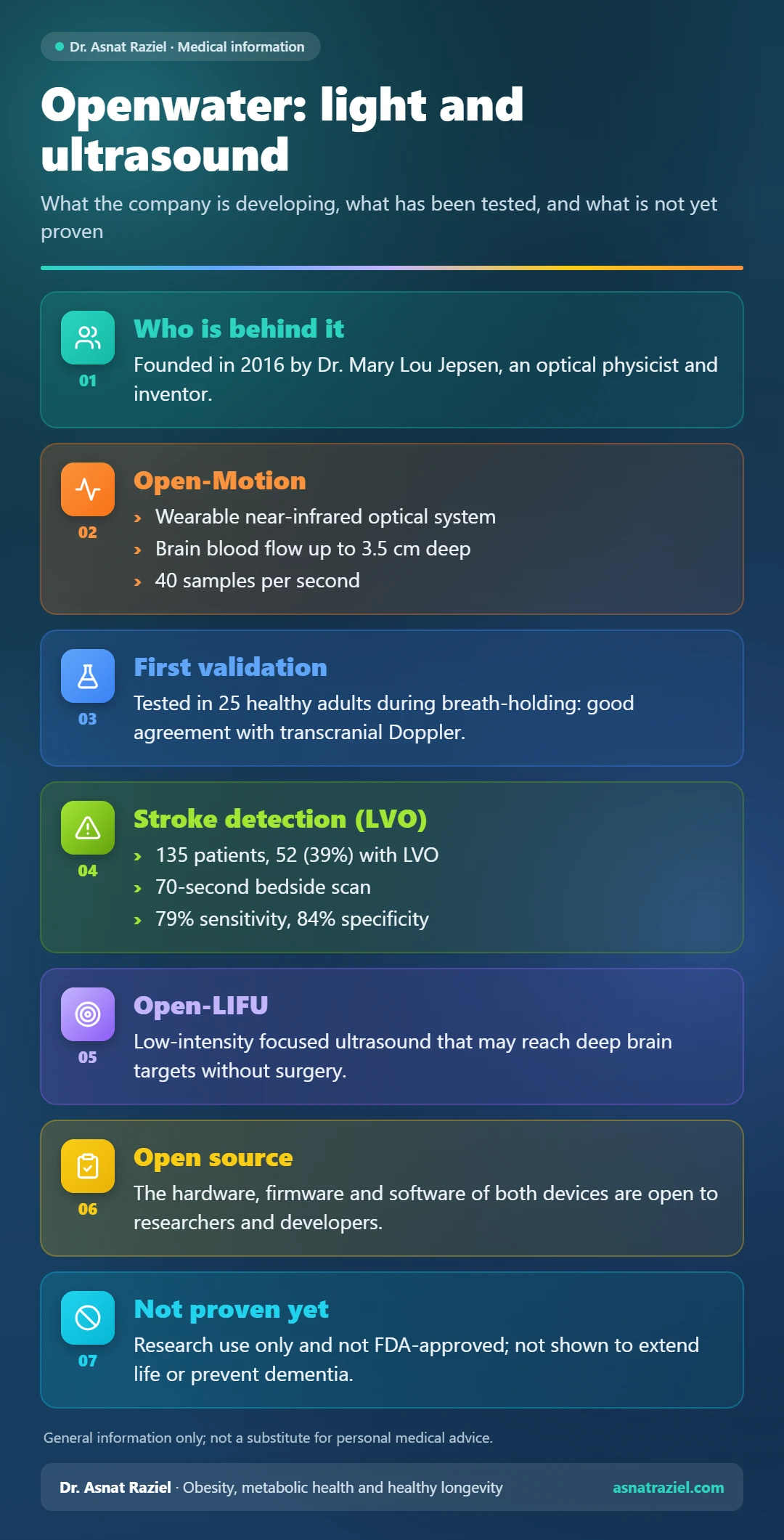
Dr. Mary Lou Jepsen, an optical physicist and inventor, founded the company in 2016. She previously led hardware projects at Google, headed engineering for the Oculus Quest 2 at Facebook/Meta and was a co-founder of One Laptop per Child. For nine years, she served as CEO and chair, and since 2025 she has been the company’s Executive Chairman.
The vision is ambitious: to use technologies from the worlds of electronics and optics to build low-cost, portable and open medical systems. These systems combine light, ultrasound, sensors, software and artificial intelligence.
What you should know from the start
Openwater is not a proven “longevity treatment.” According to the company’s website, its two main devices are intended for research use only. They lack approval for routine diagnosis or treatment. So the connection to longevity lies mainly in the potential: early measurement, continuous monitoring, and preventive, personalized medicine.
What exactly is Openwater developing?
The platform rests on two pillars. The first is Open-Motion, for measurement. The second is Open-LIFU, for intervention using low-intensity focused ultrasound.
The intriguing idea is the link between the two. You measure a process in the body, intervene, measure again and adjust the treatment. This is closed-loop medicine, in which measurement guides treatment in real time. That is exactly where Openwater becomes interesting from the perspective of longevity medicine.
Open-Motion: an optical window into blood flow
Open-Motion is a wearable optical system. It uses near-infrared light and a technology called P-SCOS (Pulsed Speckle Contrast Optical Spectroscopy). When coherent light penetrates tissue, it creates a speckle pattern, a pattern of light dots. The movement of blood cells changes the pattern, and these changes reveal information about blood flow and the microcirculation, that is, blood flow in the tiny blood vessels.
According to the company, the system measures blood flow and blood volume up to a depth of 3.5 cm in the brain, at a rate of 40 samples per second. In addition, the company presents it as a tool for measuring blood flow in the limbs too, not just in the brain. A study in Neurophotonics tested the device in 25 healthy adults during breath-holding. The researchers compared it with transcranial Doppler and found good agreement between the two measurements. However, they stressed that further validation in patients is needed.
Openwater and longevity markers
In longevity medicine, we are looking for dynamic biomarkers, biological markers that change in real time. That means not just a value obtained once a year in a blood test, but information about how the body is functioning right now.
Blood flow is deeply linked to the health of the brain, muscles and heart. With age, the function of the endothelium, the inner lining of the blood vessels, changes, and so does the ability of tissues to respond to metabolic demand. So one can imagine a future use of Open-Motion to measure the response to exercise, sleep, breathing, nutrition or medications. This is not yet an approved clinical use. Still, it is an important direction: a move from snapshot medicine, a one-time picture of a person’s state, to continuous physiology, ongoing measurement of function. We saw a similar direction in my article on smart rings for health tracking.
An application already tested: stroke detection
One of the most interesting studies is not directly about longevity. It examined the detection of a blockage in a large blood vessel in the brain, known as a large vessel occlusion (LVO). A prospective study at two stroke centers included 135 patients who arrived for a stroke evaluation. Of these, 52 (39%) had such a blockage. A bedside optical scan took 70 seconds, and a deep learning model analyzed the blood flow patterns.
The device reached a sensitivity of 79% and a specificity of 84% for detecting LVO. For comparison, the RACE scale reached a sensitivity of 60% and a specificity of 81%. In other words, the device outperformed the standard stroke scales. Even so, the researchers wrote that the findings need validation in a separate group and in the field, before patients reach the hospital.
Why is this relevant to longevity? Extending healthspan, the number of years we live in good health and with good function, is not only about slowing molecular processes. It is also about preventing serious events such as stroke, heart disease and loss of independence.
Open-LIFU: not just measuring, but influencing
The second arm is Open-LIFU (Low-Intensity Focused Ultrasound). The system directs acoustic energy to defined areas in the brain or body, without surgery. Thanks to an array of many elements and precise timing of the pulses, the system can focus the beam in three dimensions without moving the transducer.
One area under study is neuromodulation, the controlled modification of activity in neural networks. Magnetic stimulation mainly reaches the surface layers of the brain. By contrast, focused ultrasound may also reach deep targets. That is why the field is attracting interest in research on depression, addiction and neurological diseases.
In January 2026, the company announced that the Austrian company TIESA would use Open-LIFU for research on depression and anxiety. The announcement itself notes that the device is still experimental and is not approved as a treatment. The company also reports preliminary studies in humans and animals, but these are very early stages.
The brain: perhaps the most important frontier of longevity
We may be able to extend life, but the important question is how to keep the brain functioning over the years. Cognitive decline, depression, stroke and neurodegenerative diseases threaten our healthy years. I wrote about this at length in my article on preventing dementia and protecting brain health.
A technology that measures blood flow in the brain and explores non-invasive ways to influence nerve activity could become an important tool. But the distance between “could” and “proven” is large. Today, there is no basis for recommending Open-LIFU to a healthy person to “rejuvenate the brain” or prevent dementia.
What about muscles and fitness?
Muscle function is one of the most important markers of healthy aging. Muscle mass, grip strength, VO₂max (maximal oxygen uptake during exercise) and mitochondrial function are a central part of healthspan. A system that tracks blood flow in muscle could add a layer of information to the assessment of the response to training. Instead of asking only “How much weight did you lift?”, we could ask how the blood vessels and muscles responded. Nevertheless, researchers still need to show that this kind of measurement improves longevity programs.
Open source: an unusual feature of Openwater
The company chose to release a large part of its technology as open source. The hardware, firmware and software of both devices are available to researchers and developers. As a result, different labs can build on the same platform. In a world where advanced medical devices are usually closed and expensive systems, this is a rare approach. If it succeeds, it could mean the democratization of medical technology.
Could it become part of a longevity center in the future?
One can imagine a longevity center where a person undergoes blood tests, DEXA, VO₂max, grip strength, a cognitive assessment and a sleep assessment. Alongside these, functional imaging might be added: How does blood flow in the brain? How does the muscle respond to exertion? And what changes after six months of training? This is still a vision and not a proven protocol. But it reflects the direction of longevity technologies and the medicine of the future: fewer static tests and more measurement of biological function over time.
What has not yet been proven
Caution is needed here. This is a research medtech company, not an “anti-aging machine.” Both devices, Open-Motion and Open-LIFU, currently serve research purposes only, and the FDA has not approved them for diagnosis or treatment. No study has shown that using them extends life or slows biological aging. In addition, there is no proof that they prevent dementia in healthy people or improve the results of a longevity program.
The bottom line on Openwater
What is fascinating about Openwater is not a single device, but a different concept of medicine. Instead of giant machines that each do one thing, the company envisions small, low-cost systems based on light, ultrasound and artificial intelligence. If the vision comes true, it will fit longevity medicine very well: measure early, follow over time and detect change before irreversible damage. And finally, check whether the intervention really works. This is a step on the road from medicine that treats disease to medicine that preserves function for decades.
The information in this article is general and is not a substitute for personal medical advice.
References
Open-Motion Hemodynamics Platform
Openwater – Technology Platform
Openwater Developer Documentation
Openwater’s Open-LIFU Device Supports Concierge Mental Health Research with TIESA
Inside Open-LIFU: How We Open-Sourced a Focused-Ultrasound Research Platform
Some of the authors of both clinical studies are Openwater employees.




