By Dr. Asnat Raziel, bariatric surgeon specializing in obesity treatment, metabolic health and healthy longevity; Director of the Multidisciplinary Center for Obesity Treatment, Assia Medical, Assuta Ramat HaChayal, Tel Aviv
Longevity in daily life: the missing link
Longevity in daily life is the next big challenge for longevity medicine. Today we know far more about aging than we did a decade ago. We measure body composition, cardiorespiratory fitness, muscle strength, sleep, blood pressure, blood sugar, blood lipids and markers of inflammation. In addition, watches and sensors collect data around the clock, and artificial intelligence is starting to make sense of it.
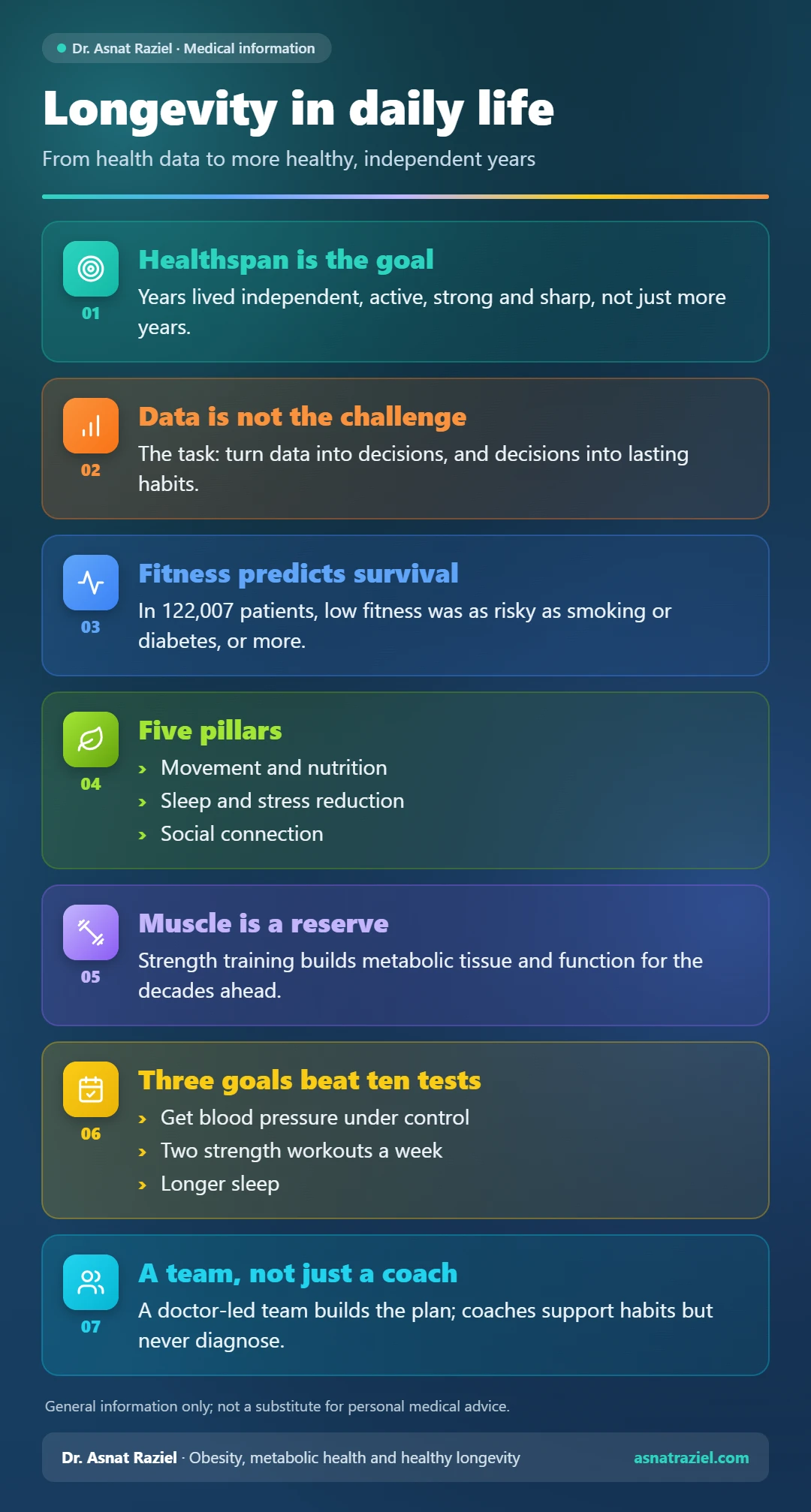
Yet this flood of information reveals something important. The challenge is not to generate more data. Instead, the challenge is to turn data into the right decisions, and decisions into habits we can live with for years.
The goal: healthspan, years of good health
People often link the word longevity with one question: how do we live to 100 or 120? However, the more important medical goal is to extend healthspan. These are the years we live with good function: independent, active, strong and mentally sharp.
Harvard Health also stresses this distinction. Lifespan is the number of years from birth to death. Healthspan, by contrast, is the period we spend free of limiting disease, pain or major disability.
This is not just semantics. A person can live many years with poorly controlled diabetes, muscle weakness, declining mobility and loneliness. So the aim is to delay these diseases and limitations, and to preserve physical, cognitive and social capacity. That is the essence of healthy aging.
We have plenty of data. Now we need to know what to do with it
An article published in Forbes in September 2026 points to an interesting paradox. The public has never had so much health information. Even so, more information does not always lead to better health.
A smart ring or watch counts steps and sleep. A sensor tracks blood sugar. In addition, a DEXA scan estimates muscle mass and deep belly fat, and blood tests provide dozens of markers. Fitness tests, for example, measure VO₂max (maximal oxygen uptake) and strength. So which measure matters most for the person sitting in front of us?
For one person, the core problem is visceral fat and insulin resistance. For another, it is loss of muscle mass. A third has high blood pressure, while a fourth struggles with poor sleep, smoking or loneliness. In other words, good longevity medicine is not a giant collection of tests. Rather, it is the ability to identify the few variables that will truly change a person’s health trajectory.
The new science of aging meets established measures
The excitement about new markers of biological age is understandable. Epigenetic clocks and molecular tests are fascinating fields of research. You can read more about them in my article on aging clocks.
Still, a paper published in May 2026 in the journal Frontiers in Aging offers a sober view. Alongside the new markers, we already have long-established physiological measures: VO₂max, body composition, muscle strength and heart rate variability. Decades of research stand behind them. For example, a study of 122,007 patients found a strong link between low cardiorespiratory fitness and death. The strength of that link was similar to, or even greater than, that of smoking and diabetes. Therefore, the future is not a choice between new and old, but a combination of both.
The five foundations of longevity in daily life
As technology advances, the basics matter more than ever. In July 2026, Harvard Health described five pillars of healthy longevity: movement, nutrition, sleep, stress reduction and social connection.
Within physical activity, strength training has a special place. Muscle is not just about looks. It is vital metabolic tissue and a functional reserve for the decades ahead. One simple measure of it is grip strength. In addition, metabolic balance, blood pressure, sleep quality and not smoking are all part of the same picture.
Longevity in daily life starts with putting it into practice
You can hand someone a detailed 20-page report and still change nothing. The real question begins the next morning. What do they eat for breakfast? Are they getting enough protein? When do they go to bed? How many times a week do they exercise, and do they do strength training?
That is why longevity in daily life means an action plan simple enough to follow. The goal is not to “improve everything” at once. Sometimes three precise goals matter more than ten extra tests. For example: getting blood pressure under control, two strength workouts a week and longer sleep.
Doctor, technology and ongoing support
The Forbes article proposes an emerging profession: the longevity coach, who translates recommendations into everyday behavior. This is an important idea, but in medicine we should set clear boundaries.
A skilled coach helps with goal setting, habit change and persistence. On the other hand, a coach must not diagnose disease or replace a doctor, dietitian, psychologist or physical therapist. The most promising model is a multidisciplinary team. The doctor assesses risk and builds a medical plan. Then nutrition, exercise and mental health professionals join in, and ongoing support turns the plan into a routine. Technology and AI fit in between them and provide continuous feedback.
Artificial intelligence and longevity in daily life
AI in preventive medicine can connect large amounts of information, spot trends and tailor recommendations. But the person is the one who lives the plan. Even the most sophisticated algorithm does not change a simple fact: the plan has to fit real life. Someone who works until 10 p.m., a mother of three and a 75-year-old with an orthopedic limitation will not get the same plan. Ultimately, a good plan connects evidence, medical risk, personal goals and the ability to stick with it.
The longevity clinic of the future
We can picture longevity medicine as a journey rather than a one-time event. First comes a broad assessment: medical and family history, body composition, fitness, strength, sleep, nutrition, metabolic health and emotional well-being. Next comes the truly important step: setting priorities. Which two or three things will have the greatest impact if we improve them now? Finally come intervention, follow-up and readjustment. This is a big change from an annual checkup, a list of results and a return to routine. I describe this model in more detail in my article on how to build a longevity clinic.
Less chasing numbers, more building capacity
One of the risks in the longevity world is turning health into an endless measurement project. Another test, another app, another supplement. Instead, we can define success simply. In ten or 20 years, will we still be able to do the things that matter to us? Climb stairs, get up from the floor, travel, work, remember, meet friends and play with our grandchildren. In many ways, these are the most important measures of all.
The bottom line on longevity in daily life
The first stage of the longevity revolution gave us vast knowledge about aging, biomarkers and monitoring technologies. The next stage needs to connect the dots: tests to decisions, decisions to behavior and technology to medicine. Perhaps the key breakthrough will not come from another blood test or a new device. Instead, it will be longevity in daily life: taking what we already know and making it work in our everyday routine.
The information in this article is general and does not replace personal medical advice.
Questions and answers
Do I need advanced tests to start a longevity plan?
No. A good medical assessment of risk factors and function is a meaningful starting point for longevity in daily life. Advanced tests add information when they answer a clear clinical question.
What matters more: biological age or physical fitness?
Biological age markers are an evolving field of research. By contrast, cardiorespiratory fitness, muscle strength, body composition and metabolic markers have a long research track record and clear clinical meaning. It makes sense to see them as complementary tools.
Can I start at an older age?
Absolutely. The goal is not to go back to age 30, but to improve your starting point and build functional reserve for the years ahead.
What is the first step?
Assess your health status and personal risk. Then choose a small number of important goals, and build a plan you can stick with.
References
Lifespan vs. healthspan: Why how you age matters more than how long you live
The Missing Link Between Longevity Science And Everyday Life
Building a framework for integrative longevity science: from rediscovery to innovation
The 5 pillars of longevity: Movement, nutrition, sleep, stress reduction, and social connection




