By Dr. Asnat Raziel, bariatric surgeon specializing in obesity treatment, metabolic health and healthy longevity; Director of the Multidisciplinary Center for Obesity Treatment, Assia Medical, Assuta Ramat HaChayal, Tel Aviv
Personalized screening in the age of longevity
Personalized screening tests are gradually replacing the one-size-fits-all checkup package. In the past, the periodic checkup was almost a fixed ritual: blood tests, blood pressure, cholesterol, perhaps a chest X-ray or an ECG. Everyone went through roughly the same list. But does the same package really suit everyone?
Many experts around the world believe the answer is no. One of the most important trends in modern medicine is the shift from uniform tests to personalized preventive medicine. This approach focuses on each person’s risk factors, not on the number of tests. In addition, it fits well into the world of longevity medicine, where the goal is not only to extend life but to extend the years lived in good health.
Not more tests, but the right tests
Today we can do genetic tests, advanced scans and hundreds of blood tests. So it is easy to think that the more information we collect, the healthier we will be. In practice, reality is far more complicated.
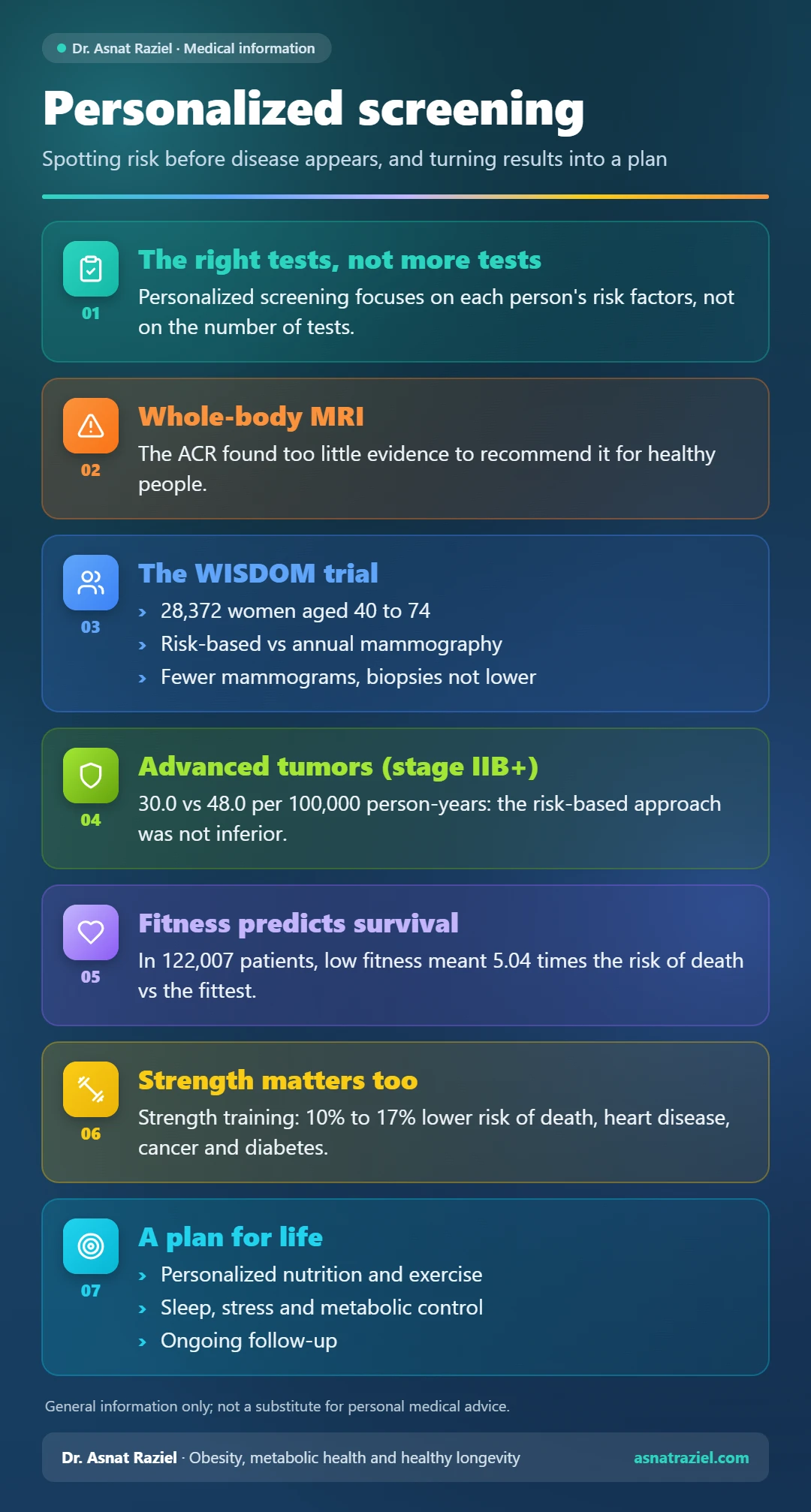
Excessive testing can cause anxiety. It also sometimes reveals meaningless incidental findings that lead to unnecessary invasive tests. For example, the American College of Radiology (ACR) has stated that there is not enough evidence to recommend whole-body MRI for healthy people. The ACR also warned that such a scan turns up many nonspecific findings. In other words, the real value does not lie in the amount of data. Instead, it lies in the ability to identify the important risk factors and turn them into an action plan.
Moreover, official recommendations themselves are based on age, sex and risk factors. This is how the U.S. Preventive Services Task Force (USPSTF) builds its recommendations, for example. It is an independent expert panel that reviews the evidence for each test.
Everyone ages differently
Two 50-year-olds can look perfectly healthy. And yet their risk profiles can be completely opposite. The first carries a high risk of heart disease because of family history, chronic stress, sleep problems and elevated inflammatory markers. The second, by contrast, has a normal metabolism, good physical fitness and a healthy lifestyle.
Despite the identical age, their prevention plans should be completely different. This is the essence of personalized medicine. The same logic guides personalized obesity treatment. Weight alone does not tell the whole story either, as I explained in my article on why a normal weight is not always healthy.
The WISDOM trial: personalized screening for breast cancer
A good example of this approach comes from the WISDOM trial, published in JAMA. The trial included 28,372 women aged 40 to 74. Half had annual mammograms. The other half received a plan based on their personal level of risk, using genetic testing, a polygenic risk score and a clinical risk model.
The result: the personalized approach was not inferior to annual mammography in detecting advanced tumors (stage IIB and above). Their rate was 30.0 per 100,000 person-years, compared with 48.0 in the annual group, although the difference was not statistically significant. In addition, women in the personalized group had fewer mammograms. However, the number of biopsies did not go down. In other words, personalized screening proved safe and effective, but it did not solve every problem.
Longevity starts long before disease
One of the central ideas in longevity medicine is not to wait for disease. Diabetes, heart disease, fatty liver and obesity do not appear overnight. Instead, they develop over years, sometimes without any symptoms.
That is why it is important to spot the signs at the earliest stage. These include, for example, insulin resistance, loss of muscle mass, an increase in visceral fat, declining aerobic fitness or sleep problems. When we catch them in time, we can change the course of health before disease develops. I also wrote about this approach to obesity in my article on timely diagnosis of obesity.
Aerobic fitness as a health marker
One of the strongest markers of future health is aerobic fitness. VO₂max describes the maximum amount of oxygen the body can use during exercise. A study of 122,007 patients who underwent exercise treadmill testing looked at the link between fitness and mortality. In people with low fitness, the risk of death was 5.04 times higher than in those with the highest fitness. This risk is similar to, and even greater than, the risk added by smoking, diabetes and coronary artery disease.
Muscle strength matters, too. A review of 16 cohort studies found that strength training is linked to a 10% to 17% lower risk of death, heart disease, cancer and diabetes. Therefore, physical fitness, body composition and muscle mass are a central part of the assessment. Muscle mass, for example, is just as important as weight, as I explained in my article on body composition.
From personalized screening to a plan for life
The test itself is only the beginning. After the results come in, they need to be interpreted in the right context. Next, a personal plan is built that includes:
- Personalized nutrition.
- Physical activity that combines strength and endurance training.
- Better sleep quality.
- Stress reduction.
- Control of metabolic risk factors.
- Medication when needed.
- Ongoing follow-up of progress.
It is precisely this ongoing support that turns medical information into a real change in habits. As a result, the improvement in health lasts over time.
The future of personalized screening
Leading longevity centers around the world don’t settle for blood pressure and blood sugar. Instead, they combine a broad assessment: body composition, muscle mass, aerobic fitness, metabolic health, sleep quality and cognitive function. Sometimes they also add lifestyle habits, genetic data and advanced biomarkers. The goal is not to find more diseases, but to prevent them in advance. You will find a practical example in my article on tests for tailoring obesity treatment.
It is also important to remember the other side. An advanced test that is not tied to a clear medical question usually adds very little. That is why it is best to build the plan together with your care team, who know your personal and family history. The team will choose which tests really matter, how often to do them and what to do with each result.
The bottom line: living for years to come
This may be the biggest change in medicine over the coming decade. Instead of asking, “Am I sick?” we are starting to ask a different question: “How will I stay healthy, independent and full of energy 20 or 30 years from now?” Ultimately, personalized screening tests are the tool that answers this question. This is the essence of longevity: medicine that detects risk in time, tailors treatment to the person rather than the disease, and above all extends healthspan.
The information in this article is general and does not replace personal medical advice.
References
ACR Statement on Screening Total Body MRI
Recommendation Topics – U.S. Preventive Services Task Force
Risk-Based vs Annual Breast Cancer Screening: The WISDOM Randomized Clinical Trial




