By Dr. Asnat Raziel, bariatric surgeon specializing in obesity treatment, metabolic health and healthy longevity; Director of the Multidisciplinary Center for Obesity Treatment, Assia Medical, Assuta Ramat HaChayal, Tel Aviv
Longevity medicine: from futuristic dream to measurable medicine
Longevity medicine is no longer a futuristic buzzword. Until a few years ago, “longevity” brought to mind a mix of science fiction, expensive supplements and dreams of eternal youth. But the field is maturing fast. It is moving away from glossy branding and toward data we can actually measure. The question is no longer “How do we extend life?” Instead, it is how to keep a sharp mind, a strong body and a healthy metabolism for many years.
The big innovation is not a single drug or a single device. Rather, it is a whole system: advanced blood tests, smartwatches and smart rings, continuous glucose monitors, imaging, and artificial intelligence that ties it all together. Instead of an annual checkup that ends with “everything is fine,” the goal is to spot early where the body is starting to weaken.
Not anti-aging anymore, but healthspan medicine
It is important to separate two worlds. On one side stands the old world of anti-aging: creams, infusions, supplements and hormones, some of which lack scientific support. On the other side, a serious field of healthspan medicine is emerging. Its goal is to extend the years we live in good health.
This kind of medicine does not promise eternal life. Instead, it aims to delay diabetes, heart disease, dementia, frailty, fatty liver, sarcopenia (age-related muscle loss) and sleep apnea. In other words, the goal is not only to add years to life, but to add life to years. Technology does not replace the doctor. However, it gives us a deep window into the body.
Biological age clocks: how fast are we aging?
In the past, chronological age was all we had. Today, science is trying to measure the pace of aging itself. The best-known tests are epigenetic clocks, which rely on DNA methylation patterns. Alongside them, researchers are developing measures based on proteins, metabolites and inflammation, and even attempts to estimate “organ age.”
Still, caution is important. A biological age test is not a verdict. It does not tell you how many years you have left, and it does not prove that you have reversed aging. At this stage, its main value lies in research and in tracking direction. For example, are weight loss, sleep and exercise changing your biology for the better?
Longevity medicine and wearables
Smartwatches, rings and sensors have become central tools. In the past, they counted steps. Today, in the world of longevity medicine, they measure sleep, resting heart rate, oxygen saturation, temperature and recovery. They also measure HRV, or heart rate variability, a marker of balance within the nervous system. The Oura ring, for example, displays a Cardiovascular Age score, an estimate of the “age” of your blood vessels.
The innovation is not just the measurement, but the immediate feedback. A person sees that during a week of six-hour nights, their heart rate went up and their hunger increased. Suddenly, “sleep well” is no longer general advice. It becomes a biological data point. I have written at length about using smartwatches in obesity treatment.
Continuous glucose monitors: metabolism in real time
For years, continuous glucose monitors (CGMs) were meant mainly for patients on insulin. Today, they are also entering preventive medicine. In March 2024, the FDA cleared the Dexcom Stelo as the first over-the-counter CGM. It is intended for adults who do not use insulin, including people without diabetes.
In June 2024, Abbott received clearance for two over-the-counter systems. Lingo is designed for people who want to improve their metabolic health. Libre Rio, by contrast, is meant for adults with type 2 diabetes who do not use insulin.
Why does this matter? Blood sugar swings, insulin resistance and visceral fat are linked to heart disease, diabetes and cognitive decline. The device shows how your body really responds. The same bowl of rice spikes one person’s blood sugar and stays reasonable in another. Even a ten-minute walk after a meal can change the whole curve. That said, not every healthy person needs a monitor all year round. Usually, short-term use as a learning tool works best.
Preventive imaging: a double-edged sword
Companies such as Prenuvo, Ezra and Neko Health offer body scans, MRI, and skin, heart and body composition tests, analyzed with artificial intelligence. The vision is clear: to detect visceral fat, calcifications, unbalanced blood pressure or fatty liver early.
But broad scans come at a price. They uncover incidental findings that are harmless, and they cause anxiety and unnecessary tests. The American College of Radiology has stated that there is not enough evidence to recommend whole-body MRI for people without symptoms or risk factors. So the key question is this: will the finding change a medical decision?
Longevity apps: your body’s personal dashboard
The new generation of apps combines blood tests, sleep, activity, body composition and nutrition into one plan. Function Health, for example, offers a membership with more than 160 lab tests, starting at $365 a year. Companies such as TruDiagnostic and Tally Health offer epigenetic tests directly to consumers.
The real value is not the number, but the behavior it drives. Do the data get a person to sleep well, eat enough protein and do strength training? Do they treat their sleep apnea and get their blood pressure under control? This is the beating heart of modern longevity medicine: care built on data rather than on general recommendations.
Longevity medicine and artificial intelligence
Artificial intelligence is entering along two tracks. The first track is clinical. The system reads hundreds of data points from one person and spots patterns the human eye misses. For example, it might flag a rising resting heart rate together with falling HRV, broken sleep and higher blood sugar after meals. For the doctor, this is a meaningful aid. As a result, longevity medicine is turning from a general idea into a system of monitoring and prevention.
The second track is drug discovery. In May 2026, Insilico Medicine announced a partnership with Human Longevity. The goal is a foundation model that will predict disease risk and explain the biology of aging. In addition, researchers are mapping the 12 hallmarks of aging to find drugs that act on them. I have also written about artificial intelligence and the future of obesity treatment.
Reprogramming: the dream of rejuvenating cells
One of the most exciting fields, and also one of the most experimental, is partial epigenetic reprogramming. The idea is to return cells to a younger state without erasing their identity.
In January 2026, Life Biosciences received FDA clearance for a human trial of ER-100. The treatment is based on the controlled expression of three Yamanaka factors: OCT4, SOX2 and KLF4. In June 2026, the first patient in the phase 1 trial was reported, in optic nerve diseases such as glaucoma and NAION. This is a historic step, but we need to be precise. It is an early trial that mainly tests safety, in a small area of the body. It is not a “youth drug.”
Senescent cells, mitochondria and muscle
Over the years, senescent cells build up in the body. These are cells that have stopped dividing but do not go away. They release inflammatory substances and damage the tissues around them. Senolytic drugs aim to clear them out, while senomorphic treatments try only to reduce their harmful secretions. Most of these applications are still in the research stage.
Another field is mitochondrial health, the cell’s “power plants.” Urolithin A often comes up here. Urolithin A is a compound that gut bacteria produce from components of pomegranates and nuts. In a trial of 66 adults aged 65 to 90, it improved muscle endurance. However, it did not significantly improve the six-minute walk distance. Larger studies are therefore needed. In the meantime, preserving muscle mass with protein and strength training remains the foundation.
Peptides, supplements and rapamycin: between research and marketing
Rapamycin, an inhibitor of the mTOR pathway, is at the center of the conversation. In mice, inhibiting this pathway is linked to longer life. In humans, however, the picture is more complex. Rapamycin is not approved as an anti-aging treatment, and it has side effects. The same goes for peptides, exosomes, stem cells and NAD boosters: marketing to the public often runs ahead of the science. You can read about the current state of the field in my article on longevity drugs.
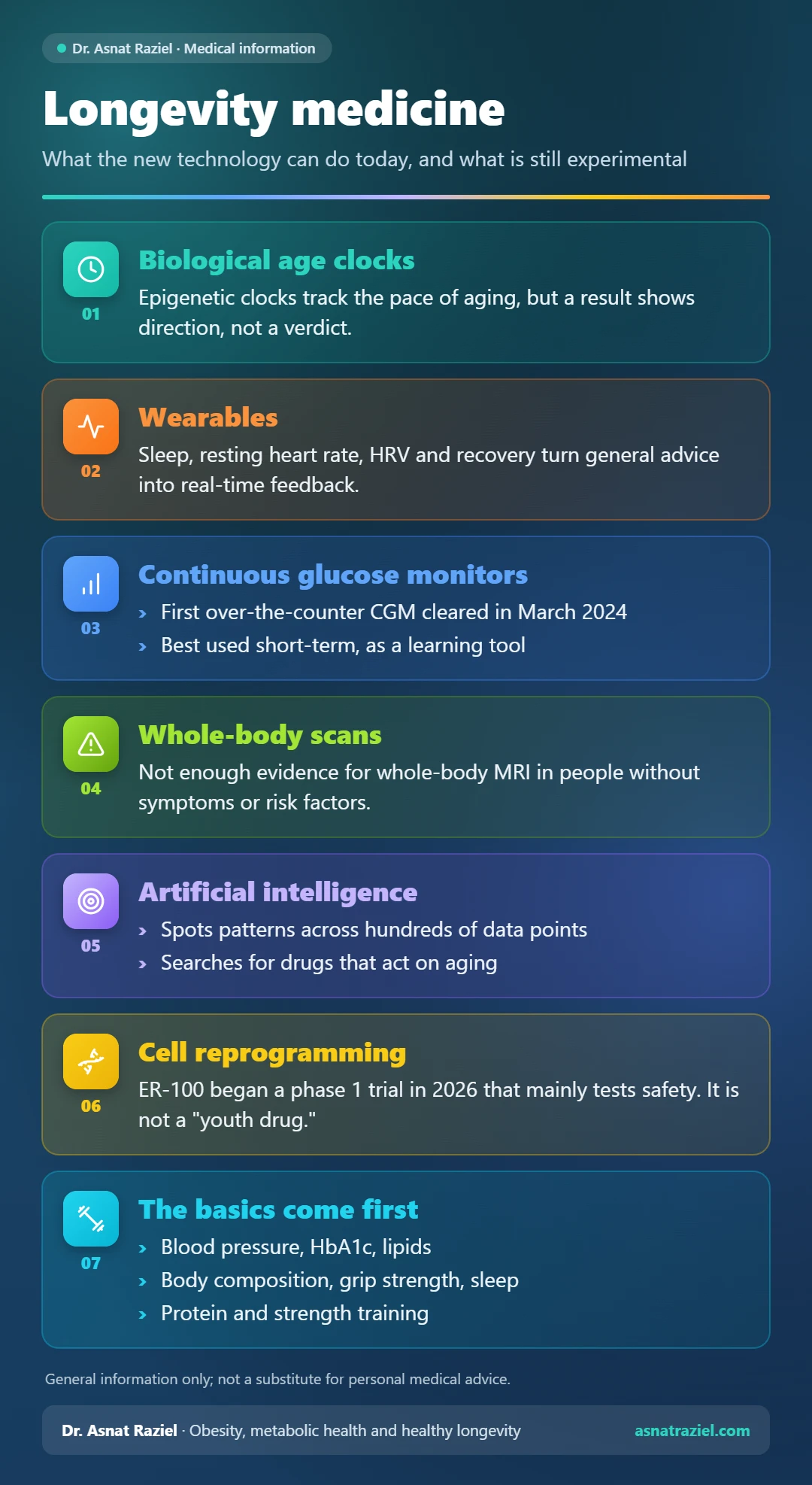
What should a serious longevity medicine center offer?
A serious center does not start with the exotic. It starts with the basics: blood pressure, HbA1c (average blood sugar over three months), blood lipids, liver and kidney function, and nutritional deficiencies. In addition, it checks body composition, visceral fat, grip strength, walking speed, sleep and mood. On top of this foundation, you can add a CGM, biological age testing, risk-based imaging and a smart dashboard.
Bottom line: where longevity medicine is heading
The next generation of longevity medicine will combine medicine, biotech, data and behavior. It will detect when a person is losing muscle, when their sleep is getting worse and when their blood sugar starts to climb. Yet the more data we have, the more judgment we need. And the more artificial intelligence we use, the more we need a doctor who understands the person behind the numbers.
This revolution does not promise eternal life. Instead, it promises something modest and important: a chance to detect problems early, intervene in time and keep body, mind and spirit vital for years to come.
The information in this article is general and does not replace personal medical advice.
References
FDA Clears First Over-the-Counter Continuous Glucose Monitor
ACR Statement on Screening Total Body MRI
Function Health secures $450M growth financing
Insilico Medicine, Human Longevity Partner for Longevity Foundation Model
Hallmarks of aging: An expanding universe




