By Dr. Asnat Raziel, bariatric surgeon specializing in obesity treatment, metabolic health and healthy longevity; Director of the Multidisciplinary Center for Obesity Treatment, Assia Medical, Assuta Ramat HaChayal, Tel Aviv
The longevity market: where the field is growing
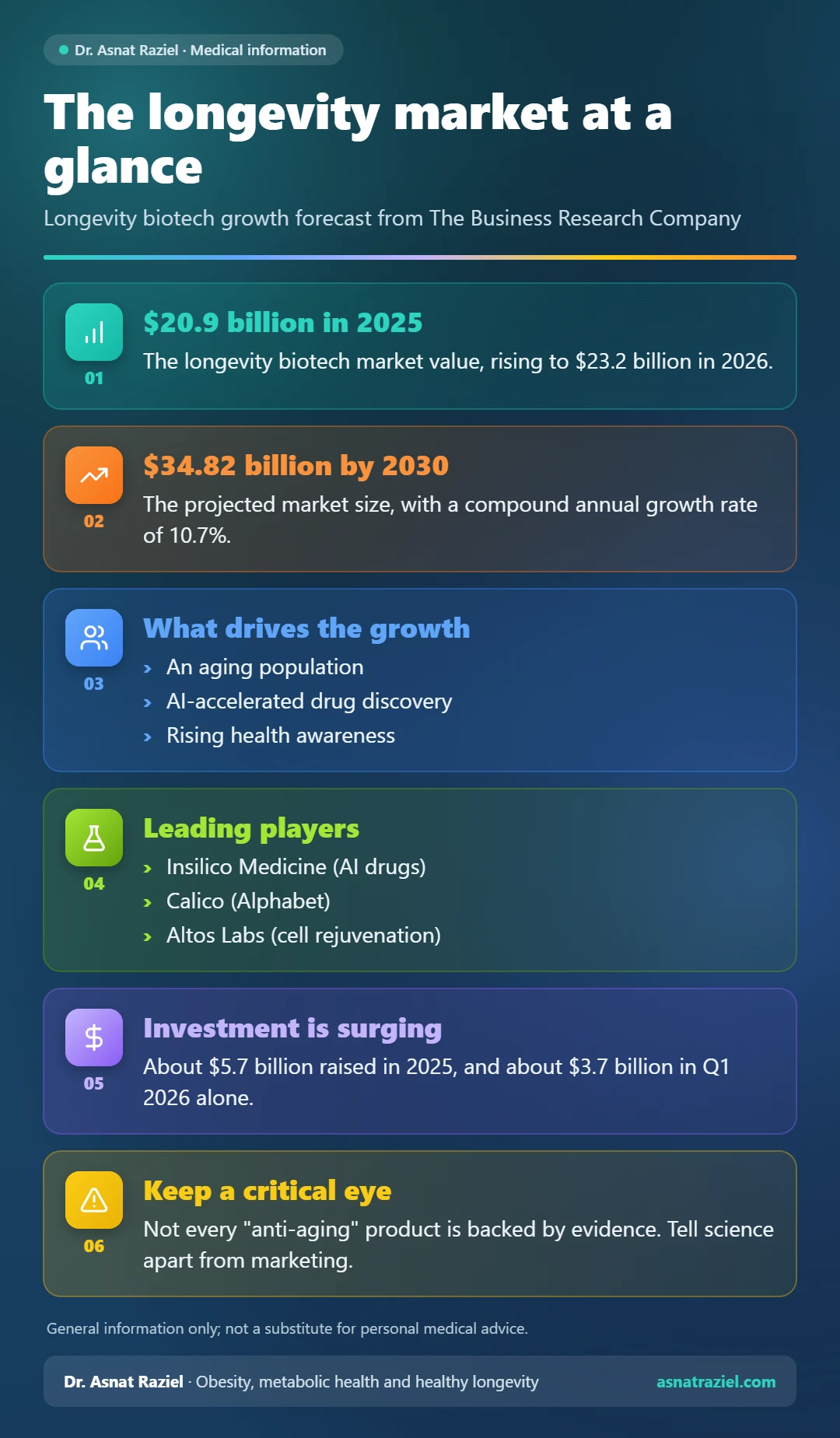
The longevity market is moving from academic research into a mature industry. A new market report from The Business Research Company values the longevity biotech sector at $23.2 billion in 2026. For comparison, it stood at $20.9 billion in 2025. The forecast for 2030 is even more striking: $34.82 billion.
What is driving the longevity market?
The compound annual growth rate is 10.7%. First, an aging population is increasing demand. In addition, artificial intelligence is speeding up the discovery of new drugs. Public awareness of metabolic health and longevity is also rising steadily. Moreover, major investors see the field as a long-term opportunity. As a result, capital is flowing in quickly.
Who are the leading companies?
The report highlights several prominent players. For example, Insilico Medicine uses artificial intelligence to develop drugs. Calico is the longevity company of Alphabet, Google’s parent company. Altos Labs, meanwhile, has raised enormous sums for research on cellular rejuvenation. Alongside them, dozens of smaller startups are at work. Together, they define the boundaries of the field and its leading research directions.
What does this mean for the public?
Here lies an opportunity, but also a risk. On the one hand, a great deal of money is speeding the move from laboratory discoveries to available treatments. On the other hand, not every product marketed as “anti-aging” is backed by evidence. So as consumers, we should keep a critical eye. It is important to tell established science apart from marketing.
Where is the money going in the longevity market?
Investment is spread across several fronts. First, drugs that target the mechanisms of aging itself. Next, early diagnosis and biological age clocks. Then food, supplements and wearable devices. Finally, data platforms that track health over many years. According to Longevity.Technology, biotech companies in the field raised about $5.7 billion in 2025, and about $3.7 billion in the first quarter of 2026 alone. Together, these areas paint a picture of a whole, diverse industry.
The bottom line
In short, the field is growing fast, and that is good news. Still, a maturing industry does not exempt us from scrutiny. To learn more, you can read about healthspan and the science of rejuvenation, about how the FDA put longevity on its agenda, and about a $435 million bet on a longevity startup. Ultimately, big money also brings big responsibility.
References
Longevity BioTech Global Market Report 2026 (The Business Research Company)
Longevity biotech investment 2026: we’re set for a breakout year




