By Dr. Asnat Raziel, bariatric surgeon specializing in obesity treatment, metabolic health and healthy longevity; Director of the Multidisciplinary Center for Obesity Treatment, Assia Medical, Assuta Ramat HaChayal, Tel Aviv
Weight regain after dieting is not a willpower problem
Weight regain after dieting is part of the journey for almost everyone who has tried to lose weight. You lose a few kilograms, you get stuck, and then the weight comes back. Most people blame themselves. However, research paints a different picture: the body itself works to bring the weight back, so treatment needs to match this biology.
In this article, I focus on the biology behind weight regain: what exactly changes in the body after weight loss, and how long those changes last. Then I show how to build a plan that holds up over time. For practical steps when a diet simply is not working, see my separate guide on what to do when a diet does not work.
Why weight regain after dieting is so common
A review by researchers at the US National Institutes of Health describes a pattern that repeats with almost every treatment method. First there is rapid weight loss, then a plateau, and finally a gradual regain. These are studies on how hard it is to maintain weight loss, and their conclusion is clear: obesity requires ongoing follow-up and treatment, not a single diet.
In other words, when the weight comes back, it does not mean you did something wrong. That is why coping starts with understanding your body. This is the body’s expected response. So instead of searching for the “right” diet, it is worth asking how to deal with this response over the years.
The biology of weight regain: the body defends its weight
According to set point theory, the brain keeps body weight within a certain range. When weight drops, it activates mechanisms to bring it back. Researchers describe several mechanisms that work together, and all of them are part of the biological explanation for this difficulty.
Hunger and fullness hormones change
In a study published in NEJM, 50 participants lost an average of 13.5 kg on a low-calorie diet. After the weight loss, fullness hormones fell and the hunger hormone ghrelin rose. Appetite also increased. Moreover, one year later most of these changes were still present, and participants were hungrier than at the start.
Metabolism slows down
Besides hunger, the body burns less energy. A follow-up study of contestants on the TV show “The Biggest Loser” illustrates this well. The contestants lost an average of 58.3 kg, and their resting metabolic rate dropped by 610 calories a day. Six years later, they had regained 41 kg, yet their metabolism remained 704 calories lower than at the start.
A timeline of weight regain after dieting
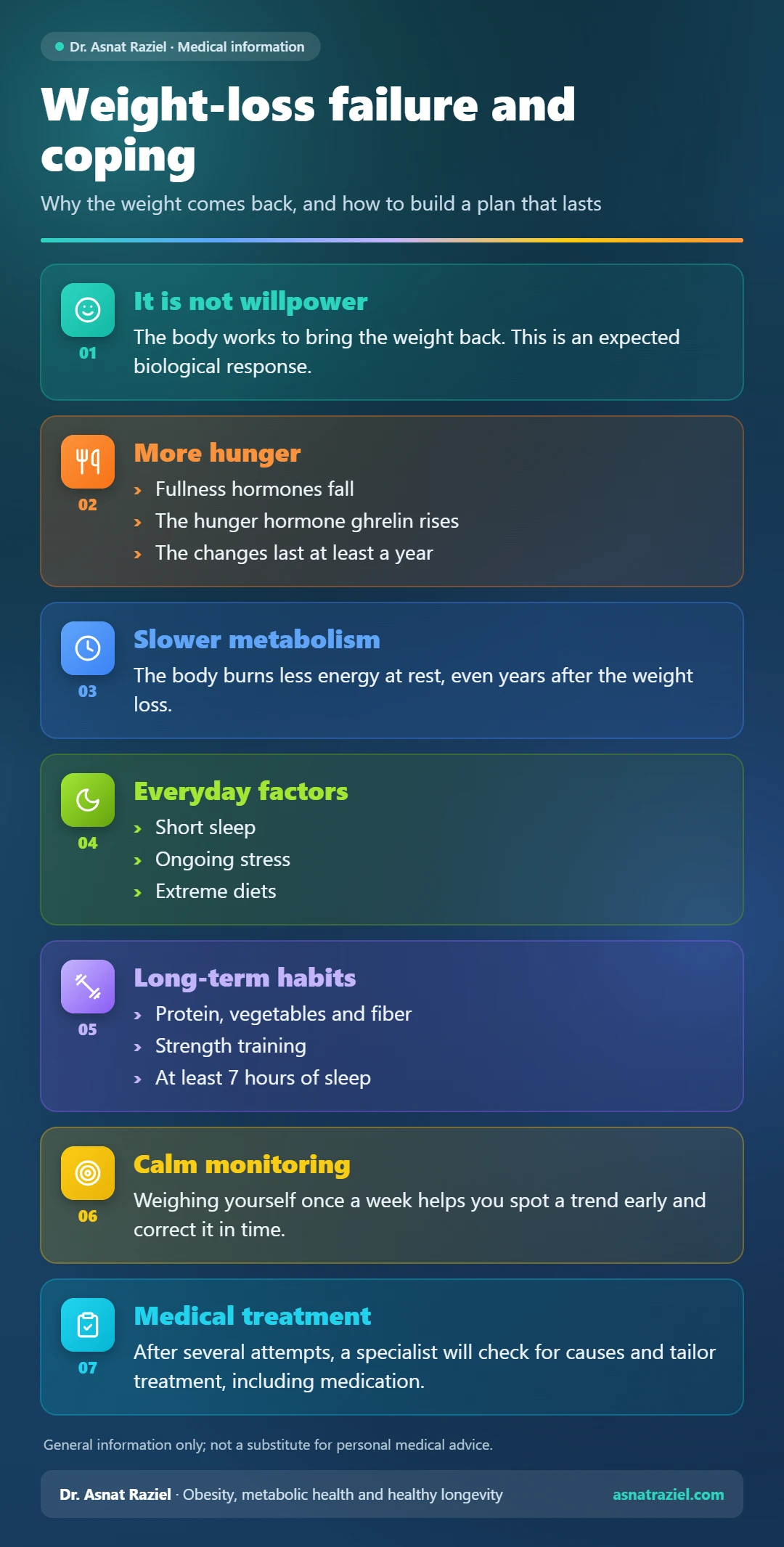
Putting these studies together shows how long the body’s defenses last. Right after weight loss, fullness hormones fall, ghrelin rises and appetite increases. One year later, in the NEJM study, most of these changes were still present. Six years later, in the Biggest Loser follow-up, contestants had regained 41 kg, and their metabolism was still 704 calories a day lower than at the start. In other words, the pull toward weight regain does not end when the diet ends. That is why a maintenance plan needs to last for years, not weeks.
Everyday factors behind weight regain after dieting
Beyond biology, everyday factors make things much harder. The review in Diabetes Spectrum estimates that about half of the differences in weight between people come from genetics, and the rest from the environment. These are the factors I see most often in my clinic:
- Short sleep: lack of sleep increases hunger and cravings for sweets. I wrote about this in my article on sleep and brain health.
- Ongoing stress: psychological stress encourages emotional eating, as I explained in my article on stress and obesity.
- Extreme diets: severe restriction usually leads to intense hunger and overeating. This cycle is familiar from yo-yo dieting.
- Exercise without changing your diet: exercise alone takes off only a little weight. That is why many people ask why they are working out but not losing weight.
- Illnesses and medications: an underactive thyroid, polycystic ovary syndrome and certain medications affect body weight.
How to prevent weight regain over the long term
The first step is to change the goal. Instead of a number on the scale, focus on health: blood pressure, blood sugar, blood fats and daily functioning. It is also important to remember that a normal weight does not always mean good health. After that, these are the principles that work over the long term:
Habits you can keep for years
First, an eating pattern you can live with, with protein, vegetables and fiber at every meal. Second, strength training to preserve muscle mass. In addition, at least seven hours of sleep and set mealtimes. Finally, planning the week ahead helps a lot: a shopping list, prepared meals and fixed times for physical activity.
Do not panic over a small gain
A gain of a kilogram or two is no reason to give up on everything. In fact, these are exactly the moments to return to the basic habits, rather than jump into a new extreme diet. In addition, weighing yourself regularly once a week helps you spot a trend early and correct it before it grows. It is also important to talk to yourself with patience: harsh self-criticism increases stress, and stress increases emotional eating.
What to do when your weight stalls
A plateau is a natural stage, not a sign of failure. At this point, it is worth reviewing portion sizes, activity levels and sleep. You will find practical details in my article on the weight-loss plateau.
When weight regain after dieting calls for medical treatment
If you have tried several times without success, it is time to see a doctor who specializes in obesity. Today, there are medications for obesity that act on exactly the mechanisms I described: they mimic fullness hormones and weaken hunger. However, they work only as long as you take them, so treatment is long term. For people with severe obesity, bariatric surgery is also an option.
An Oxford review of 37 studies, published in The BMJ, illustrates this point. After stopping weight-loss drugs, people regained weight faster than after ending diet and exercise programs.
At our clinic, we start with a full workup: blood tests, eating habits, sleep and emotional well-being. Then we build a plan together with a dietitian, a trainer and sometimes a psychologist. This combination treats both the body and the habits.
Bottom line
Weight regain after dieting is a matter of biology, not weakness. The body increases hunger and slows metabolism in order to bring the weight back. That is why success comes from a long-term plan: habits you can keep, medical follow-up and, when needed, medication. If you would like to learn more about my approach, you can read about me, Dr. Asnat Raziel.
The information in this article is general and does not replace personal medical advice.
Questions and answers
Why does weight come back after a diet?
After weight loss, hunger hormones rise and fullness hormones fall. In addition, the body burns less energy. These changes can last for years, so you need a long-term strategy.
Does weight regain after dieting mean I lack willpower?
No. Studies show that the body actively works to bring the weight back. This is a biological response, and it occurs in almost everyone.
When should I see a doctor?
It is worth seeing a doctor after several unsuccessful attempts, or when you have weight-related health problems. A specialist will check for medical causes and tailor treatment.
Do obesity medications solve the problem?
They help some patients a great deal, because they weaken hunger. On the other hand, they work only during treatment, so they are combined with habit change and follow-up.
Sources
Maintenance of Lost Weight and Long-Term Management of Obesity
Why Weight Loss Maintenance Is Difficult
Long-term persistence of hormonal adaptations to weight loss
Persistent metabolic adaptation 6 years after “The Biggest Loser” competition