By Dr. Asnat Raziel, bariatric surgeon specializing in obesity treatment, metabolic health and healthy longevity; Director of the Multidisciplinary Center for Obesity Treatment, Assia Medical, Assuta Ramat HaChayal, Tel Aviv
Weight loss drugs and emotions: why we need to talk about it
Weight loss drugs and emotions are more closely connected than you might think. GLP-1-based drugs, such as Ozempic and Mounjaro, have fundamentally changed the conversation about obesity. What began as a diabetes treatment became, within just a few years, one of the most important tools in obesity medicine. Their impact runs deep: on weight, on metabolic health, on self-image and on mental well-being.
Alongside the public excitement, the celebrities and the colorful media coverage, fundamental questions arise. They deserve serious, thoughtful answers. In this article, I will try to provide them.
An injection today, a pill tomorrow
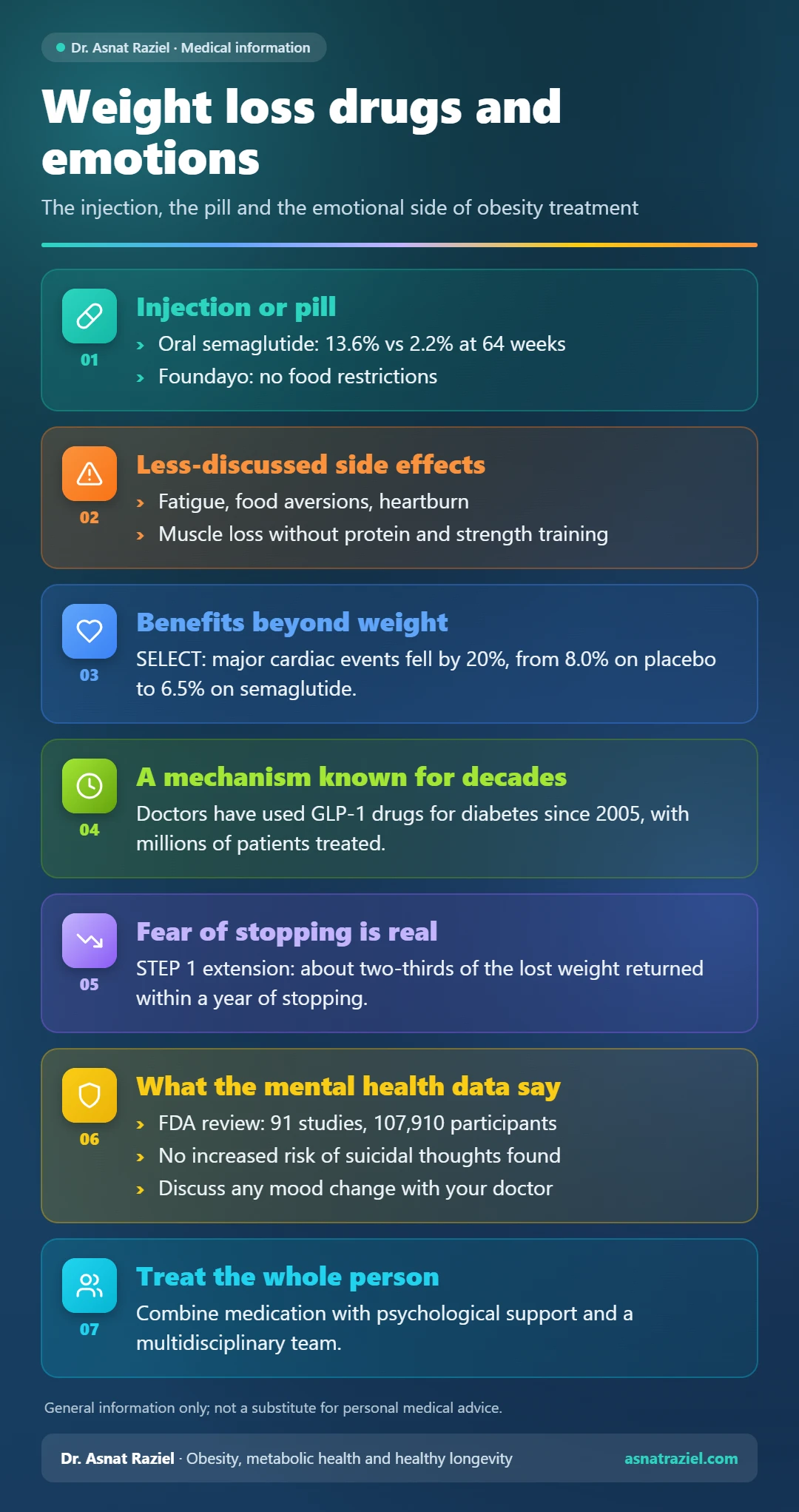
One of the most intriguing developments is the shift from the injection pen to the pill. The FDA, the US Food and Drug Administration, approved the Wegovy pill in December 2025. In the OASIS 4 trial, participants lost an average of 13.6% of their body weight after 64 weeks, compared with 2.2% on placebo. In April 2026, the FDA approved Foundayo, an orforglipron pill that you can take with no food restrictions. Foundayo then reached pharmacies in Israel in September 2026.
The reason for this development is clear: not everyone feels comfortable with injections. Some people are afraid of needles. Others struggle with the idea of injecting themselves regularly. And for some, the injection makes them feel labeled as “sick.” The pill is therefore meant to make treatment more accessible, reduce psychological barriers and make it easier to stay on treatment.
However, a pill is not necessarily “easier” on the body. Absorption through the digestive system, different doses and individual sensitivity all affect effectiveness and side effects. Nausea and digestive symptoms are common with the pill as well. In other words, it is not a magic solution, but another option in the toolbox that requires personal tailoring. The choice between an injection and a pill is also part of the link between weight loss drugs and emotions. Convenience, a sense of control and how you feel about the treatment all affect persistence. You’ll find a detailed comparison in my article Wegovy pill vs. Foundayo.
The side effects people talk about less
Most public discussion focuses on nausea, vomiting and constipation. These are indeed common at the start of treatment. In most cases, we can control them by adjusting the dose, increasing it slowly and giving the right nutritional guidance. But there are also side effects that get less attention.
Examples include fatigue, loss of appetite to the point of difficulty eating, aversion to certain foods, heartburn and sometimes general weakness. Some patients also lose muscle mass if they don’t make sure to get enough protein and do strength training. In addition, there are rare effects that require medical monitoring, such as gallstones, an increased heart rate or upper digestive complaints. That is why treatment is not “inject and forget,” but a medical process in every sense.
These drugs are young, and the fear is understandable
One of the most common questions is: what will happen in ten or twenty years? The concern about a lack of long-term research is completely legitimate. Indeed, the widespread use of obesity drugs began only in recent years. Still, it is important to be precise. Medicine has known the GLP-1 mechanism for decades, and doctors have used drugs from this family to treat diabetes since 2005.
Clinical experience today includes millions of patients. Moreover, studies show benefits beyond weight. In the SELECT trial, for example, the risk of a major cardiac event fell by 20%: from 8.0% on placebo to 6.5% on semaglutide. There is no such thing as zero risk in medicine, but there is a balance between risk and benefit. In obesity, a chronic disease with proven complications, the risk of not treating is sometimes greater than the risk of treatment. You’ll find more in my article on the fear of long-term side effects.
Weight loss drugs and emotions: what happens inside
This is one of the most fascinating and challenging aspects. Losing weight changes your relationship with food, with your body and with the people around you. Some people experience enormous relief, freedom from constant hunger and a sense of inner calm. Others find themselves confused. Who am I without food? What fills the emotional space that has opened up?
Some patients develop feelings of guilt, dependence or fear of stopping the drug. This fear is not detached from reality. In the STEP 1 trial extension, participants regained about two-thirds of the weight they had lost within a year of stopping treatment. On the other hand, others actually gain self-confidence and motivation to change their lifestyle. I wrote about coping with this fear in my article on the fear of regaining weight.
Weight loss drugs and emotions: what the data say about mental health
In recent years, a concern arose that these drugs increase suicidal thoughts. In January 2026, the FDA requested removal of this warning from the labels of Wegovy, Zepbound and Saxenda. The FDA analyzed 91 controlled studies with 107,910 participants and found no increased risk. In addition, it found no increase in anxiety, depression or irritability. Even so, any change in mood warrants a conversation with your doctor. You can read more on this topic in my article on GLP-1 drugs and mental health.
That is why drug treatment must address psychological and emotional needs, not just the number on the scale. The drug does not replace inner work. Rather, it makes it possible. When we connect weight loss drugs and emotions, with support from a psychologist or a multidisciplinary team, the chance of deep and lasting change grows.
Between medicine, fashion and stigma
When celebrities such as Oprah Winfrey speak openly about using a drug to maintain their weight, the conversation swings between inspiration and envy, and between criticism and stigma. It is important to remember that obesity is not a moral failure but a complex medical condition. These drugs are not a shortcut for the lazy, but medical treatment for those who need it. You can read about the harm of labeling in my article on weight stigma.
The bottom line on weight loss drugs and emotions
The new weight loss drugs are a revolution. They are powerful, effective and life-changing, but they are not free of questions, concerns and challenges. Ultimately, weight loss drugs and emotions are intertwined, with the injection and with the pill alike. The right path is personalized medicine, close medical follow-up and an open conversation that respects both the excitement and the fears.
The information in this article is general and does not replace personal medical advice.
References
Oral Semaglutide at a Dose of 25 mg in Adults with Overweight or Obesity
No more injections? New weight-loss pill to launch in Israel next week
Semaglutide and Cardiovascular Outcomes in Obesity without Diabetes
Oprah Winfrey Admits She Uses Weight-Loss Medication as a ‘Maintenance Tool’