By Dr. Asnat Raziel, bariatric surgeon specializing in obesity treatment, metabolic health and healthy longevity; Director of the Multidisciplinary Center for Obesity Treatment, Assia Medical, Assuta Ramat HaChayal, Tel Aviv
War and weight gain: a pattern that returns after every round
War and weight gain often go hand in hand, even for people who did not deliberately change anything in their habits. The war may end on the battlefield, but in the body and mind it keeps working for a long time. In the months after periods of security tension, we see a recurring pattern in the clinic: weight gain, sometimes rapid and seemingly unexplained.
This is not just a matter of “I ate more” or “I moved less.” Behind the gain lies a deep change in the body’s control systems. Since October 2023, Israel has been through repeated rounds of fighting, including the war with Iran in 2026. So the question is relevant today for many of us. In this article I focus on the body’s long recovery: why the scale keeps climbing after the sirens stop, and how to get back to balance.
What actually happened to us: the data from Israel
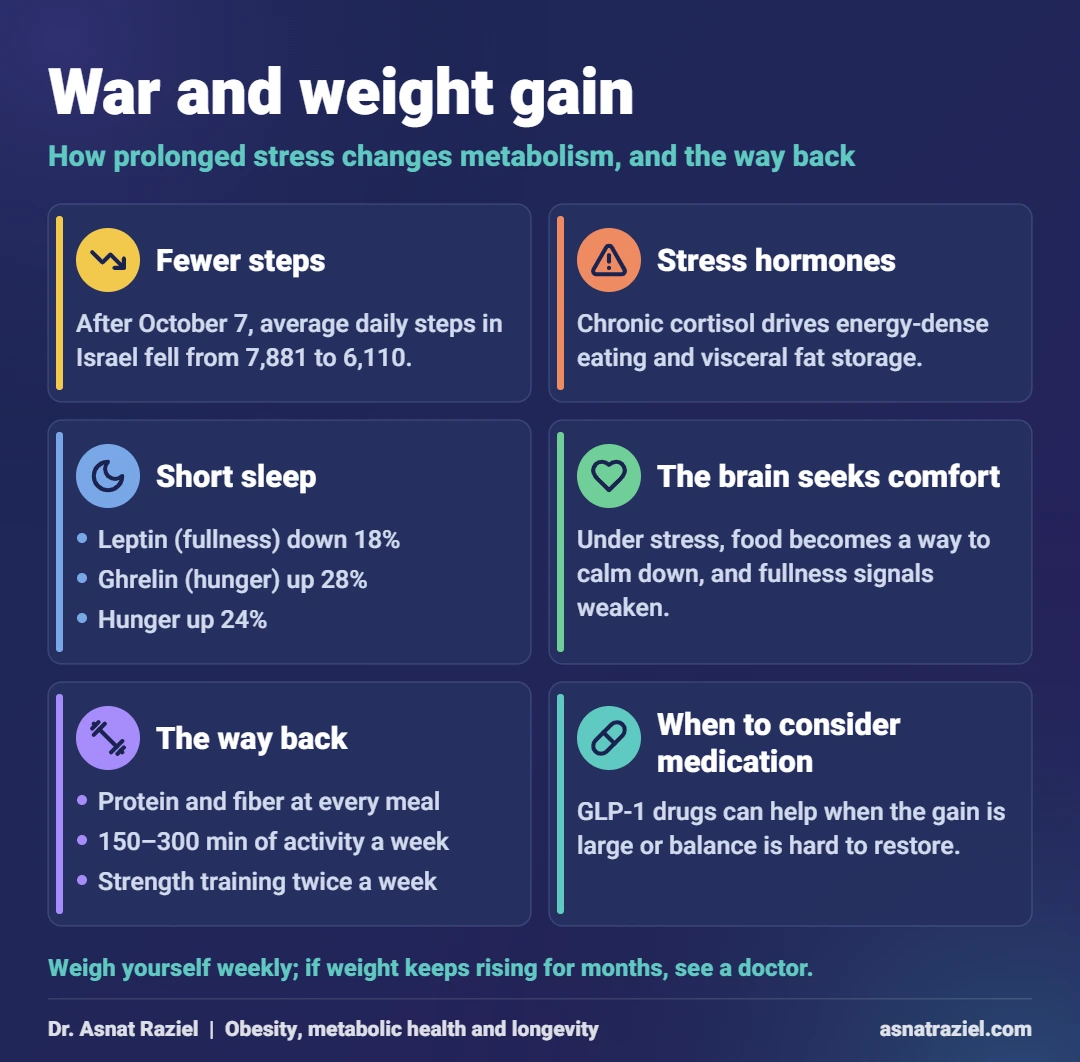
Since 2020, researchers at Tel Aviv University have been following about 5,000 Israelis using smartwatches and a dedicated app. According to data published in December 2023 (in Hebrew), after October 7 the average number of daily steps fell from 7,881 to 6,110. In addition, reported sleep quality dropped, and the stress index peaked at 3.45 on a scale of 1 to 5. That is a much higher value than during the COVID-19 period.
There is an encouraging side, too. An earlier study by the same group examined 954 Israelis during a military operation in May 2021. Then, too, heart rate rose, and sleep became shorter and poorer. However, after that short operation, the measures returned to baseline in almost all participants. By contrast, a prolonged war with repeated rounds keeps the body on alert for a long time.
The hormonal axis that goes on alert
Under stress, the body activates the hypothalamic-pituitary-adrenal (HPA) axis, and as a result cortisol levels rise. This hormone was originally designed for survival, but it changes your metabolism. A comprehensive review of stress, eating and the reward system describes how chronic cortisol encourages eating energy-dense food and storing visceral fat, the fat around the abdominal organs. At the same time, it impairs insulin sensitivity.
Harvard Health also explains why stress causes people to overeat. When stress persists, cortisol can stay high and increase appetite.
But that is not the end of it. Ongoing stress also disrupts sleep, and short sleep throws appetite hormones off balance. In a controlled trial in healthy young men, two nights of restricted sleep lowered the satiety hormone leptin by 18%. Meanwhile, the hunger hormone ghrelin rose by 28%, and hunger increased by 24%. This creates a self-feeding cycle: stress leads to eating, eating raises weight, and weight adds to stress. I wrote more about this link in my article on sleep deprivation and obesity.
The brain looks for comfort, and the body pays the price
Beyond hormones, there is also a deep neurobiological component here. The brain’s reward systems, especially the dopamine pathways, change under stress. Food becomes a way to calm down, almost like a medicine. This explains why so many people report emotional eating in wartime during exactly these periods.
In other words, chronic stress changes how the brain responds to fullness signals. Even when the body needs no extra energy, the urge to eat stays high. This is a real change in how the brain processes information, not a lack of discipline.
Less movement, less routine
In wartime, physical activity naturally declines. People leave home less, lose their routine and sit a lot. NEAT also drops sharply. NEAT, or non-exercise activity thermogenesis, is the energy the body burns in unplanned daily activity, such as walking, climbing stairs or doing chores at home.
This drop is barely noticeable. Over weeks and months, however, it adds up to weight gain. The data from Israel show this clearly: about 1,800 fewer steps every day, day after day.
War and weight gain: why going back to routine doesn’t rebalance things on its own
One of the biggest challenges comes precisely after the sirens stop. The body does not “reset” itself right away. Eating patterns, changes in sleep and new habits stay with us. That is why many people are surprised to find that their weight keeps rising even after life gets back on track.
This is exactly where a conscious intervention matters. Not an extreme diet, but rebuilding balance. You may also want to read about wartime stress and its effect on body and mind.
The way back from war-related weight gain: an integrative approach
The first step is understanding. The link between war and weight gain is not a personal failure but a well-known biological response. Recognizing this allows precise treatment and reduces guilt.
Next come the practical steps:
- A diet rich in protein and dietary fiber, which strengthens the feeling of fullness and stabilizes blood sugar levels.
- A gradual return to daily movement, even short walks. For example, a steady daily step count helps you maintain your weight.
- A weekly activity target: the World Health Organization guidelines recommend 150 to 300 minutes of moderate-intensity activity, plus strength training twice a week.
- Good-quality sleep, and sometimes active intervention to improve it.
- Tools to reduce stress, such as breathing exercises, meditation and social support.
Remember that managing stress is part of the treatment itself, not a luxury. Even ten minutes a day of slow breathing, a walk outdoors or a talk with a friend lowers your level of alertness. In addition, a regular bedtime and less screen time in the evening help the body leave emergency mode. I have written in detail about the link between stress and obesity, including practical tools.
In many cases, it is also worth considering medication, especially when the gain is significant or when it is hard to get back to balance. GLP-1 medications such as semaglutide (Ozempic/Wegovy) and tirzepatide (Mounjaro/Zepbound) act on the hunger and satiety centers in the brain. In some patients they also reduce emotional eating, as I described in my article on GLP-1 and emotional eating. So during stressful periods, they can be an important tool for stabilizing the system.
Looking ahead: what the war taught us about the body
The war revealed how sensitive the body is to environmental and emotional change. It also highlighted that obesity is not just the result of choices, but of an entire system responding to reality. Beyond that, it reminded us that our health is tied to the resilience of all of us.
From my experience in the clinic, people who spot the change early manage to stop it quickly. So it is worth weighing yourself once a week and paying attention to your sleep and appetite. If your weight keeps rising for several months, that is the time to see a doctor. Early treatment is much easier than treating a gain that has built up over a year.
The bottom line on war and weight gain
The important news is that this system can be rebalanced. War and weight gain are not destiny. With understanding, professional support and the right combination of lifestyle and medical treatment, you can return to your previous weight. What’s more, you can build a stable, healthy foundation for the future.
This article provides general information and does not replace personal medical advice.
References
Mental stress rose, physical activity fell: how the war affected us (Maariv, in Hebrew)
Real-time sensing of war’s effects on wellbeing with smartphones and smartwatches
Stress, eating and the reward system
World Health Organization 2020 guidelines on physical activity and sedentary behaviour