By Dr. Asnat Raziel, bariatric surgeon specializing in obesity treatment, metabolic health and healthy longevity; Director of the Multidisciplinary Center for Obesity Treatment, Assia Medical, Assuta Ramat HaChayal, Tel Aviv
Retatrutide and heart disease: why the TRIUMPH-3 trial matters
Retatrutide and heart disease are an important pairing to understand, because obesity and heart disease often go hand in hand. The TRIUMPH-3 trial looked at exactly this group: people with severe obesity and established cardiovascular disease. In this article, I focus on what the trial showed for them, and then on what TRIUMPH-2 found in people with diabetes.
In July 2026, Eli Lilly announced success in two more phase 3 trials of retatrutide. The drug acts on three receptors at once: GLP-1, GIP and glucagon. Both trials met their main efficacy goals. As a result, the company plans to submit an application for approval to the FDA in the first quarter of 2027.
According to the company, this completed five positive phase 3 trials in the development program. At the end of September 2026, two full papers were also published in leading journals. Still, it is important to remember that, as of early November 2026, the drug is not approved in any country, including Israel.
Who took part in TRIUMPH-3, and what was tested in diabetes
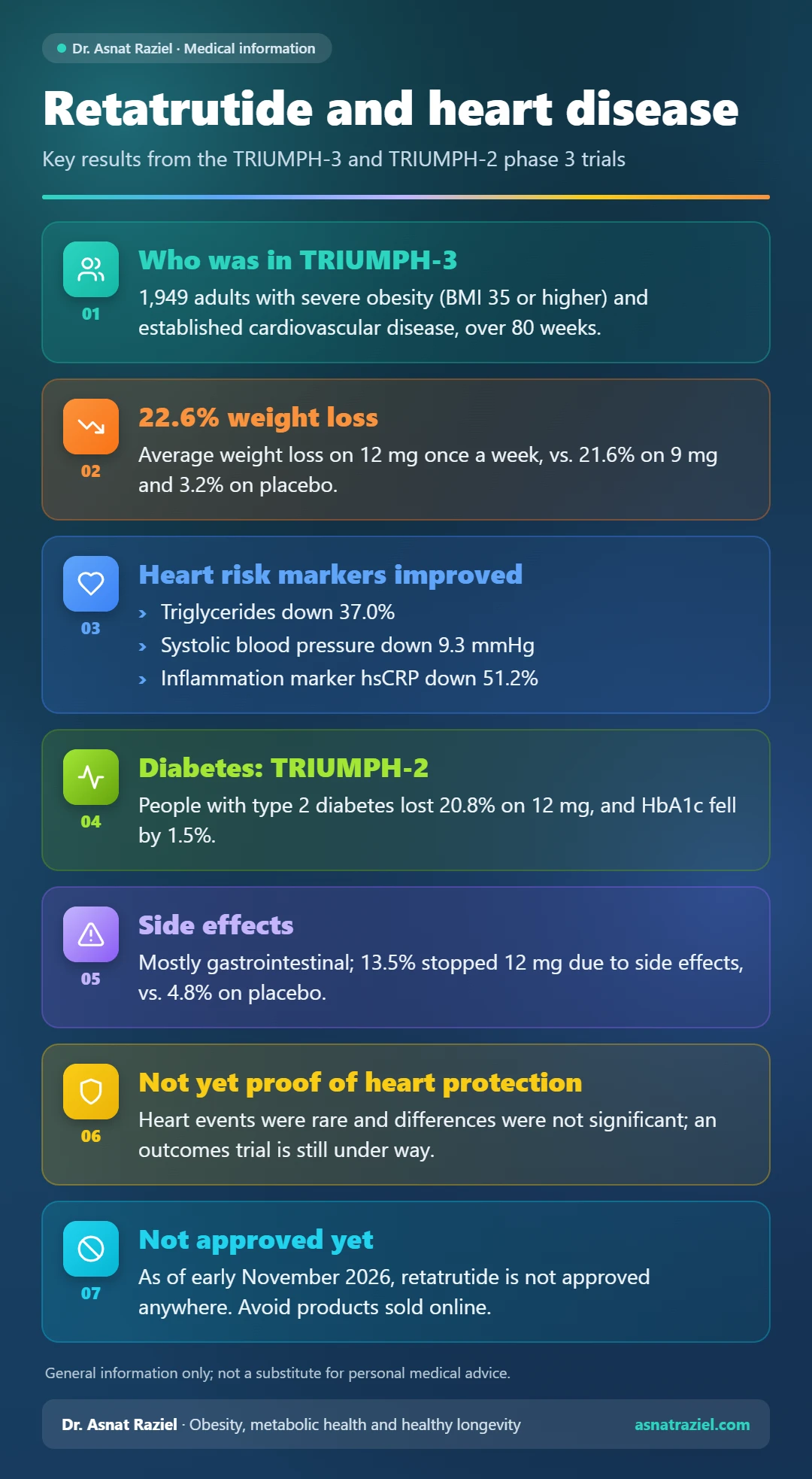
Both trials lasted 80 weeks and compared a weekly injection of retatrutide with placebo. TRIUMPH-2 included 1,152 adults with obesity or overweight and type 2 diabetes. TRIUMPH-3, on the other hand, included 1,949 adults with severe obesity (a BMI of 35 or higher) and established cardiovascular disease, with or without diabetes.
One term is worth knowing here. The efficacy estimand is an efficacy analysis, meaning the result in people who kept taking the drug as planned. Company announcements usually report this analysis. Scientific papers also report an intention-to-treat analysis, which includes all participants, and its results are slightly lower.
Retatrutide and heart disease: 22.6% weight loss
In TRIUMPH-3, participants on the high dose, 12 mg once a week, lost an average of 22.6% of their body weight. On 9 mg, weight loss reached 21.6%, and in the placebo group it was only 3.2%. This is an impressive result, especially in a population at high cardiac risk.
In addition, on 12 mg the company reported a 37.0% drop in triglycerides and a 16.5% drop in non-HDL cholesterol. Systolic blood pressure fell by 9.3 mmHg. Likewise, hsCRP, a sensitive blood marker of inflammation in the body, dropped by 51.2%. However, the announcement did not detail the corresponding changes in the placebo group.
What this means for people with heart disease considering retatrutide
First, the 22.6% weight loss was achieved in a population at high cardiac risk, not only in relatively healthy people. Second, several cardiac risk factors improved at the same time: triglycerides fell by 37.0%, systolic blood pressure by 9.3 mmHg and the inflammation marker hsCRP by 51.2%. Even so, better risk markers are not yet proof that the drug protects the heart. So if you live with heart disease, it makes sense to consider obesity treatment together with your doctors, without giving up your cardiology care. For a broader view of all the trials and how to read their numbers, see my article on how the results of every retatrutide trial compare.
Beyond heart disease: people with diabetes also lost about 20% of their weight
In TRIUMPH-2, according to the efficacy analysis, patients on 12 mg lost an average of 20.8% of their body weight. On 9 mg they lost 19.1%, and on 4 mg 12.7%, compared with 4.0% on placebo. At the same time, HbA1c (average blood sugar over the past three months) fell by 1.5% on 12 mg and by 1.6% on 9 mg. In the placebo group, it fell by only 0.2%.
The full paper in The Lancet also presented the intention-to-treat analysis. According to that analysis, weight loss on 12 mg reached 18.8%, compared with 5.1% on placebo. Weight loss like this in people with diabetes is especially impressive, because it is harder for them to lose weight. For a deeper look at TRIUMPH-2 itself, see my article on retatrutide and diabetes, which is devoted entirely to people with diabetes.
Three hormones, one strategy
Retatrutide is one of the first drugs to activate three hormone receptors together. First, GLP-1 and GIP reduce hunger and improve insulin secretion. I have written in detail before about the role of the hormone GIP. Second, activating the glucagon receptor may increase energy expenditure and fat breakdown, mainly in the liver.
In other words, the combination is designed not only to reduce how much you eat, but also to affect metabolism. Researchers suspect this may explain the large weight loss seen across the program. For a detailed comparison with semaglutide, you can also read my article on retatrutide versus Wegovy.
Five trials, one message
According to the company, the five phase 3 trials paint a consistent picture. In December 2025, the TRIUMPH-4 trial reported weight loss of up to 28.7% and relief of knee pain. I wrote about this in my article on retatrutide and knee pain.
Then, on September 29, 2026, the TRIUMPH-1 trial was published in NEJM. It included 2,339 adults with obesity and without diabetes. In the intention-to-treat analysis, they lost 17.6%, 23.7% and 25.0% of their weight on the three doses, compared with 3.9% on placebo. In addition, the drug reduced knee pain and sleep apnea events.
Safety and heart events in TRIUMPH-3
The common side effects were gastrointestinal: diarrhea, nausea, constipation and reduced appetite. For example, in TRIUMPH-3, nausea occurred in 22.4% of people on 12 mg, compared with 5.8% on placebo. Some patients also reported dysesthesia, an unusual or unpleasant sensation in the skin. According to the company, most side effects were mild to moderate.
The rate of stopping treatment because of side effects was higher than on placebo. In TRIUMPH-3, it reached 13.5% on 12 mg, compared with 4.8% on placebo. Meanwhile, heart events in both groups were rarer than expected. On the broad measure (MACE-5), there were 44 events in the drug groups and 52 on placebo.
By contrast, on the narrower measure (MACE-3), meaning heart attack, stroke and cardiovascular death, there were 27 events in the drug groups and 23 on placebo. The differences are not statistically significant, so no conclusion can be drawn from them. The trials were also not designed to test cardiac safety. A dedicated outcomes trial, which is still under way, will examine this question.
Retatrutide and heart disease: what it means for you
The TRIUMPH trials strengthen the view that retatrutide may become a key drug in obesity medicine. If it is approved, it will compete not only on the number of kilograms lost, but also on its ability to improve diabetes, blood fats and blood pressure. Until approval, however, the drug is available only within clinical trials.
That’s why it is important to be wary of products sold online under the name retatrutide. They are not a regulated drug, and no one knows what is inside them. Meanwhile, effective approved treatments already exist. You’ll find information about them in my guide to retatrutide for weight loss and in other articles on the site.
Bottom line
The new TRIUMPH trials broaden the evidence for people with diabetes and for patients with heart disease. Weight loss remained large, and risk markers also improved. Ultimately, the decision about treatment should be made with a doctor, based on each person’s medical situation.
The information in this article is general only and is not a substitute for personal medical advice.
References
Retatrutide, a Triple Hormone Receptor Agonist, for Treatment of Obesity
The studies were funded by Eli Lilly, the drug’s manufacturer.