By Dr. Asnat Raziel, bariatric surgeon specializing in obesity treatment, metabolic health and healthy longevity; Director of the Multidisciplinary Center for Obesity Treatment, Assia Medical, Assuta Ramat HaChayal, Tel Aviv
Peptide injections often get pitched as a shortcut to faster healing and a younger body. Before you roll up your sleeve, though, it pays to ask what each popular peptide has actually been tested for and how safe it is. In this article, I focus on that practical side: the evidence behind the best-known peptides, the safety risks, and a short checklist to use before any treatment. If you are more interested in the market and the regulatory battle behind the trend, I cover them in my article on the peptide craze and the race between hype and science.
Why peptide injections need a safety check now
Over the past year, peptide injections have become one of the most talked-about topics in longevity medicine, the field focused on extending healthy life. Social media presents them as a fix for almost everything. They promise rapid healing of injuries, muscle building and fat loss. They also promise better sleep, a sharper memory and even slower aging.
Behind the excitement, however, the reality is far more complicated. Some peptides are proven, approved medicines. Researchers have barely tested many others in humans, and the evidence for them is weak. And right now, as the FDA (the US Food and Drug Administration) rethinks its policy, the debate is only heating up.
What is a peptide, and why isn’t every peptide a medicine?
Peptides are short chains of amino acids, the building blocks of proteins. In the body, they act as signaling molecules that carry messages between cells. They help regulate hormone release, tissue repair, immune activity, metabolism and muscle growth.
In fact, some of the most important drugs in medicine are peptides. Insulin and growth hormone are long-standing examples. GLP-1 drugs such as Ozempic, Wegovy and Mounjaro are also peptide-based. All of these went through large clinical trials. For example, the STEP 1 trial enrolled 1,961 adults, and the weekly injection led to a 14.9% drop in body weight. I explain where peptides fit in medicine in my article on peptides as the new language of medicine.
The problem starts when people project that success onto hundreds of other peptides. Most of them have never gone through the same research path. Interestingly, the approved GLP-1 drugs are now the subject of early studies on aging itself, as I described in my article on GLP-1 drugs and aging.
Popular peptide injections, one by one
In recent years, several experimental peptides have become especially popular:
- BPC-157: sellers market it as a way to speed the healing of tendons, muscles and the digestive tract.
- TB-500: users credit it with better recovery after injuries and less inflammation.
- CJC-1295 and ipamorelin are meant to boost growth hormone release, to improve muscle mass and body composition.
- GHK-Cu appears mainly in aesthetics marketing, with claims of better skin and hair growth.
- Epitalon: sellers present it as acting on telomeres, the protective caps at the ends of chromosomes, and on cell aging.
Despite the promises of these peptide injections, most of the evidence comes from lab and animal studies. Sometimes there are also small case series in humans. Still, there are no large clinical trials that allow a clear conclusion.
BPC-157 as a test case: what the evidence shows
Longevity experts warn that the use of peptide injections is spreading much faster than knowledge about it. BPC-157 is a good example. A 2025 systematic review found 36 studies on it. Of these, 35 took place in animals or in the lab, and only one in humans. In that single study, 7 of 12 patients with knee pain reported relief. In addition, the researchers found no clinical safety data in humans.
Many claims about slower aging, better thinking or “renewing the body” rest on theoretical mechanisms. Even when an interesting effect shows up in the lab, that does not mean the treatment will improve health or extend life. So, as of today, no experimental peptide has proven that it extends human life in a high-quality clinical trial. For a broader review of drugs under study against aging, see my article on longevity drugs.
The safety risks of peptide injections
Most of these peptides are not approved for medical use. As a result, websites often sell them as “research chemicals,” outside a regulated supply chain. In that situation, there is no guarantee of the purity, the dose or even the identity of what is in the vial. An analysis published in Health Affairs found that even the quality certificates submitted to the FDA did not include specific tests for contaminants and bacterial toxins.
Even when the peptide is “real,” we lack information on side effects with long-term use. There are concerns about effects on the immune system, hormonal disturbances and allergic reactions. Moreover, some peptides encourage the growth of new blood vessels, so there is a theoretical concern that they could fuel tumors. According to a review in Pharmacy Times, the World Anti-Doping Agency banned BPC-157 back in 2022.
What has changed in US regulation?
In 2023, the FDA placed 19 peptides on a list of substances with significant safety concerns. This effectively barred pharmacies from compounding them. In February 2026, US Health Secretary Robert F. Kennedy Jr. announced that about 14 of them would get broader access. According to a summary by AJMC, the names mentioned included BPC-157, TB-500, CJC-1295, ipamorelin and GHK-Cu.
On July 23–24, 2026, an FDA advisory committee on pharmacy compounding met. FDA scientists recommended against adding any of the peptides to the list of permitted substances. Even so, the committee voted by a narrow margin, 8 to 6, in favor of BPC-157 and KPV. The recommendation was not binding on the FDA.
Then, on October 28, 2026, the US Department of Health and Human Services (HHS) announced an interim policy. Under strict conditions, pharmacies may compound six peptides (BPC-157, TB-500, KPV, MOTS-c, Semax and epitalon) for a specific patient. This is not FDA approval, and it does not add them to the official list. The advisory committee is expected to discuss five more peptides in February 2027.
Supporters argue that compounding in licensed pharmacies is safer than the gray market. Opponents, by contrast, warn that people will read wider access as indirect approval of substances that still lack evidence.
Approved peptides versus experimental ones
Peptides are a fascinating field with real medical potential. Some of them will likely become important drugs in the coming decades. The promising areas include aging, muscle disease, tissue repair, metabolic disease and perhaps nerve disease too.
Even so, it is important to tell two groups apart. On one side are peptides that proved themselves and became approved drugs, such as the GLP-1 medications. On the other are hundreds of peptides still in early stages of research. Anyone considering such a treatment should ask a few simple questions:
- Are there controlled trials in humans?
- Does the product come from a regulated manufacturer, with quality testing?
- Who will track side effects over time?
A practical checklist before peptide injections
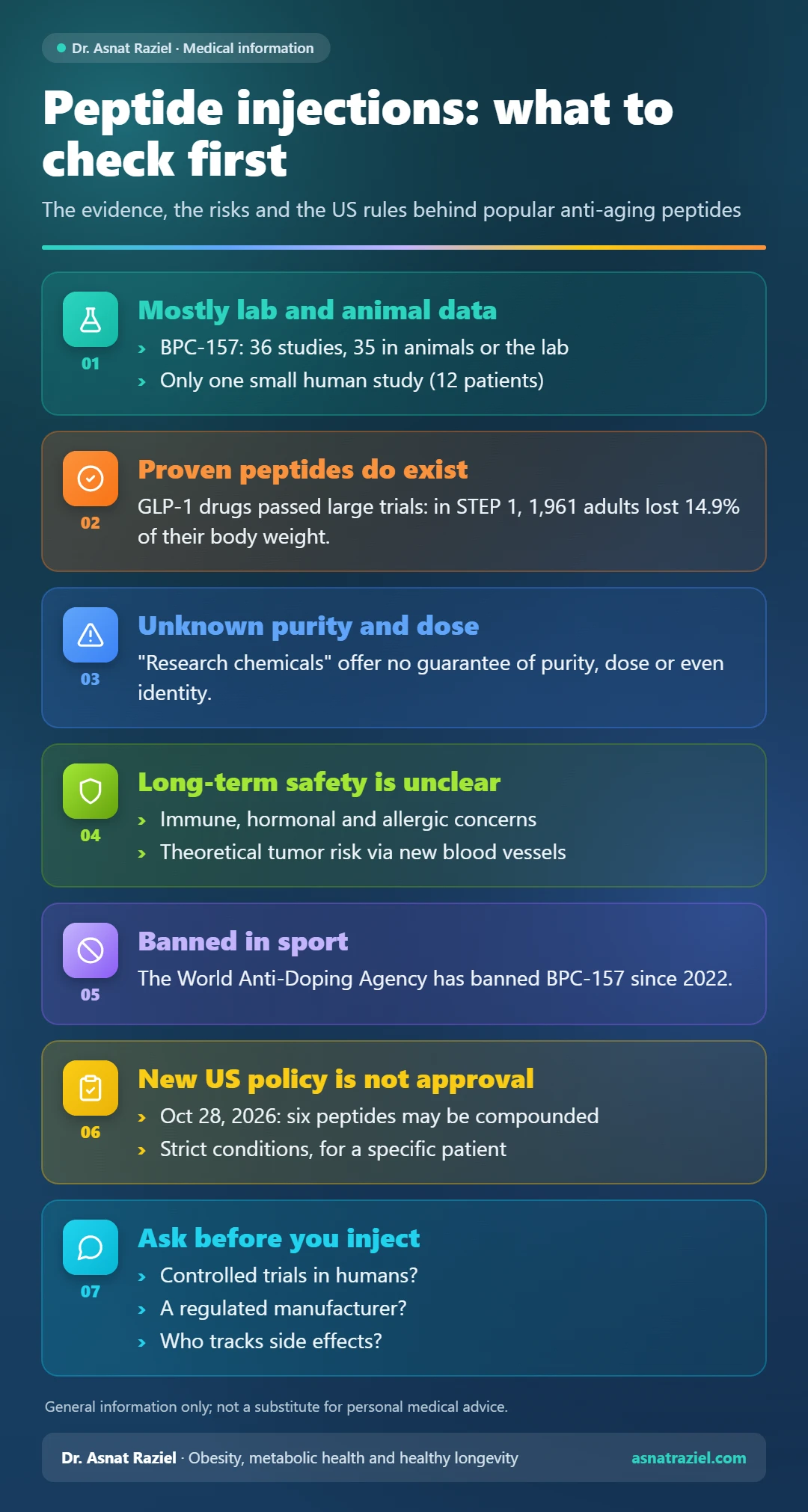
Here is how I would turn those questions into practice, using only what we know today. First, ask for the human data. For BPC-157, for example, one small study of 12 patients is not enough to judge benefit or harm. Second, ask where the vial comes from. A product sold as a “research chemical” offers no guarantee of purity, dose or identity. Third, ask about long-term safety, including immune, hormonal and allergic effects. Fourth, if you compete in sports, remember that the World Anti-Doping Agency has banned BPC-157 since 2022. Finally, keep in mind that the new US policy allows compounding, but it is not an approval.
Bottom line
In evidence-based longevity medicine, there is no room for adopting a treatment just because it is popular on social media. Any decision about peptide injections should rest on the quality of the evidence, the safety profile, manufacturing quality and close medical follow-up. In the end, the foundation of healthy longevity remains nutrition, movement, sleep and social connection. I have written about this approach in my articles on wellness and lifestyle medicine and on longevity and rejuvenation.
This article provides general information and is not a substitute for personal medical advice.
References
Emerging Use of BPC-157 in Orthopaedic Sports Medicine: A Systematic Review
FDA Advisory Committee’s Vote May Open A Drug-Compounding Back Door For Unapproved Peptides
FDA advisory committee backs two controversial peptides
5 Things to Know About the FDA’s Peptide Reversal
Peptides: HHS Announces Limited Enforcement Discretion for Compounding of Six Peptides
Heal or Harm: Body Protective Compound-157 in the Gray Zone
Once-Weekly Semaglutide in Adults with Overweight or Obesity