By Dr. Asnat Raziel, bariatric surgeon specializing in obesity treatment, metabolic health and healthy longevity; Director of the Multidisciplinary Center for Obesity Treatment, Assia Medical, Assuta Ramat HaChayal, Tel Aviv
The peptide craze: big promises, a huge market and open questions
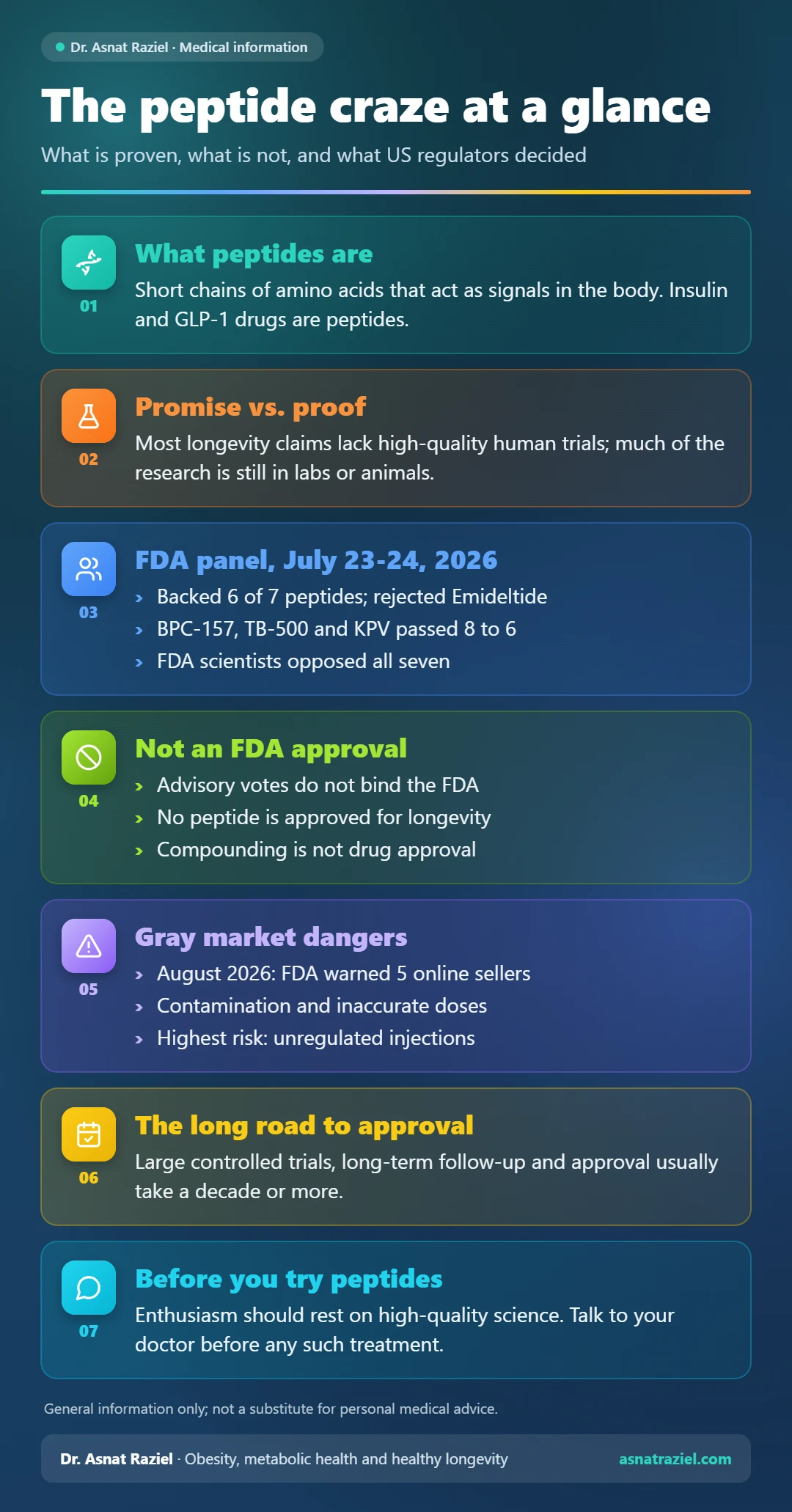
The peptide craze is sweeping through the world of longevity medicine today. As a result, clinics around the world offer more and more peptide treatments. However, experts warn that public and commercial enthusiasm is often running ahead of the scientific evidence. That is the message of an article from Northeastern University published in July 2026. It appeared amid a broad debate in the United States about the regulatory future of several peptides.
Peptides: the building blocks of future medicine?
Peptides are short chains of amino acids. They make up proteins and act as signaling molecules in the body. In addition, they bind to specific receptors on cells and switch on many biological processes. These range from hormone release to metabolic regulation and tissue repair.
In fact, some of the most important drugs in modern medicine are peptides. Insulin, for example, is a peptide. Likewise, the GLP-1 drugs, including Ozempic, Wegovy and Mounjaro, are peptides that have become a proven medical revolution. You can read about how they work in my article on how obesity medication works. For a look at the field as a whole, see my article on peptides in medicine.
What sparked the peptide craze?
The huge success of GLP-1 drugs fueled the peptide craze, creating unprecedented interest in other peptides. On social media, at conferences and in longevity clinics, peptides are now marketed with promises of:
- Slower aging.
- Better mitochondrial function.
- Faster injury healing.
- Building muscle mass.
- Better athletic performance.
- Higher-quality sleep.
- Skin rejuvenation.
- Sharper thinking.
- A longer life.
Yet most of these promises are still not backed by high-quality clinical trials in humans.
When science says “not yet”
Prof. Mansoor Amiji of Northeastern University, an expert in drug delivery systems, explains that the potential of peptides is indeed enormous. Even so, the road there is full of challenges.
First of all, peptides break down quickly in the body. Moreover, they sometimes struggle to reach the target tissue, and some need to get inside the cell itself. For this reason, they require advanced systems for precise delivery. Without such systems, he says, many of the peptides sold online probably never reach their target at all. He also stresses that there is still no evidence to support claims of longer life. In many cases, research is still at the lab or animal stage. Only a few peptides have proven effective and safe in large trials.
The peptide craze and the regulatory battle in the US
On July 23-24, 2026, the PCAC met. This is the FDA’s advisory committee on pharmacy compounding. The committee discussed whether to let pharmacies custom-prepare several peptides for patients with a prescription, a process known as compounding. The peptides under discussion were:
- BPC-157
- TB-500
- MOTS-c
- KPV
- Semax
- Emideltide
- Epitalon
According to an AJMC report, the committee backed six peptides and rejected Emideltide. Overall, the votes were close. For example, BPC-157, TB-500 and KPV passed by 8 to 6, with one abstention. Notably, the FDA’s own scientific staff recommended against all seven peptides. In their words, the data are “insufficient to establish safety or effectiveness.”
What does this mean in practice?
It is important to stress that this is only a recommendation. An advisory committee vote is not an FDA decision, and it does not bind the agency. Then, on October 28, 2026, the US Department of Health and Human Services (HHS) announced an interim policy for these six peptides. Under strict conditions, it will not take action against pharmacies and doctors who compound them for a specific patient. However, the policy does not add the peptides to the official list, and it is not FDA approval. Next, the committee is expected to discuss five more peptides in February 2027.
In any case, none of these peptides is FDA-approved as a longevity or anti-aging treatment. Also, pharmacy compounding is not drug approval. It lacks the quality controls that an approved drug goes through.
The criticism: a back door for unapproved drugs
The recommendation drew sharp criticism. An opinion piece in Health Affairs argued that the vote ignores weak clinical evidence as well as safety and quality concerns. According to the authors, most of the committee members who voted in favor had ties to peptide businesses or clinics. As a result, they warn that the list will give peptides a legitimacy they have not earned and bypass the FDA approval process.
Between luxury clinics and the gray market
The demand behind the peptide craze has created a global market worth billions of dollars. Alongside the clinics, a gray market of peptides sold online has also grown. Often there is no oversight, no quality control and no reliable information about what the product contains. In August 2026, the FDA sent warning letters to five online sellers that sold peptides labeled “for research use only.”
Consequently, experts warn of contamination, inaccurate doses and safety risks. The danger is especially great with injections from unregulated sources.
Not all peptides are created equal
It is important to distinguish between two completely different worlds. On the one hand, some peptides have gone through large clinical trials and received regulatory approval. Doctors have used them for years, as with insulin and GLP-1 drugs.
On the other hand, dozens of peptides are still in early stages of research. A mechanism of action that sounds promising is not proof of safety or effectiveness in humans. Incidentally, the drugs now being tested to slow aging go through the same long research path. You can read more in my article on longevity drugs.
Where is the field heading?
Peptides will likely become one of the central areas of longevity medicine in the coming decade. The combination of molecular biology, pharmaceutical engineering and artificial intelligence is expected to produce a new generation of peptides. In particular, they will be precise, stable and targeted. I wrote more about this trend in my article on medical longevity, biotech and artificial intelligence.
Still, there is a long way to go. To move from the lab to accepted treatment, a peptide needs large controlled trials, proof of efficacy, long-term follow-up and regulatory approval. Approval of a new drug usually takes a decade or more.
Bottom line on the peptide craze
Peptides are not a passing fad, and they may become an important key to the medicine of the future. Today, however, there is a wide gap between the marketing promises and the evidence. The success of Mounjaro and Wegovy proves that peptides can spark a revolution. By contrast, it does not prove that every new peptide slows aging or extends life.
Ultimately, the peptide craze is a reminder of an old rule. In longevity medicine, as in every field of medicine, enthusiasm should rest on high-quality science, not replace it. So before any treatment of this kind, it is worth consulting a doctor.
This article provides general information and is not a substitute for personal medical advice.
References
Peptides – Are they the key to longevity or another health grift?
FDA Panel Backs 6 Peptides for Compounding
FDA’s Advisory Committee Votes on Peptides: What It Does and Doesn’t Do
Peptides at a Crossroads: What Wellness Providers Need to Know About HHS and FDA Actions
FDA Advisory Committee’s Vote May Open A Drug-Compounding Back Door For Unapproved Peptides




