By Dr. Asnat Raziel, bariatric surgeon specializing in obesity treatment, metabolic health and healthy longevity; Director of the Multidisciplinary Center for Obesity Treatment, Assia Medical, Assuta Ramat HaChayal, Tel Aviv
Orforglipron for weight maintenance: why the question matters
Orforglipron for weight maintenance has been one of the hottest topics in obesity medicine over the past year. Obesity is a chronic disease, so its treatment also continues over time. Losing a lot of weight is an important achievement. However, the stage that follows is just as hard: keeping the weight off. The ATTAIN-MAINTAIN trial tested exactly this question. Can you switch from a weekly injection to a daily pill without losing what you have achieved?
The answer is encouraging. Most participants who switched to the pill kept most of their weight loss. In contrast, those who switched to a dummy pill clearly regained weight. This picture fits what we know about weight regain after stopping GLP-1 drugs. In this guide, I go through the questions patients ask me when they consider making the switch.
What is orforglipron, and where is it approved?
Orforglipron is a GLP-1 drug taken as a pill once a day. Unlike the injections, it is a small molecule rather than a protein. Therefore, you can take it at any time of day, with or without food, and without special rules about drinking. The Japanese company Chugai developed the molecule. Later, Eli Lilly acquired the rights to it and completed its development.
Since the first version of this article, the picture has changed. On April 1, 2026, the US Food and Drug Administration approved the drug under the brand name Foundayo. The approved uses include weight loss as well as long-term weight maintenance. In August 2026, the UK became the first country in Europe to approve it. In addition, on October 16, 2026, the scientific committee of the European Medicines Agency recommended approval. Information about the drug’s arrival in Israel appears in my article on Foundayo in Israel.
How was the ATTAIN-MAINTAIN trial designed?
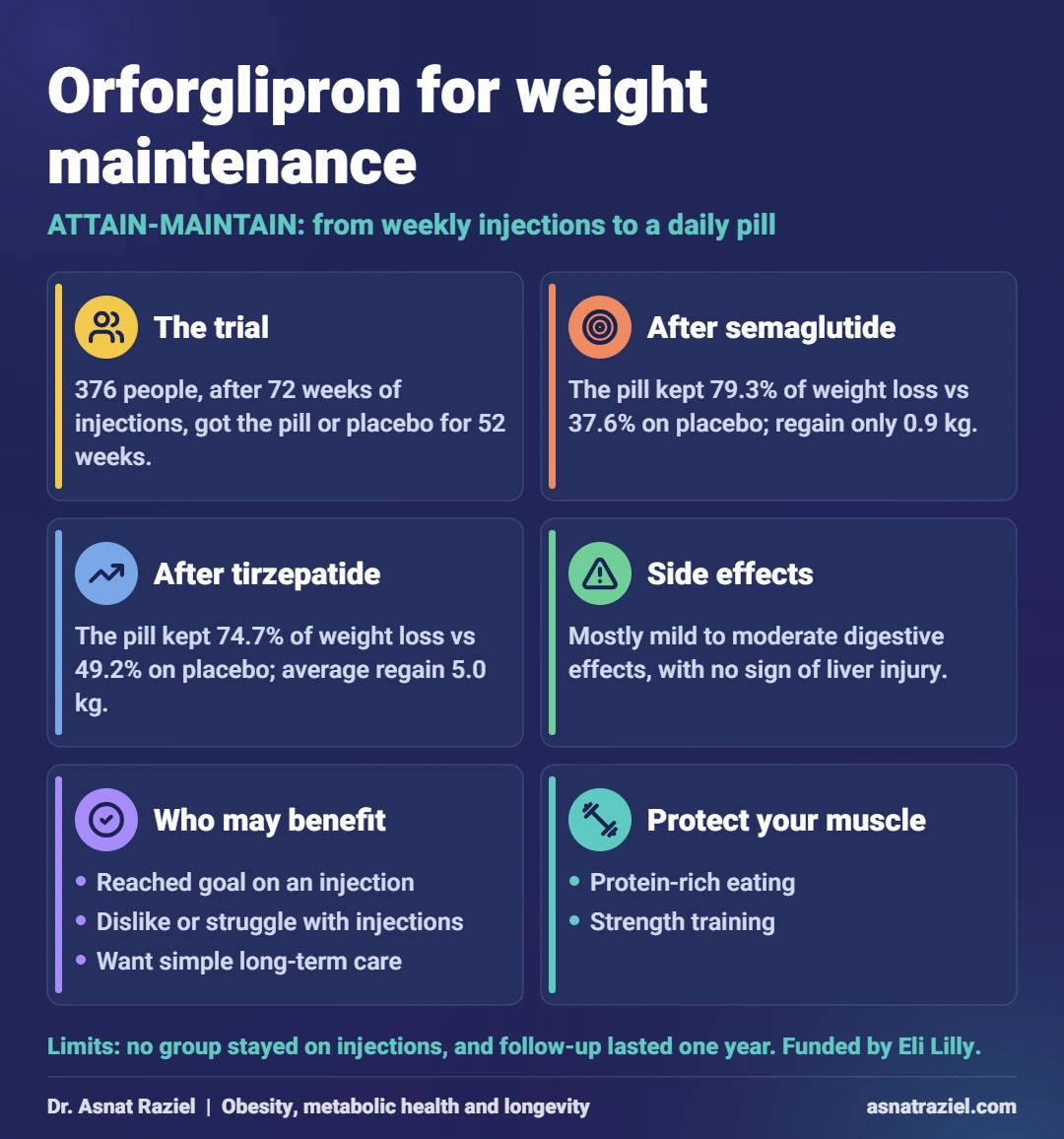
The participants came from the SURMOUNT-5 trial. In that trial, they had received a weekly injection for 72 weeks. The injection was either tirzepatide, the active ingredient in Mounjaro, or semaglutide, the active ingredient in Wegovy. At the end, the researchers randomly assigned them to two groups. One group received daily orforglipron, and the other received a dummy pill (placebo). Treatment continued for another 52 weeks.
In total, 376 people took part. The group coming from tirzepatide had 205 participants, and the group coming from semaglutide had 171. The trial was double-blind. In other words, neither the participants nor the staff knew who was receiving the drug and who was receiving placebo.
Results: orforglipron for weight maintenance after injections
The full results were published in May 2026 in the journal Nature Medicine. The researchers checked how much of the weight loss was maintained after one year. They looked at participants whose weight had stabilized by the end of injection treatment. In the tirzepatide group, the pill maintained an average of 74.7% of the weight loss. By contrast, placebo maintained only 49.2%. In the semaglutide group, the pill maintained 79.3% of the weight loss, compared with 37.6% on placebo. In both groups, the difference was statistically significant.
Measured in kilograms, the picture is just as clear. According to the company’s December 2025 announcement, those who switched from semaglutide weighed 95.0 kg at the switch and 95.9 kg after one year. That is, they regained an average of only 0.9 kg. Those who switched from tirzepatide weighed 90.9 kg at the switch and 95.9 kg after one year, a gain of 5.0 kg. Even so, at the start of SURMOUNT-5 they had weighed 115.8 kg on average.
A further analysis at 24 weeks sharpened the difference. People who switched from semaglutide to the pill lost another 0.1 kg, while those on placebo gained 9.4 kg. In the tirzepatide group, the pill led to a gain of 2.6 kg, compared with 9.1 kg on placebo. It is important to note that this was a post hoc analysis, done after the fact.
Is it safe? Side effects and warnings
The common side effects were digestive, such as nausea, constipation and diarrhea. Most were mild to moderate. In addition, the researchers found no sign of liver injury. The rate of stopping treatment because of side effects was similar between the groups. In the semaglutide group, 4.8% stopped on the pill and 7.6% on placebo. In the tirzepatide group, 7.2% stopped on the pill and 6.3% on placebo.
As with all GLP-1 drugs, the label warns about pancreatitis, gallbladder problems and dehydration. You must not take the drug if you or a family member has had medullary thyroid cancer, or if you have multiple endocrine neoplasia type 2 (MEN 2). That is why a medical evaluation before you start treatment is important.
Should you switch? Orforglipron for weight maintenance in practice
The findings open up a new option. A patient who reached their goal with a weekly injection may be able to switch to a daily pill and keep most of the result. This is especially important for people who struggle with injections or prefer a pill. Moreover, pills are usually simpler and cheaper to produce than injections. As a result, the pill may reach a much wider audience.
However, the trial has limitations that the researchers themselves point out. First, there was no group that stayed on injections. In other words, we cannot know whether the pill maintains weight as well as continuing the injection would. Second, follow-up lasted only one year. In addition, some of the weight came back in the tirzepatide group, so the switch suits some patients better than others.
So who can benefit? Orforglipron for weight maintenance mainly suits people who reached their goal with an injection and either have trouble with it or prefer a pill. People whose weight has stabilized and who want a simple long-term treatment may also be good candidates. At the same time, it is important to keep eating plenty of protein and doing strength training, to protect your muscle mass.
In practice, the decision should be personal. It depends on your starting weight, your previous drug, your side effects and your preferences. A comparison of the options appears in my article on the Wegovy pill vs. Foundayo. Details on how to take the pill appear in my complete guide to Foundayo treatment. If you are thinking of moving from an injection to a pill, you will also find practical information in my article on switching to the Wegovy pill. For the wider picture of long-term care, see my article on maintenance treatment for obesity.
Bottom line
Orforglipron for weight maintenance is no longer just a research idea. The drug is approved in the United States and the UK. In Europe, the regulator’s scientific committee has recommended approval, and the European Commission’s final decision is still pending. In the ATTAIN-MAINTAIN trial, people who switched from an injection to the pill kept 74.7% to 79.3% of their weight loss. Ultimately, the pill adds an important tool for the long-term treatment of obesity. Still, the decision to switch should be made with a doctor, together with nutrition and exercise support.
The information in this article is general and does not replace personal medical advice.
References
Tirzepatide as Compared with Semaglutide for the Treatment of Obesity
UK first in Europe to authorise orforglipron for weight management and type 2 diabetes
EMA Panel Backs Lilly’s Foundayo for Obesity and Type 2 Diabetes in Europe
The studies were funded by Eli Lilly, the drug’s manufacturer.