By Dr. Asnat Raziel, bariatric surgeon specializing in obesity treatment, metabolic health and healthy longevity; Director of the Multidisciplinary Center for Obesity Treatment, Assia Medical, Assuta Ramat HaChayal, Tel Aviv
The orforglipron phase 3 program is one of the largest research efforts ever run for an obesity drug. In this article, I walk through it trial by trial: who took part in each study, what it measured and what it found, in people with and without type 2 diabetes.
Orforglipron phase 3: a new era in obesity treatment?
Orforglipron for weight loss is not just another optimistic headline. Phase 3 data have, for the first time, put forward a real pill alternative to injectable treatments. This is one of the broadest research programs in the field, with thousands of participants in many studies. Based on these results, the FDA approved the drug on April 1, 2026, under the name Foundayo. For doctors, this is not only progress in drug therapy. It is a change in how we approach a chronic disease like obesity.
Orforglipron was developed by Eli Lilly. It activates the GLP-1 receptor, like the familiar injections. Unlike them, however, it is a small molecule rather than a protein, so it is not broken down in the digestive tract. The meaning is simple but profound: you take one pill a day, with no refrigeration, no injection pen and no food or water restrictions. A full guide to the drug itself appears in my article on Foundayo dosing and safe use.
How orforglipron works
Orforglipron acts on GLP-1 receptors, like the familiar treatments. It increases fullness, reduces hunger and slows stomach emptying. It also improves blood sugar control. Unlike protein-based drugs, however, the molecule is well absorbed through the digestive tract.
This is a significant advantage. It allows simple treatment with a pill, without depending on an injection. For many patients, that is the difference between starting treatment and giving it up. I compare the two routes in my article on choosing a pill or an injection for obesity.
How the orforglipron phase 3 program was built
Lilly tested the drug in two research programs. The ATTAIN program studied people with obesity or overweight. The ACHIEVE program studied people with type 2 diabetes. In each trial, researchers assigned participants to different doses of orforglipron, compared with placebo or another drug. They measured body weight, metabolic markers and safety.
The main obesity trial is ATTAIN-1, published in NEJM. It enrolled 3,127 adults with obesity and without diabetes, for 72 weeks. Participants took 6, 12 or 36 mg of orforglipron as a capsule, or a placebo, along with a healthy diet and physical activity.
Weight-loss results from the orforglipron phase 3 trials
The results show a clear and consistent pattern. After 72 weeks, weight fell by 7.5% with 6 mg, 8.4% with 12 mg and 11.2% with 36 mg. In the placebo group, by contrast, weight loss was 2.1%. Among those who stayed on treatment, according to a Lilly announcement, the high dose led to an average loss of 12.4%.
The weight loss was dose-dependent. In other words, the higher the dose, the better the response. On the high dose, 54.6% of participants lost 10% or more of their weight. In addition, 36.0% lost 15% or more, and 18.4% lost 20% or more. In the placebo group, the rates were 12.9%, 5.9% and 2.8%, respectively. Doctors consider a 10% loss a clearly meaningful clinical threshold.
People with type 2 diabetes also lost weight. In the ATTAIN-2 trial, which included 1,613 participants, the high dose led to a 9.6% loss after 72 weeks. In the placebo group, weight loss was 2.5%. As is well known, weight loss with these drugs tends to be more modest in people with diabetes.
Broad metabolic effects
Alongside weight loss, the researchers saw improvements in metabolic markers. In ATTAIN-1, waist size, systolic blood pressure, triglycerides and non-HDL cholesterol all improved. In addition, in the ACHIEVE-1 trial in people with early type 2 diabetes, HbA1c (average blood sugar over the past three months) fell by 1.24 to 1.48 percentage points. On placebo, by contrast, it fell by only 0.41 percentage points.
Moreover, the ACHIEVE-4 trial compared the drug with insulin glargine in 2,749 people with diabetes and raised heart risk. Serious cardiovascular events occurred in 4.2% of the orforglipron group, compared with 5.0% of the insulin group. In this way, the drug met its heart-safety goal. I wrote about the link to preventing diabetes and heart disease in my article on Foundayo and disease prevention.
Reading the program as a whole
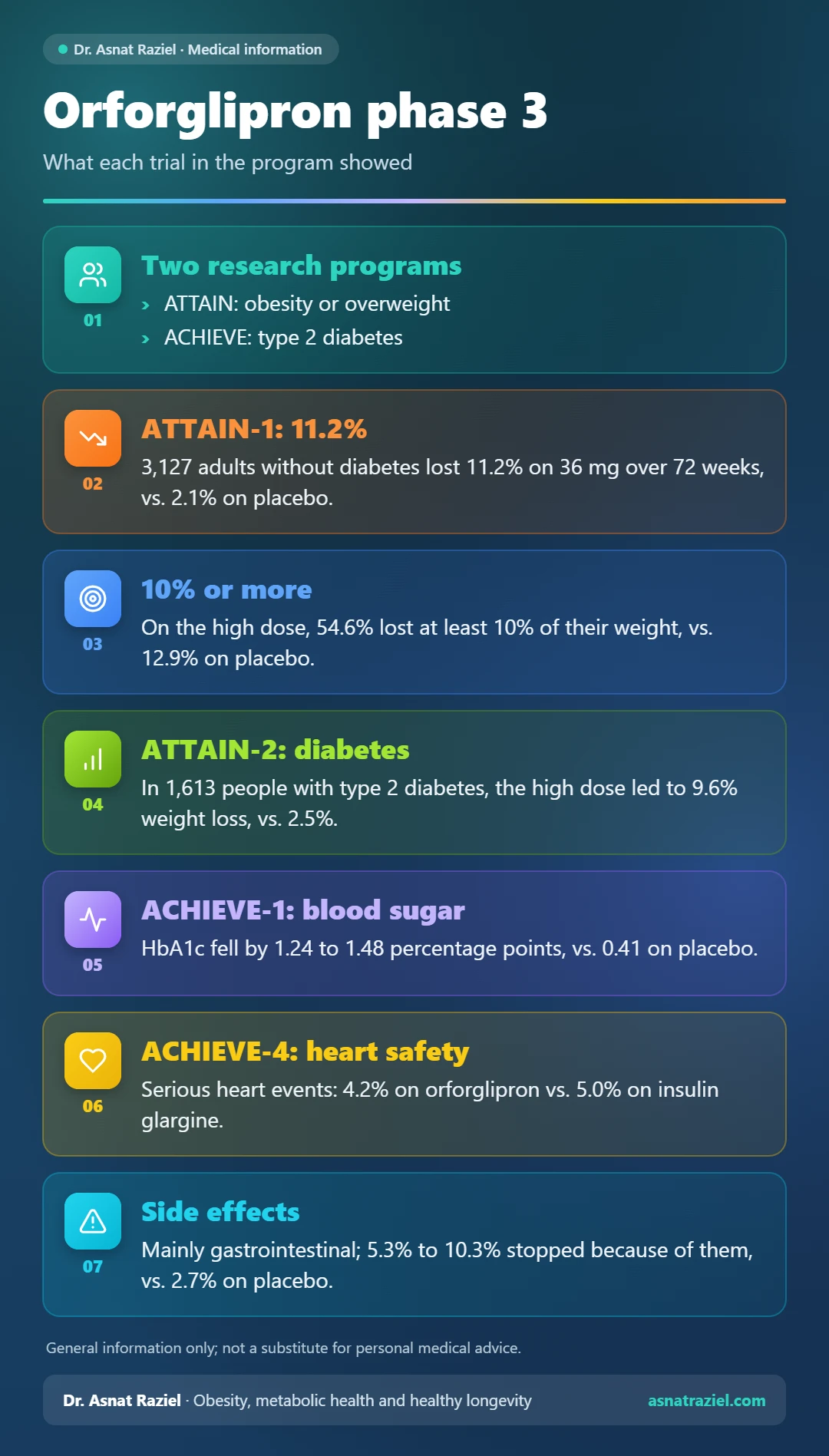
Each trial answers a different question, so it helps to read them side by side. ATTAIN-1 shows the effect on weight in people without diabetes: 11.2% on the high dose. ATTAIN-2 shows that people with diabetes also lose weight, though somewhat less: 9.6%. ACHIEVE-1 adds the effect on blood sugar, with HbA1c falling by up to 1.48 points. Finally, ACHIEVE-4 addresses safety, with fewer serious heart events than insulin glargine. Taken together, the picture is consistent. The drug lowers weight, improves metabolic markers and has not shown a heart-safety problem.
Safety and tolerability
The safety profile is similar to what we know from the GLP-1 family. According to ATTAIN-1 safety data, these are the common side effects:
- Nausea in 28.9% to 35.9% of patients, compared with 10.4% on placebo
- Constipation in 21.7% to 29.8%, compared with 9.3% on placebo
- Diarrhea in 21.0% to 23.1%, compared with 9.6% on placebo
- Vomiting in 13.0% to 24.0%, compared with 3.5% on placebo
In most cases, these effects are mild to moderate. They appear mainly while the dose is being raised. The rate of stopping treatment because of side effects ranged from 5.3% to 10.3%, compared with 2.7% on placebo. No new safety signals emerged.
What the orforglipron phase 3 results mean in practice
The implications are very broad. One of the biggest barriers in obesity treatment has been the injection itself. Some patients gave up on treatment, and others did not stick with it. This is where orforglipron comes in. It allows simple treatment that is easy to stay on and accessible at an early stage. In addition, the researchers describe it as an option that can be distributed on a global scale, so it may reach new populations.
Pills join a wider range of options, which I outline in non-surgical obesity treatment.
Will the pill replace injections?
The answer is not clear-cut. Injections still show very high efficacy, especially at higher doses. However, the pill creates a new tier of treatment. It can serve as a first-line option, an intermediate step or a way to maintain weight after injections. I wrote about this in my article on keeping weight off after stopping the shots. A comparison with the semaglutide pill appears in my article on Foundayo versus oral semaglutide. Instead of one-size-fits-all treatment, we are moving toward a personal approach.
Orforglipron in Israel
In Israel, Foundayo has been available since September 15, 2026, with a doctor’s prescription. The drug comes as tablets in doses of 0.8 to 17.2 mg. The 17.2 mg tablet is equivalent to the 36 mg capsule tested in the trials. Details on price and how to get it appear in my article on Foundayo in Israel.
The bottom line
The data on orforglipron for weight loss show a real breakthrough, not only in efficacy but also in accessibility. It allows simple treatment and expands the options. Ultimately, it strengthens the understanding that obesity is a chronic disease that needs ongoing, personalized treatment.
The information in this article is general and does not replace personal medical advice.
References
Orforglipron, an Oral Small-Molecule GLP-1 Receptor Agonist for Obesity Treatment
Orforglipron, an Oral Small-Molecule GLP-1 Receptor Agonist, in Early Type 2 Diabetes
All the studies were funded by Eli Lilly, the drug’s manufacturer.