By Dr. Asnat Raziel, bariatric surgeon specializing in obesity treatment, metabolic health and healthy longevity; Director of the Multidisciplinary Center for Obesity Treatment, Assia Medical, Assuta Ramat HaChayal, Tel Aviv
Non-surgical obesity treatment: what the options are today
Non-surgical obesity treatment is now a complete medical pathway, not just “another diet.” It includes nutritional and behavioral support, effective medications and, in some cases, an endoscopic procedure. Thanks to the new medications, many people reach a loss of 15% or even 20% of their body weight without an operating room. However, long-term success depends on personalization and follow-up.
Obesity is a chronic disease, not a failure of willpower. So treating it resembles treating high blood pressure or diabetes: we diagnose, choose tools, measure and adjust. In this article, I focus on the evidence: what each non-surgical option has achieved in clinical trials. For a practical, step-by-step comparison, see my guide on how to lose weight without surgery.
Who is a candidate for medical obesity treatment?
The starting point is a medical assessment. We usually begin with body mass index, which you can easily calculate with a BMI calculator. Still, the number alone does not tell the whole story. Waist circumference, blood tests and medical conditions matter just as much.
According to the approved drug labels, medication is generally suitable for adults with a BMI of 30 or higher. It is also suitable for a BMI of 27 or higher when there is a weight-related condition, such as type 2 diabetes, high blood pressure or sleep apnea. At our clinic, we always start with a conversation about your weight history, appetite and sleep.
Three layers of non-surgical obesity treatment
First, it is important to understand that there is no “single method.” We build treatment in layers, and we usually combine them as needed.
- Lifestyle: nutrition, movement, sleep and emotional support. This is the foundation of every pathway.
- Medication: injections or pills that act on the hunger and fullness centers in the brain.
- Endoscopic treatment: a procedure performed through the mouth, without incisions, that reduces stomach volume.
Lifestyle: the foundation you cannot skip
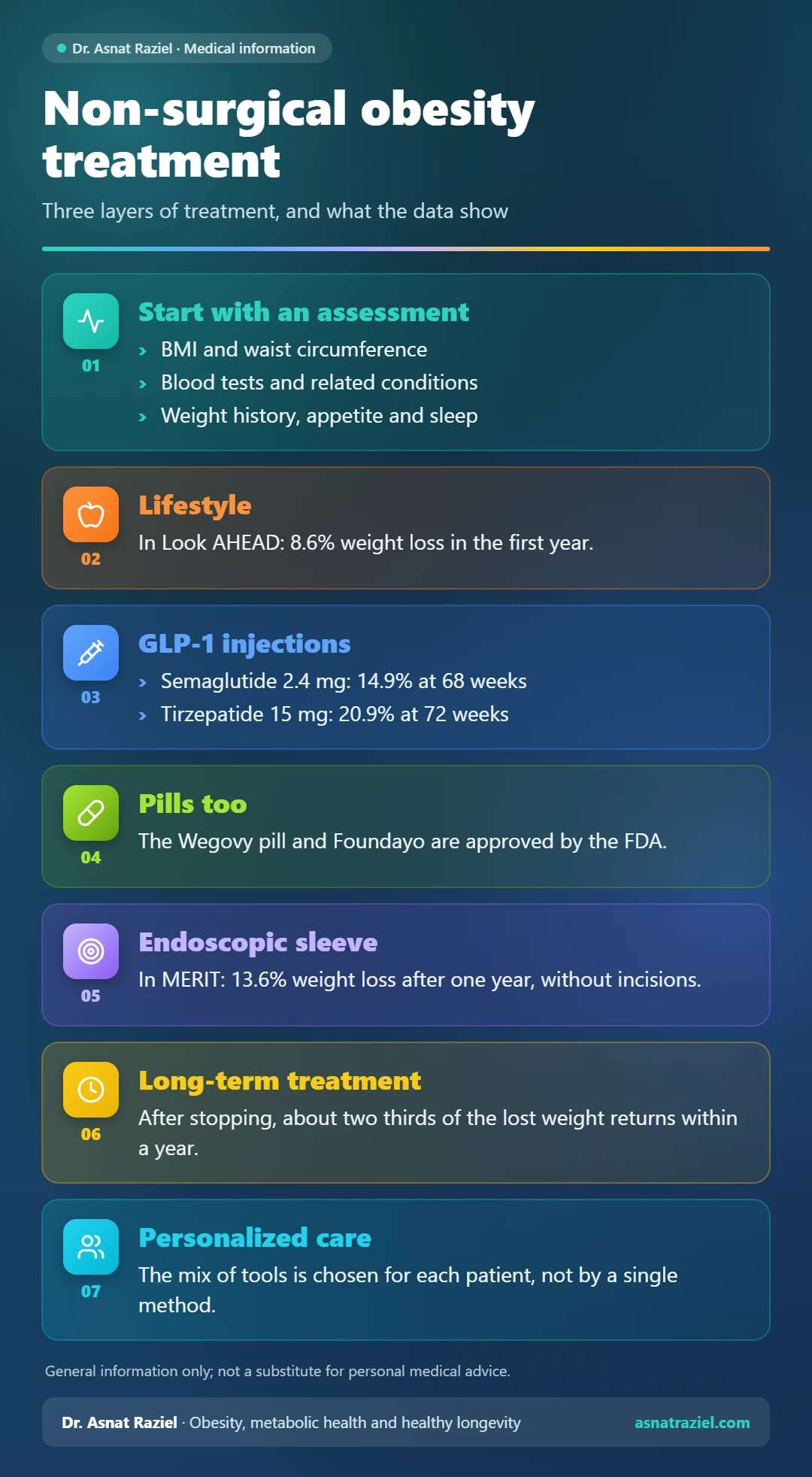
A structured habit-change program produces real results. In the Look AHEAD trial, for example, people with type 2 diabetes lost an average of 8.6% of their weight in the first year, compared with 0.7% in the control group. Blood sugar, blood pressure and blood lipids also improved.
At the same time, the body responds to weight loss by increasing hunger. Many people know food noise, the constant thoughts about food. That is why I believe in a holistic approach to obesity treatment that connects nutrition, movement, sleep and mind.
Medication: the big change of the decade
GLP-1 medications have changed the picture. In the STEP 1 trial, semaglutide 2.4 mg once a week led to an average loss of 14.9% of body weight after 68 weeks, compared with 2.4% in the placebo group. In the SURMOUNT-1 trial, tirzepatide, the active ingredient in Mounjaro, led to a loss of 20.9% at the 15 mg dose after 72 weeks.
Moreover, the FDA has approved a weekly 7.2 mg dose of Wegovy for people who need further weight loss. You can find details in my article on Wegovy 7.2 mg.
Pills, not just injections
People who are wary of injections can now consider a daily pill. In December 2025, the FDA approved the Wegovy pill at a 25 mg dose. Then, in April 2026, the FDA approved Foundayo (orforglipron) as well. In the ATTAIN-1 trial, it led to a loss of up to 12.4% of body weight after 72 weeks.
Beyond that, there are other, older medications. A general overview of anti-obesity medications shows how much the field has grown. We tailor the medication to your medical conditions, preferences and budget, as I explain on my page about drug treatment for obesity and metabolic disease.
Non-surgical obesity treatment by endoscopy
The doctor performs an endoscopic procedure through the mouth, under anesthesia, with no skin incisions. In endoscopic sleeve gastroplasty (ESG), the doctor sutures the stomach from the inside and reduces its volume. In the MERIT trial, patients who had an endoscopic sleeve lost 13.6% of their body weight after one year, compared with 0.8% in the group that changed only their lifestyle. Serious complications occurred in 2% of patients.
This option is mainly suitable for class 1 or 2 obesity. Around the world, medical centers such as Nusbaum Medical Centers also offer medical pathways alongside surgery. The decision is always personal and comes after a full evaluation.
Non-surgical obesity treatment by the numbers
How do these options compare? Here is what the trials in this article showed. First, a structured lifestyle program led to an 8.6% loss in the first year in Look AHEAD. Second, weekly semaglutide 2.4 mg led to 14.9% after 68 weeks in STEP 1. Third, tirzepatide 15 mg led to 20.9% after 72 weeks in SURMOUNT-1. Next, the Foundayo pill led to up to 12.4% after 72 weeks in ATTAIN-1. Then, the endoscopic sleeve led to 13.6% after one year in MERIT. Finally, these numbers come from different trials and different populations, so they are not a head-to-head comparison. Above all, they only hold while treatment continues.
What happens when treatment stops
Obesity is a chronic disease, so its treatment is long term too. In the follow-up to the STEP 1 trial, people who stopped semaglutide regained about two thirds of the weight they had lost within a year. In other words, a good pathway includes a plan for maintaining results from the outset.
This is where muscle, protein, movement and regular follow-up come in. It is also important to detect weight regain early and adjust treatment before it builds up.
How to build a non-surgical obesity treatment plan that fits you
In practice, the process starts with a medical assessment, blood tests and a conversation about your goals. Next, we choose the tools together. One patient will start with medication and a dietitian, while another will prefer an endoscopic procedure. That is why it is worth seeking professional advice to tailor your treatment rather than choosing on your own.
YouTube and social media are full of weight loss videos. But here too, what looks free can end up costing you. Inaccurate information can delay the right treatment.
Where the field is heading
The pace is very fast. Every year, researchers present new drugs at obesity medicine conferences, and some combine several hormones. I have written about this at length in my article on obesity medicine in the next decade. What is more, digital tools are starting to help with follow-up.
The bottom line
Non-surgical obesity treatment today includes three layers: lifestyle, medication and endoscopic procedures. The new medications allow many people to lose 15% to 20% of their body weight. However, success depends on personalization, preserving muscle mass and long-term treatment.
The information in this article is general and does not replace personal medical advice.
Frequently asked questions
Is non-surgical obesity treatment as effective as surgery?
Bariatric surgery still leads to the largest and most durable weight loss. However, the new medications come close to it in some patients, and they are also suitable for people who are not candidates for surgery.
How long does drug treatment last?
It is usually a long-term treatment. Stopping early generally leads to weight regain, so we plan the maintenance phase in advance.
Can medication and an endoscopic procedure be combined?
Yes, in some cases we combine them. The decision depends on weight, medical conditions and the response to the first treatment.
Sources
Once-Weekly Semaglutide in Adults with Overweight or Obesity
Tirzepatide Once Weekly for the Treatment of Obesity
Wegovy pill approved in the US as first oral GLP-1 for weight management
FDA approves orforglipron, an oral GLP-1, for adults with obesity