By Dr. Asnat Raziel, bariatric surgeon specializing in obesity treatment, metabolic health and healthy longevity; Director of the Multidisciplinary Center for Obesity Treatment, Assia Medical, Assuta Ramat HaChayal, Tel Aviv
Who needs high-dose Wegovy? Another step in the obesity treatment revolution
Who needs high-dose Wegovy, and when does it make sense to move from 2.4 mg to 7.2 mg? This article is about that decision: who may benefit, what to expect and what to ask your doctor. For the full trial data, see my article on the STEP UP trial results in detail.
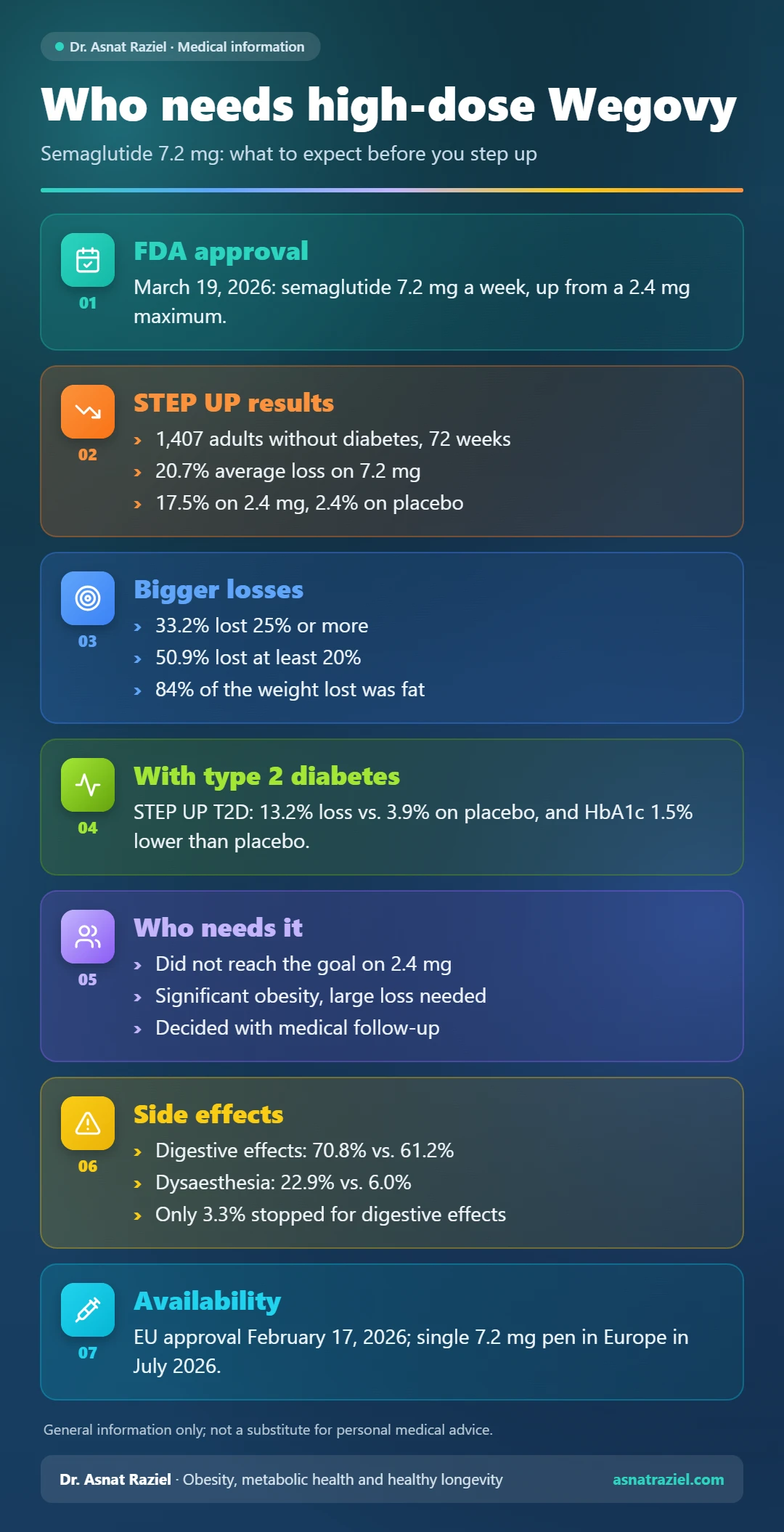
High-dose Wegovy (Wegovy HD) received approval from the US Food and Drug Administration on March 19, 2026. The drug is based on semaglutide, and the new dose is 7.2 mg a week. Until now, the maximum dose was 2.4 mg. So it is a much more powerful option for anyone who truly needs high-dose Wegovy.
The approval came through an accelerated review pathway. The FDA granted the drug a Commissioner’s National Priority Voucher, a new program that shortens review time. According to the company’s announcement, this is the first GLP-1 drug approved through this pathway. In other words, the regulator recognizes the urgent need for effective treatments for obesity, a chronic disease with wide-ranging effects.
The fast approval reflects a change in thinking
The fast-track pathway is not just a technicality. It reflects a deep shift in medical thinking. Obesity is no longer seen as purely a behavioral problem. It is a metabolic disease that affects the heart, the hormones and mental health. When a leading regulator speeds up approval of a drug like this, it signals how important the field is.
High-dose Wegovy results: what the STEP UP trial found
The approval rests on the STEP UP trial, published in Lancet Diabetes & Endocrinology. It enrolled 1,407 adults with obesity who did not have diabetes, for 72 weeks. Participants received 7.2 mg, 2.4 mg or placebo, together with lifestyle support.
Among those who stayed on treatment, weight dropped by an average of 20.7% on 7.2 mg. By comparison, the loss was 17.5% on 2.4 mg and 2.4% on placebo. In the analysis that included all participants, including those who stopped, the loss was 18.7% versus 15.6% and 3.9%. In addition, the company reported that 84% of the weight lost was fat tissue.
How many patients lost 25% or more?
According to data presented at the ADA meeting, 33.2% of patients on 7.2 mg lost 25% or more of their weight. On 2.4 mg the rate was 16.7%, and on placebo it was zero. Moreover, 50.9% lost at least 20%, compared with 35.1% on the standard dose. These results bring drug treatment closer to outcomes that, in the past, only surgery achieved. You will find a full comparison in my article on obesity drugs vs. bariatric surgery.
What about diabetes?
A parallel trial, STEP UP T2D, studied 512 adults with obesity and type 2 diabetes. There, weight fell by 13.2% on 7.2 mg, compared with 3.9% on placebo. HbA1c, the average blood sugar over the past three months, also dropped by 1.5% more than with placebo. As usual, weight loss in diabetes is more modest than in people without diabetes.
Who needs high-dose Wegovy?
The new dose is not meant for every patient automatically. It suits mainly people who did not reach their goal on 2.4 mg. It also suits people with significant obesity who need a large weight loss to improve their health. This is one more tool in the toolbox, and it should be used with judgment. This approach is called treat to target, and I expand on it in my article on tirzepatide and semaglutide dosing.
The decision to use a high dose should be made with medical supervision. Your doctor looks at your response to treatment, how well you tolerate it and your overall health picture.
Questions to ask before you move to high-dose Wegovy
Before we decide together, I go through a few questions with each patient. Every one of them comes from the data in this article:
- Have you reached your goal on 2.4 mg? If not, note that in STEP UP the average loss was 20.7% on 7.2 mg vs. 17.5% on 2.4 mg.
- Do you need a large weight loss for your health? A third of patients on 7.2 mg lost 25% or more.
- Do you have type 2 diabetes? Then expect a more modest loss, about 13.2% in STEP UP T2D.
- How do you tolerate side effects now? Digestive symptoms and skin sensations were more common on the higher dose.
- Is the dose available to you? In Israel, check with your doctor what is currently on offer.
So, who needs high-dose Wegovy? Usually someone who answers yes to the first two questions and tolerates treatment well.
Side effects: balancing effectiveness and tolerability
As the dose goes up, so does the chance of side effects. Most involve the digestive system: nausea, vomiting, diarrhea and constipation. In STEP UP, 70.8% of patients on 7.2 mg reported these effects, compared with 61.2% on 2.4 mg and 42.8% on placebo. However, only 3.3% stopped treatment because of digestive effects.
A relatively new effect is dysaesthesia, an unusual skin sensation such as tingling, burning or sensitivity to touch. It occurred in 22.9% of patients on the high dose, compared with 6.0% on the standard dose. It is usually mild and passes. Anyone who needs high-dose Wegovy should therefore raise the dose gradually and keep close follow-up. You can read more about managing side effects in my article on Wegovy side effects.
Availability and how it is given
In the United States, Wegovy HD has been available in pharmacies since April 7, 2026, in a dedicated single-use injection pen. In the European Union, approval had already come on February 17, 2026. At first, the European Commission allowed the dose to be given as three 2.4 mg injections on the same day. Later, in July 2026, a single pen was approved in Europe for the 7.2 mg dose. As for Israel, ask your treating doctor what is available right now.
High-dose Wegovy in a competitive market
The approval comes amid fierce competition. The main rival is tirzepatide from Eli Lilly, known as Mounjaro. The two companies lead the field, and the race between them is speeding up new developments. You will find a comparison of the two in my article on Mounjaro vs. Wegovy 7.2 mg.
At the same time, we are seeing a trend toward oral drugs. The Wegovy pill was approved in the United States in December 2025, and Foundayo was approved in April 2026. In addition, companies are developing new drug combinations. All of these expand the options for patients.
What it means in the clinic: personalized treatment
High-dose Wegovy marks an era in which people can lose more than 20% of their weight without surgery. That is significant progress. However, deciding who needs high-dose Wegovy calls for great responsibility in tailoring treatment to each patient.
The drug is part of a complete program, not a stand-alone solution. Success depends on good nutrition, physical activity, good sleep and emotional support. Only a multidisciplinary approach lets you get the full potential out of treatment.
Bottom line
Approval of the 7.2 mg dose is another milestone in obesity treatment. It expands the limits of drug therapy and offers an effective option for many patients. In the end, the person who needs high-dose Wegovy is usually someone who did not reach their goal on the standard dose. The decision is right when it combines advanced science with a deep understanding of the person.
The information in this article is general and does not replace personal medical advice.
Sources
Wegovy® HD (semaglutide 7.2 mg) approved in the US, providing 20.7% mean weight loss
The European Commission approves more effective dose of injectable Wegovy® for adults with obesity
The studies were funded by Novo Nordisk, the drug’s manufacturer.