By Dr. Asnat Raziel, bariatric surgeon specializing in obesity treatment, metabolic health and healthy longevity; Director of the Multidisciplinary Center for Obesity Treatment, Assia Medical, Assuta Ramat HaChayal, Tel Aviv
How to lose weight without surgery: what to expect
How to lose weight without surgery is one of the most common questions I hear in my clinic. The short answer: it is possible, and often to a significant degree. Today there are three main tools: lifestyle change, modern medications and endoscopic treatments performed through the mouth. In this article, I will explain how much weight each one actually takes off, who it suits and how to maintain the result.
It is important to remember one point from the start. Obesity is a chronic disease, not a lack of willpower. Therefore, treating it, with or without surgery, is a long-term process.
Why diet alone usually isn’t enough
When you lose weight, your body reacts as if it were in danger. Hunger hormone levels rise, the feeling of fullness weakens and your metabolic rate drops. In addition, the brain starts to focus on food far more than usual. As a result, most people who lose weight through diet alone regain it within a short time.
That is exactly why I talk about weight management as an ongoing process rather than a diet with an end date. What works is a combination of several tools, tailored to the individual, with support over time.
How to lose weight without surgery through lifestyle changes
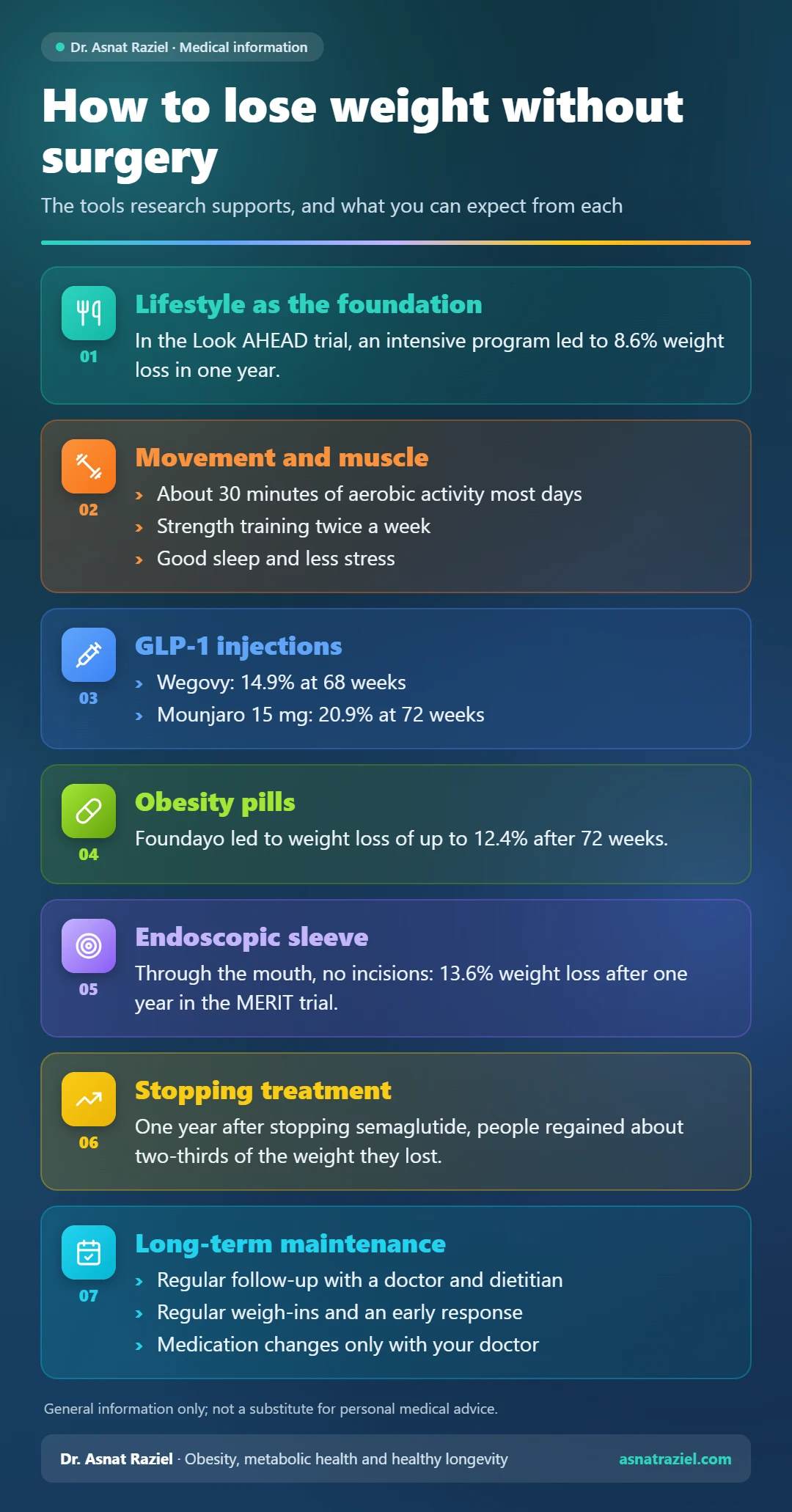
Lifestyle is the foundation of every other treatment. In the Look AHEAD trial, for example, people with type 2 diabetes received an intensive diet and exercise program. After one year, they lost an average of 8.6% of their body weight, compared with 0.7% in the control group. In addition, their blood sugar, blood pressure and blood lipids improved, and some even reduced their medications.
In other words, a structured program with close support achieves real results. However, few people manage to lose 15% or more this way alone.
A diet you can stick with
No single diet suits everyone. What matters is a moderate calorie deficit you can live with. The Mayo Clinic, for example, recommends proven weight-loss strategies such as losing half a kilo to one kilo a week and setting a first goal of 5% of body weight. In practice, it is worth building every meal around protein, vegetables and whole grains. On the other hand, it is best to cut back on added sugar, processed food and sweetened drinks.
Exercise, sleep and stress
Exercise on its own takes off only a little weight. However, it is crucial for maintaining the result and preserving muscle mass. The recommendation is about 30 minutes of aerobic activity on most days of the week, plus strength training at least twice a week. I have written more about how to prevent muscle loss during weight loss in a separate article. In addition, short sleep and ongoing stress increase hunger, so they are also part of the treatment.
How to lose weight without surgery with modern medications
The new medications have changed the picture. They act like natural satiety hormones, slow stomach emptying and reduce constant thoughts about food. You can read about them in detail in my article on treating obesity without surgery.
- Wegovy: the active ingredient is semaglutide, given as a once-weekly injection. In the STEP 1 trial, participants lost 14.9% of their body weight after 68 weeks, compared with 2.4% in the placebo group.
- Mounjaro: the active ingredient is tirzepatide. In the SURMOUNT-1 trial, the average weight loss after 72 weeks was 20.9% at the 15 mg dose, compared with 3.1% in the placebo group. The US Food and Drug Administration (FDA) approved tirzepatide for the treatment of obesity in November 2023, under the brand name Zepbound.
- Pills: the FDA has also approved the Wegovy pill (oral semaglutide 25 mg) and Foundayo, whose active ingredient is orforglipron. In the ATTAIN-1 trial, Foundayo led to weight loss of up to 12.4% of body weight after 72 weeks.
The most common side effects are nausea, diarrhea and constipation, mainly while the dose is being increased. They are usually mild and pass. Even so, treatment requires medical follow-up, and it is a good idea to learn in advance about Wegovy side effects and how to manage them.
What happens when you stop the medication
This is a point worth understanding before you start. In an extension of the STEP 1 trial, participants stopped treatment after 68 weeks. Within a year, they regained about two-thirds of the weight they had lost, and most of the improvement in their blood tests also disappeared. That is why I see these medications as long-term treatment, much like treatment for high blood pressure. I have written separately about the importance of sticking with obesity treatment.
How to lose weight without surgery with endoscopic treatment
Between medications and surgery, there is a middle ground. These are treatments performed through the mouth, with no incisions in the abdomen.
First, there is endoscopic sleeve gastroplasty (ESG). In this procedure, the doctor sutures the stomach from the inside and reduces its volume. In the MERIT trial, people with class 1 or class 2 obesity lost 13.6% of their body weight after one year, compared with 0.8% with lifestyle treatment alone. Moreover, serious side effects occurred in only 2% of patients.
Second, an intragastric balloon fills part of the stomach for a limited period and promotes a feeling of fullness. Finally, there is also a mechanical weight-loss capsule, which you swallow and which breaks down inside the digestive tract. I have gathered the full comparison of these options in my article on alternatives to bariatric surgery.
How to lose weight without surgery and keep it off
Losing the weight is only half the journey. Keeping it off requires a plan of its own. At our clinic, we build this plan in advance, even before treatment begins. These are the principles I recommend:
- Keep up regular follow-up with a doctor and a dietitian, even after you reach your goal.
- Make protein and strength training a priority to preserve muscle.
- Weigh yourself regularly and respond early to a small gain.
- Do not stop a medication on your own; plan every change with your doctor.
For people on weight-loss injections, the right nutrition is especially important. You can read more about it in my guide to nutrition tailored to weight-loss injections.
Who is surgery still right for?
Bariatric surgery still leads to the largest and most lasting weight loss on average. For this reason, it remains an important option, especially in severe obesity with diabetes or serious related conditions. Still, the decision is not “surgery or nothing.” For many people, a combination of lifestyle, medication and endoscopic treatment is enough to reach a meaningful health goal. The choice depends on body mass index (BMI), related conditions, personal preferences and the history of previous attempts.
Bottom line
Today, there is a good answer to the question of how to lose weight without surgery. A structured lifestyle is the foundation. In studies, modern medications led to an average weight loss of about 15% to 21%, and the endoscopic sleeve offers another option. The key is a personal plan and long-term treatment, not a magic fix. If you are unsure, a consultation with a doctor who specializes in obesity will help you choose the right path for you.
The information in this article is general and does not replace personal medical advice.
Frequently asked questions
What is the first step if I want to lose weight without surgery?
An assessment by a doctor who specializes in obesity. The doctor will check your BMI, blood tests and related conditions, and build a tailored plan with you.
How much weight can you lose with medication?
In studies, semaglutide led to an average weight loss of 14.9%, and tirzepatide to a loss of up to 20.9%. Individual results vary from person to person.
Do I have to stay on the medication for life?
Not necessarily, but stopping usually leads to weight regain. So any decision to stop or lower the dose should be made together with your doctor.
Is an endoscopic sleeve a form of surgery?
Not in the usual sense. The procedure is performed through the mouth, with no incisions, and recovery is usually short.
Sources
Once-Weekly Semaglutide in Adults with Overweight or Obesity
Tirzepatide Once Weekly for the Treatment of Obesity
FDA Approves New Medication for Chronic Weight Management
FDA approves orforglipron, an oral GLP-1 for adults with obesity