By Dr. Asnat Raziel, bariatric surgeon specializing in obesity treatment, metabolic health and healthy longevity; Director of the Multidisciplinary Center for Obesity Treatment, Assia Medical, Assuta Ramat HaChayal, Tel Aviv
Foundayo vs oral semaglutide: what was studied?
Foundayo vs oral semaglutide is a comparison that many doctors and patients are talking about right now. On September 29, 2026, Eli Lilly announced a new analysis presented at the European diabetes congress (EASD) in Milan. According to the analysis, Foundayo, which contains orforglipron, led to slightly greater reductions in weight and blood sugar. The comparator was oral semaglutide 25 mg a day, in adults with type 2 diabetes.
However, this is an indirect comparison. In other words, no patient was randomized to either of the two drugs within the same trial. That is why we need to read the findings alongside the safety data and the differences between the studies. A broader comparison of the two pills for obesity treatment appears in my article on the Wegovy pill and Foundayo.
Foundayo vs oral semaglutide: what did the comparison find?
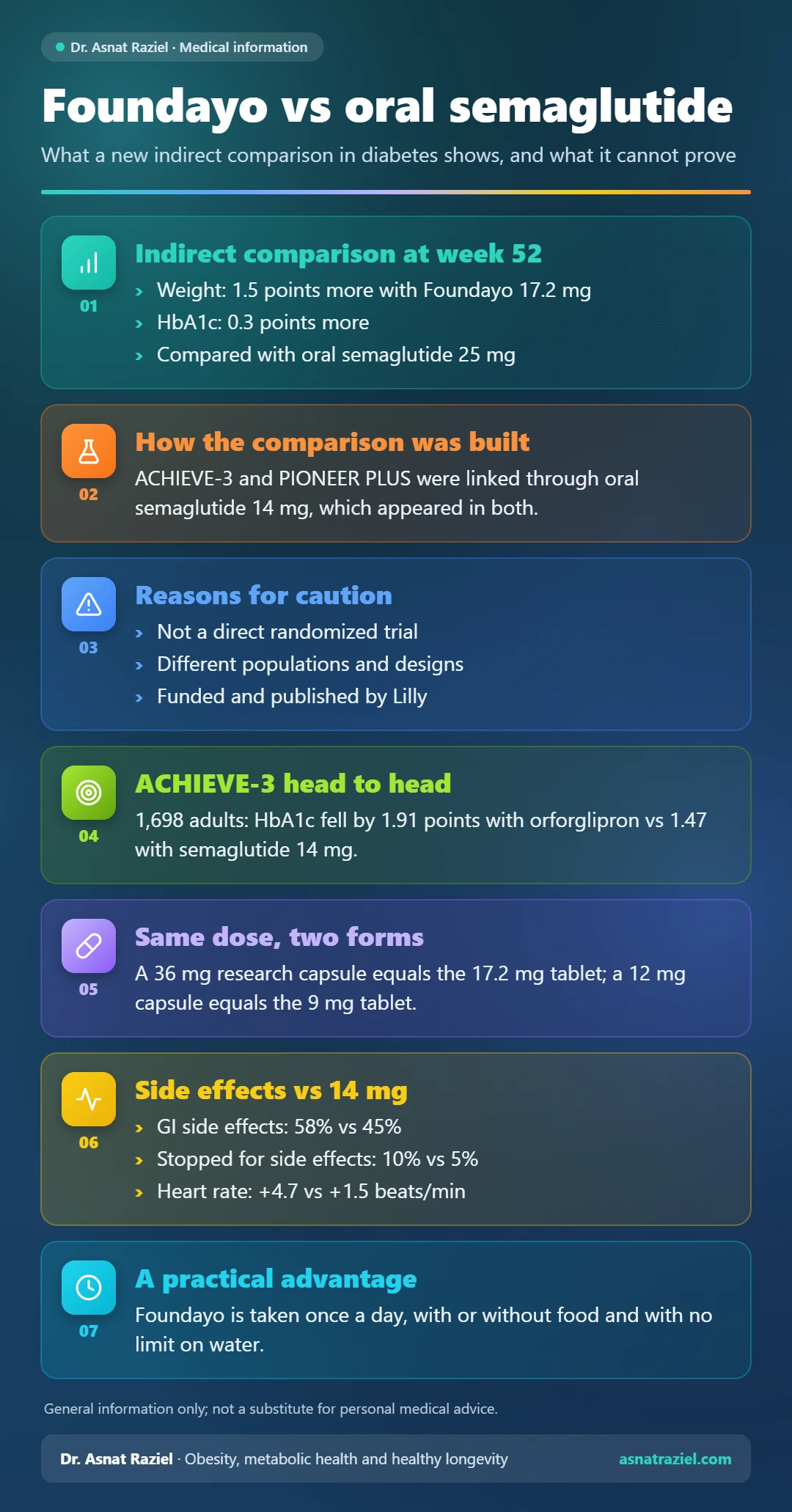
The analysis combined data from two studies. The first was ACHIEVE-3, which tested orforglipron against oral semaglutide at doses of 7 and 14 mg. The second was PIONEER PLUS, which tested oral semaglutide at 14, 25 and 50 mg. Semaglutide 14 mg appeared in both studies, so it served as a “bridge” between them. The comparison focused on week 52, and the results in favor of Foundayo 17.2 mg were:
- An additional 1.5 percentage points of body weight loss (95% confidence interval: 0.2 to 2.7).
- An additional 0.3 percentage-point reduction in HbA1c, the average blood sugar over the past three months (95% confidence interval: 0.1 to 0.6).
These are differences between the treatments, not the overall amounts lost. Just as an illustration, a gap of 1.5 percentage points in a person weighing 100 kg equals 1.5 kg. Similarly, a gap of 0.3 percentage points in HbA1c is, for example, the difference between 7.0% and 6.7%. These examples are not a forecast of how any individual patient will respond.
Why does it matter that the comparison is indirect?
The researchers linked the results of two trials using a statistical model. They also adjusted the data for sex, age, starting weight and starting HbA1c. In additional sensitivity analyses, the weight advantage ranged from 1.5 to 2.4 percentage points, and the HbA1c advantage from 0.3 to 0.6.
Still, the populations differed. In ACHIEVE-3, the average starting HbA1c was 8.3%. In PIONEER PLUS, by contrast, the average age was 58.2 and the starting HbA1c was 9.0%. Beyond that, PIONEER PLUS was double-blind, while ACHIEVE-3 was an open-label trial. The adjustments narrow some of these gaps, but they cannot remove the effect of factors that were not measured. Therefore, only a direct randomized trial can confirm the results. It is also worth noting that the company itself funded and published the analysis.
What has already been tested head to head?
The ACHIEVE-3 trial, published in The Lancet, included 1,698 adults whose diabetes was not controlled on metformin. It was a randomized, open-label trial that lasted 52 weeks. In the main analysis, which included all participants, HbA1c fell by 1.91 percentage points with the higher dose of orforglipron. With semaglutide 14 mg, by comparison, it fell by 1.47. The difference was 0.44 percentage points in favor of orforglipron (95% confidence interval: 0.26 to 0.62).
The efficacy estimand: different numbers for a different question
In its new announcement, Lilly also presents the ACHIEVE-3 results using the efficacy estimand. This estimates the outcome if all participants had stayed on treatment without adding another glucose-lowering drug. The indirect comparison uses the same approach. The results were:
- Orforglipron 9 mg: 6.7% weight loss and a 1.9 percentage-point drop in HbA1c.
- Orforglipron 17.2 mg: 9.2% weight loss and a 2.2 percentage-point drop in HbA1c.
- Oral semaglutide 7 mg: 3.7% weight loss and a 1.1 percentage-point drop in HbA1c.
- Oral semaglutide 14 mg: 5.3% weight loss and a 1.4 percentage-point drop in HbA1c.
So do not mix these numbers with the main analysis, which answers a different question.
Why does the study mention a 36 mg dose?
ACHIEVE-3 used research capsules at doses of 12 and 36 mg. The equivalent commercial tablets contain 9 and 17.2 mg, respectively. A pharmacokinetic study showed bioequivalence between the two forms at the matched doses. In other words, 36 mg in a capsule and 17.2 mg in a tablet are the same treatment, and you should not compare them by the number of milligrams.
Foundayo vs oral semaglutide: side effects
In the head-to-head comparison in ACHIEVE-3, at the higher doses, the picture was less clear-cut:
- Gastrointestinal side effects occurred in 58% with orforglipron, compared with 45% with semaglutide 14 mg.
- Stopping treatment because of side effects: 10% with orforglipron, compared with 5% with semaglutide.
- Average rise in heart rate: 4.7 beats per minute with orforglipron, compared with 1.5 with semaglutide.
Most of the digestive side effects were mild to moderate. However, these data refer to the comparison against 14 mg. They cannot tell us what the safety difference would be against 25 mg.
A daily pill with a practical advantage
Orforglipron is a GLP-1 receptor agonist, but it is a small molecule rather than a protein. As a result, patients can take it once a day, with or without food, and with no limit on water. Oral semaglutide, on the other hand, requires an empty stomach and a wait before eating. This convenience may make the treatment routine easier, but it has not yet been shown to improve persistence.
The FDA approved Foundayo on April 1, 2026 for weight loss and weight maintenance. The indication covers adults with obesity, or with overweight and a related medical condition. In the United States, the drug is not yet approved for treating diabetes. In Europe, by contrast, the EMA’s scientific committee recommended on October 16, 2026 that it be approved for both weight management and type 2 diabetes. The final decision rests with the European Commission. In Israel, the drug has been available since mid-September 2026, as I described in my article on Foundayo in Israel. It is also important to remember that oral semaglutide 25 mg is not currently approved in the United States for treating diabetes.
According to the US prescribing information, treatment starts at 0.8 mg and the dose goes up gradually, no more often than every 30 days. The maximum dose is 17.2 mg. The label includes warnings about pancreatitis, severe gastrointestinal side effects, dehydration and kidney injury, and gallbladder disease. In addition, there is a risk of low blood sugar when combined with certain diabetes drugs. Women taking birth control pills should add a barrier method or switch to a non-oral method. This advice applies for 30 days after starting treatment and for 30 days after each dose increase. A full guide to using the drug appears in my article on treatment with Foundayo.
Foundayo vs oral semaglutide: what does it mean?
The analysis provides evidence that orforglipron may have an advantage over oral semaglutide 25 mg in people with type 2 diabetes. However, it does not test the two drugs directly. It also does not compare either one with injectable Wegovy. Nor does it determine which drug is better for people with obesity who do not have diabetes.
When choosing a treatment, you also need to weigh tolerability, existing conditions, other medications, convenience and cost. An average advantage in a study can inform the decision, but it does not guarantee an advantage for every patient. If you already take oral semaglutide for diabetes, you may also want to read about Rybelsus and weight loss.
The bottom line
The comparison of Foundayo vs oral semaglutide points to a modest advantage for Foundayo in weight and blood sugar. On the other hand, it is indirect and funded by the manufacturer. Moreover, in the head-to-head trial, orforglipron also had higher rates of digestive side effects and treatment discontinuation. Ultimately, only a direct trial between these doses, along with follow-up of long-term health outcomes, will clarify the clinical meaning of the difference.
The information in this article is general and does not replace personal medical advice.
References
FDA Approves First New Molecular Entity Under National Priority Voucher Program
EMA Panel Backs Lilly’s Foundayo for Obesity and Type 2 Diabetes in Europe
FOUNDAYO (orforglipron) tablets, for oral use – Prescribing Information
Disclosure, according to the sources: Eli Lilly funded the indirect comparison, the ACHIEVE-3 trial and the bioequivalence study. Novo Nordisk funded the PIONEER PLUS trial.