By Dr. Asnat Raziel, bariatric surgeon specializing in obesity treatment, metabolic health and healthy longevity; Director of the Multidisciplinary Center for Obesity Treatment, Assia Medical, Assuta Ramat HaChayal, Tel Aviv
A healthy Shavuot without giving up the holiday
How do you enjoy a healthy Shavuot without skipping the cheesecake? I hear this question in my clinic every year, as the season of cakes and blintzes approaches. Shavuot is the Jewish Feast of Weeks, and in Israel it is traditionally celebrated with dairy foods. The reassuring answer is that one festive meal does not undo your progress. However, several days in a row of heavy eating can leave a few hundred grams behind that do not come off on their own. Below, I explain what the research says and how to plan a tasty, balanced holiday meal: before, during and after.
What happens to body weight over the holidays
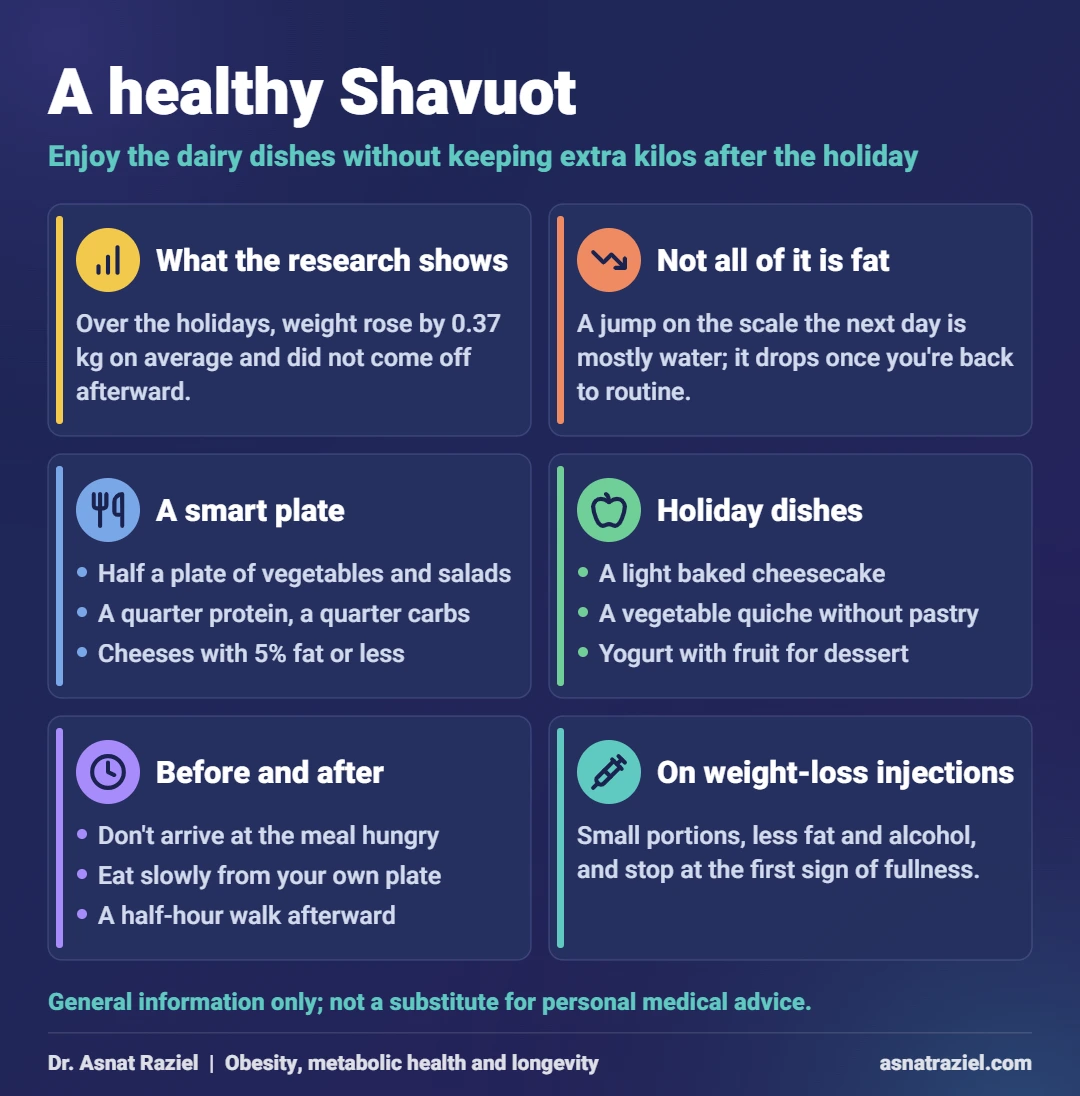
A study published in the NEJM weighed 195 adults before, during and after the US holiday season. During the holidays, weight rose by only 0.37 kg on average, much less than most people think. On the other hand, that gain did not come off in the months that followed. The researchers concluded that a small gain like this, year after year, contributes to gradual weight gain over a lifetime.
In other words, the problem is not the holiday itself but the habits that linger after it. Also, not every kilo you see on the scale the next morning is fat. Salty, carb-rich food makes the body hold on to water, and that water comes off within a few days once you return to your routine.
The same approach works for other holidays too. For the spring holiday, see my healthy Passover recipes.
Why Shavuot makes it easy to gain weight
According to Shavuot customs, people eat dairy foods on the holiday, and the dishes vary from one community to another. For many families, that means cheesecake, blintzes, savory pies (quiches) and lasagna. These foods are delicious, but many of them are rich in fat, sugar and white flour.
What’s more, the holiday usually brings family gatherings, party platters and leftovers in the fridge. For people who struggle with food noise, meaning constant thoughts about food, cakes sitting on the kitchen counter are a real challenge.
Step one for a healthy Shavuot: build a smart plate
The simplest rule is how you divide your plate. Fill half with vegetables and salads, a quarter with protein and a quarter with carbohydrates. At a dairy meal, the protein can come from low-fat cheeses, yogurt, eggs or fish.
This rule follows Harvard’s Healthy Eating Plate, which fills half the plate with vegetables and fruits. It also lists fish, poultry, beans and nuts as healthy protein sources.
- Start with a large salad or a vegetable soup before the main dishes.
- Choose cheeses with 5% fat or less, and keep the full-fat cheeses for a taste.
- Serve the quiche or lasagna as one small portion, not as the base of the meal.
- Drink water or soda water, and limit alcohol and sweet drinks.
Dairy products themselves are not the enemy. On the contrary, they are a good source of protein and calcium, and I wrote about this in detail in my guide to dairy and weight loss. The real question is how much cream, butter and sugar gets added to them.
The science on dairy has shifted over the years, and I summarize it in what has really changed about dairy and health.
Lighter recipes for the holiday table
You can make lighter versions of your favorite dishes without missing out on the experience. For example:
- Baked cheesecake made with 5% cheese, less sugar and no crumb layer.
- A vegetable quiche with eggs and low-fat cheese instead of a pastry-based pie.
- A hearty salad with cubes of reduced-fat Bulgarian-style feta, tomatoes and fresh herbs.
- A bowl of yogurt with fresh fruit and a few nuts for dessert.
For related reading, see my article on dairy protein during GLP-1 treatment. Healthy Passover recipes follow similar principles, and they suit any holiday.
A healthy Shavuot after the meal, too
Small habits before and after the meal make the big difference. First, don’t arrive at the meal starving. A breakfast with protein and vegetables keeps you from attacking the platters in the evening.
In addition, eat slowly, put a portion on your plate and avoid nibbling straight from the serving dishes. After the meal, a half-hour family walk is a pleasant way to end the holiday. Finally, send leftovers home with your guests or freeze them, so the holiday doesn’t stretch over a whole week.
Do habits like these really help? A systematic review of prevention studies during holiday periods found that, in adults, prevention programs led to an average difference of 0.99 kg in favor of the participants. However, the difference was not statistically significant, and the quality of the evidence was rated very low. So the direction is encouraging, but good studies are still lacking.
The day after the holiday, go back to your regular meals, with no fasting and no “make-up” days. For many people, skipping meals actually leads to intense hunger in the evening and to eating more. Instead, return to a simple routine: a breakfast with protein, vegetables at every meal and enough fluids. That way your weight settles quickly, and there is no need for any crash diet.
Your kitchen setup also shapes your choices. A fruit bowl in plain sight and the cake tray inside a cupboard make good decisions easier. It is also worth keeping an easy-to-reach shelf in the fridge for cut vegetables and fruit.
A healthy Shavuot on weight-loss injections
People taking medication for obesity from the GLP-1 family need to be especially careful with large, fatty meals. A joint advisory from four professional organizations recommends avoiding large, high-fat meals to reduce nausea and diarrhea. It also recommends cutting back on alcohol, which can make nausea and heartburn worse. So on the holiday, it is better to eat small portions, start with protein and stop at the first sign of fullness.
The bottom line
How do you keep from gaining weight on Shavuot? Mostly by planning ahead: a plate that is half vegetables, low-fat cheeses, small portions of the holiday dishes and a quick return to your routine. One meal does not change the picture, but the habits that continue after the holiday do. If you find it hard to keep your weight stable over time, it is worth consulting a physician who specializes in obesity.
This article provides general information and does not replace personal medical advice.
Questions and answers
How much weight do people gain over the holidays on average?
In the American study, the average gain over the holiday season was 0.37 kg. However, it did not come off in the months that followed.
I gained a kilo after the holiday meal. Is it fat?
Usually not. Much of a rapid gain is water and the contents of your gut. If you go back to your routine, your weight usually settles within a few days.
How do I host a healthy Shavuot meal?
Serve a large vegetable platter and salads at the start of the meal, and offer at least one light dairy dish. That way, both guests and hosts can enjoy a balanced choice.
Can I eat cheesecake?
Absolutely. One slice, eaten slowly and with pleasure, fits into a balanced menu. Choose a baked version made with low-fat cheese and less sugar.
What should I do if I’m on a GLP-1 medication?
Eat small portions, start with protein and avoid very fatty foods. If you get nausea or vomiting, talk to your treating physician.