By Dr. Asnat Raziel, bariatric surgeon specializing in obesity treatment, metabolic health and healthy longevity; Director of the Multidisciplinary Center for Obesity Treatment, Assia Medical, Assuta Ramat HaChayal, Tel Aviv
Dairy and health: what has really changed
Dairy and health is a topic that comes back every year ahead of Shavuot, the Jewish harvest holiday that is traditionally celebrated with dairy foods. For years, the articles dealt with the same issues: lactose, milk allergy, how much calcium cheese contains, and whether milk is healthy or not. But in 2026 the scientific conversation changed. Today it focuses on the links between dairy and obesity, the microbiome, fullness, muscle, inflammation and metabolic health.
The big news is that science has stopped seeing dairy foods as a single group. Fermented yogurt, butter, goat cheese, industrial ice cream and high-protein cottage cheese are completely different foods. Each of them has its own biological effect.
The big shift: not all milk fat is bad
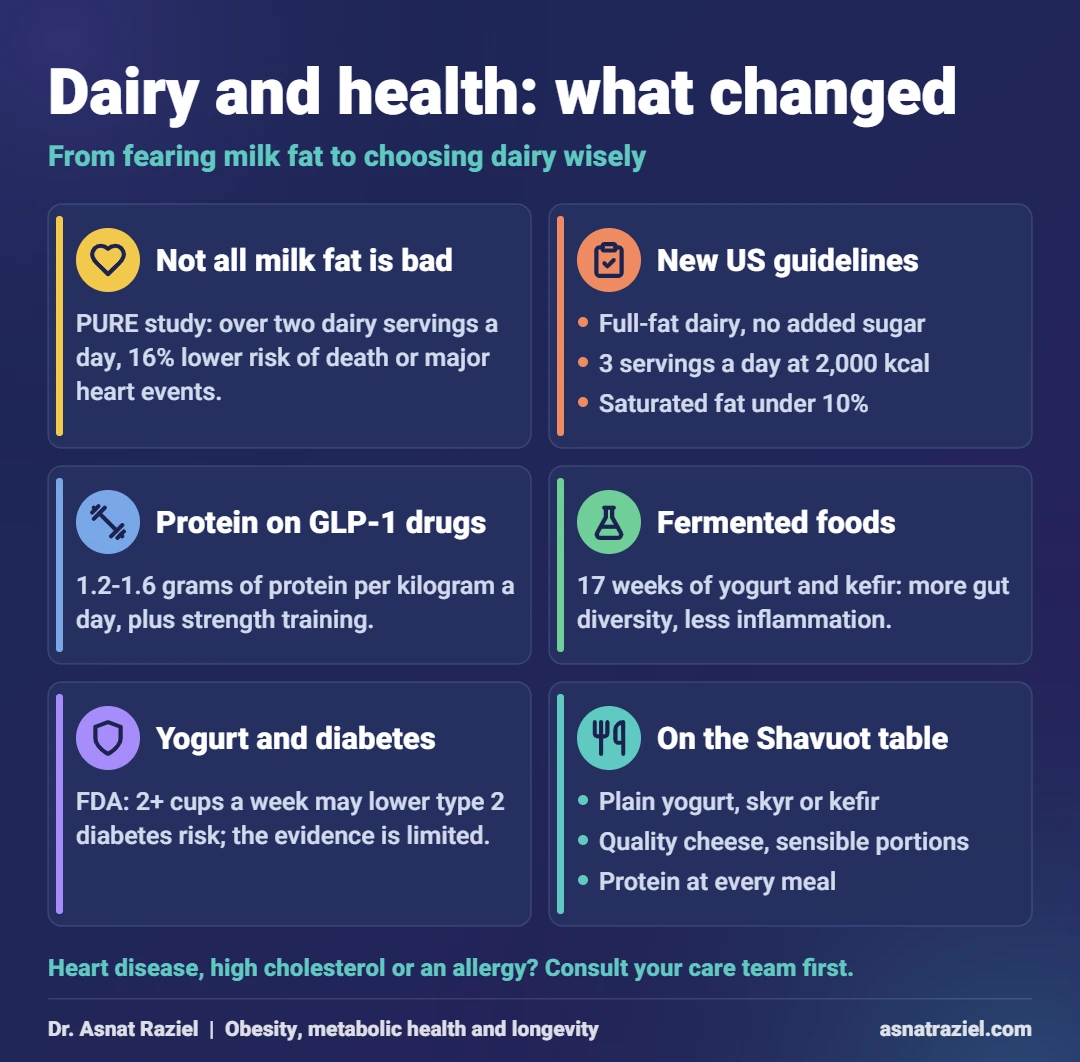
One of the most notable changes is the attitude toward milk fat. For decades, we were taught to choose only low-fat products. However, the research paints a far more nuanced and interesting picture. For example, the PURE study followed 136,384 people in 21 countries for an average of 9.1 years. People who ate more than two servings of dairy a day had a 16% lower risk of death or a major cardiovascular event, compared with people who ate no dairy at all. Milk and yogurt, each on its own, were also linked to lower risk. By contrast, cheese and butter showed no significant association.
In January 2026, a change came at the policy level, too. The new Dietary Guidelines for Americans for 2025-2030 include full-fat dairy without added sugar, at three servings a day in a 2,000-calorie diet. At the same time, the guidelines still limit saturated fat to less than 10% of daily calories. I wrote about this turnaround in my article on the real food dietary guidelines.
That is why we are seeing a comeback of full-fat cheeses and plain yogurt, mainly as part of a Mediterranean diet and a menu low in ultra-processed food. The message is not to eat without limits. In most cases, the main problem with the modern diet is too much processed food, sugar and white flour, and not quality cheese.
Dairy and health in the era of weight loss drugs
This may be one of the most important developments of 2026. The use of drugs such as Wegovy, Ozempic and Mounjaro has risen sharply. As a result, medicine faces a new challenge: how to prevent muscle loss during rapid weight loss.
This is where dairy comes back into the picture. High-protein yogurt, skyr, cottage cheese and protein-rich cheeses help preserve muscle and the feeling of fullness. A joint advisory from four American organizations on nutrition during GLP-1 therapy puts protein at the center, together with strength training. In addition, the new US dietary guidelines recommend 1.2-1.6 grams of protein per kilogram of body weight per day. In other words, this time dairy is returning to the recommendations not because of calcium, but because of protein. You can read more in my article on eating well on weight loss injections.
The microbiome: does yogurt affect the brain and metabolism?
One of the hottest fields today is the link between fermented foods and the microbiome, the population of bacteria in the gut. In a Stanford University study, participants ate a diet rich in fermented foods, such as yogurt and kefir, for 17 weeks. The diversity of their gut bacteria rose gradually, and inflammation markers in their blood went down.
Moreover, researchers now understand that the gut is not just a digestive tube. It is a biological system that communicates with the brain, the immune system and metabolism. You can read about this connection in my article on the microbiome and biological aging.
Yogurt and diabetes
In March 2024, the FDA, the US Food and Drug Administration, approved a qualified health claim for yogurt. According to the wording, regularly eating at least two cups of yogurt a week may reduce the risk of type 2 diabetes. However, the FDA itself stressed that the evidence for this is limited.
Genetics enters the plate
Another innovative direction is personalized nutrition. Researchers are studying why some people feel great with dairy, while others suffer from bloating, fatigue or discomfort. It turns out that the response is not linked only to lactose. It is also linked to genetics, the microbiome, the immune system and the makeup of the whole diet. In other words, in the future there may not be one general recommendation about dairy and health, but a personal recommendation for each person.
Is everyone who thinks they are sensitive to dairy really sensitive?
Here, too, there has been an interesting change. In recent years, many people have stopped eating dairy. Yet a large share of them do not have an allergy or significant lactose intolerance. According to the US National Institute of Diabetes and Digestive and Kidney Diseases, most people with lactose intolerance can eat a certain amount of lactose without symptoms.
Sometimes the problem is actually too much processed food, stress, eating too fast, or sensitivity to other ingredients. So many people discover that they can eat yogurt, hard cheeses or fermented products without trouble.
The new trend: less diet food, more real food
If I had to sum up the message of 2026 in one sentence: the world is replacing diet foods with real food. For years, 0% fat products looked especially healthy. Today it is clear that natural, filling, less processed food is usually a much better choice. You can find practical ideas in my article on a healthy shopping basket.
How to apply the new dairy and health findings on Shavuot
You can translate the science to the holiday table in a few simple steps:
- Choose plain yogurt, skyr or kefir with no added sugar.
- Prefer quality cheeses in reasonable portions over sweet dairy desserts.
- Include a protein source, vegetables and a few whole-grain carbohydrates at every meal.
- If you are on medication for obesity, make sure you get a portion of protein already at your first meal of the day.
It also pays to listen to your body. People who feel bloated after milk can first try fermented products or hard cheeses, which contain little lactose. For more holiday ideas, see my related articles on a healthy Shavuot and on dairy and weight loss.
The bottom line on dairy and health
The dairy innovations are not a new product on the shelf. Instead, they are a shift in thinking: not to fear dairy automatically, but to choose well and eat mindfully. In the end, plain yogurt, quality cheese and fermented products can fit into a healthy menu. However, people with heart disease, high cholesterol or an allergy should consult their care team before making a change.
The information in this article is general and does not replace personal medical advice.
References
Dietary Guidelines for Americans, 2025-2030
Gut-microbiota-targeted diets modulate human immune status
FDA Announces Qualified Health Claim for Yogurt and Reduced Risk of Type 2 Diabetes