By Dr. Asnat Raziel, bariatric surgeon specializing in obesity treatment, metabolic health and healthy longevity; Director of the Multidisciplinary Center for Obesity Treatment, Assia Medical, Assuta Ramat HaChayal, Tel Aviv
Anorexia and bulimia: from stigma to science
For years, anorexia and bulimia were seen as disorders of body image, control and cultural ideals. The image of a very thin girl who refuses to eat, or vomits in secret, still shapes the conversation. Over the past decade, however, medical understanding has changed fundamentally. Today it is clear that these are complex disorders with a brain, genetic and hormonal basis. In other words, they are not just the product of social pressure or a wish to be thin.
In this article, I will explain what has changed in our understanding of anorexia nervosa and bulimia nervosa. I will also describe what modern treatment looks like and where to get help in Israel.
The brain at the center of the disorder
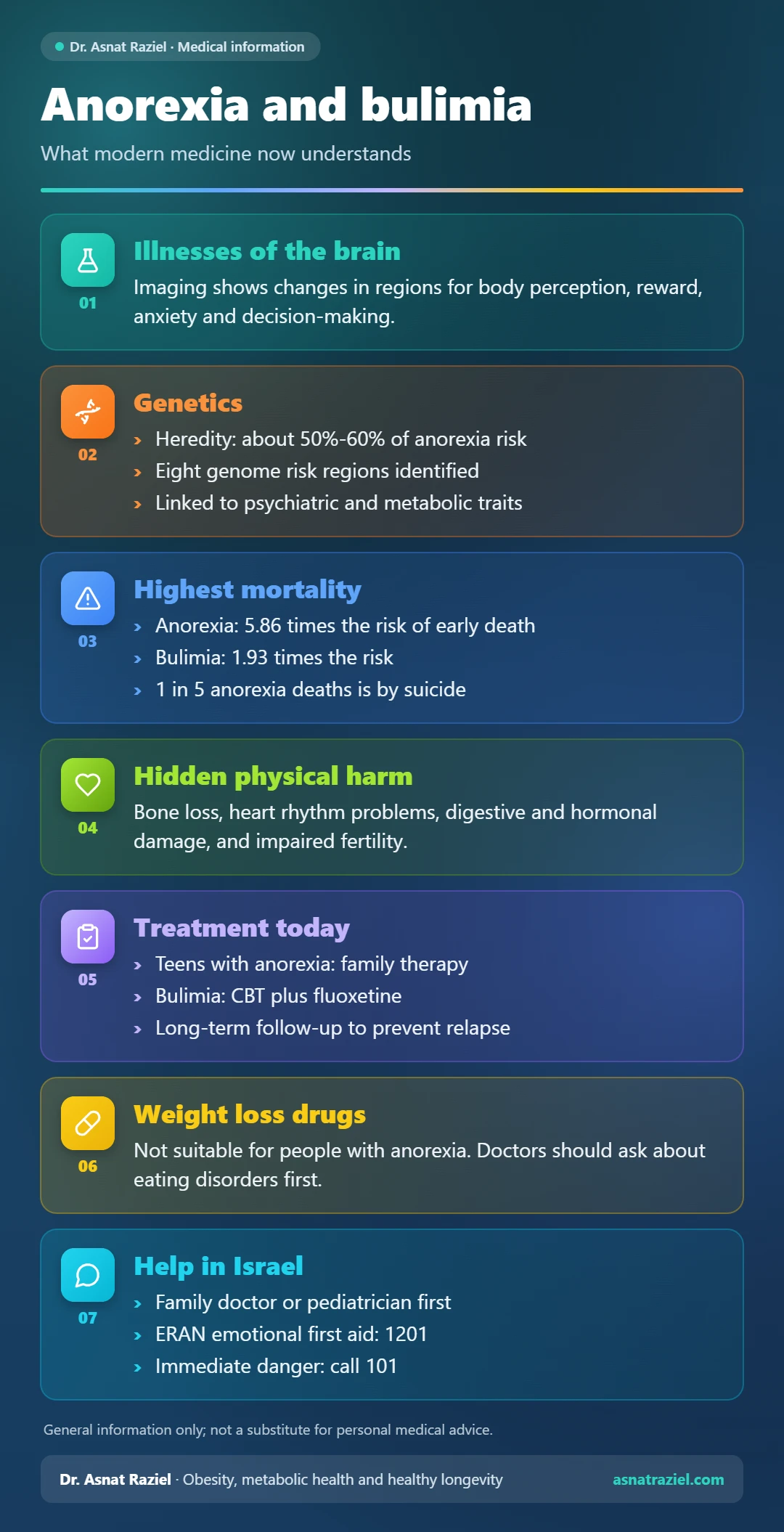
Imaging studies show changes in brain regions involved in body perception, reward, anxiety and decision-making. The brain responds to food and to the body in a way that does not match physical reality. For example, in anorexia, the brain disrupts hunger and fullness signals, even during dangerous malnutrition. In bulimia, by contrast, there is a sharp swing between an intense urge to eat and a need to compensate and regain control.
This understanding explains why persuasion, pressure or comments about appearance do not lead to recovery. Sometimes they even make the disorder worse. That is why families and care teams are now learning to talk differently, without blame and without power struggles.
The genetics of anorexia and bulimia
Twin studies estimate that heredity accounts for about 50% to 60% of the risk of anorexia. A large 2019 genetic study examined 16,992 people with anorexia and 55,525 people without the disorder. The researchers identified eight regions of the genome linked to risk. Moreover, these genes are linked both to psychiatric illnesses and to metabolic traits, such as blood sugar and blood lipid levels. As a result, the researchers proposed viewing anorexia as a “metabo-psychiatric” disorder, that is, an illness of both the mind and metabolism.
An important update came in 2026. A new genetic analysis included 24,223 people with anorexia and again confirmed eight risk regions. In addition, anorexia and binge eating have a similar genetic link to psychiatric illnesses. However, their genetic link to body build runs in opposite directions. The meaning is simple: some people are born with a biological vulnerability, and under certain conditions it erupts as an illness.
Physical consequences you can’t always see
Anorexia has the highest mortality rate of all eating disorders. A meta-analysis of 36 studies found that the risk of early death in anorexia is 5.86 times higher than in the general population. In bulimia, the risk is 1.93 times higher. Furthermore, one in five people with anorexia who died, died by suicide. Therefore, emotional distress in an eating disorder demands immediate attention.
Beyond the psychological harm, there are wide-ranging medical consequences. These include reduced bone density, heart rhythm disturbances, digestive damage, hormonal disruption and impaired fertility. In bulimia too, where weight is often normal, the risk is real. It includes damage to the esophagus, teeth and heart, and to blood electrolytes. Ultimately, the damage sometimes builds up silently, even when the person seems to function well. That is why diagnosing eating disorders at any weight is such an important principle.
Treating anorexia and bulimia in a new era
Treatment has changed a great deal. Today the emphasis is on a multidisciplinary team: dedicated psychotherapy, medical nutrition support, medical monitoring and sometimes tailored medication. The 2023 American Psychiatric Association guideline recommends eating disorder-focused family therapy for adolescents with anorexia. For adults, it recommends eating disorder-focused psychotherapy.
For bulimia, the guideline recommends focused cognitive behavioral therapy (CBT), together with a selective serotonin reuptake inhibitor such as fluoxetine. A review in The Lancet Psychiatry stresses that adults with anorexia can also recover or improve greatly. The current approach emphasizes personalization, a gradual pace and building trust, rather than coercion.
In addition, it is now clear that long-term follow-up is needed. Even after nutritional status improves or vomiting stops, follow-up continues to prevent a relapse.
A word about weight loss medications
As a doctor who treats obesity, I feel it is important to say this too. A 2026 review in Biological Psychiatry found signs that GLP-1 medications may help with binge eating and bulimia. However, the researchers call for close monitoring of a possible risk for anorexia. Therefore, weight loss medications are not suitable for people with anorexia, and doctors must ask about eating disorders before starting treatment.
Signs worth knowing
Early detection improves the chances of recovery. So it is worth paying attention to changes in behavior around food, not just to weight. For example, avoiding shared meals, constant preoccupation with calories and appearance, or going to the bathroom right after eating. In addition, compulsive exercise, loss of periods in girls and women, and social withdrawal are warning signs. If you recognize signs of anorexia and bulimia in yourself or someone close to you, don’t wait. A sensitive conversation and a referral for evaluation are the right step.
Where to get help in Israel
The first step is to see your family doctor or pediatrician. Israel’s national health basket covers treatment for eating disorders. For example, at Maccabi (in Hebrew), members aged 12 and over can receive an evaluation and a course of treatment. Also, the Israeli Association for the Prevention, Treatment and Research of Eating Disorders (in Hebrew) publishes a directory of treatment centers and a guide for families.
If you are in emotional distress, you can contact ERAN, emotional first aid (in Hebrew), at 1201, around the clock. In immediate danger, call Magen David Adom (Israel’s emergency medical service) at 101 or go to an emergency room.
The bottom line: anorexia and bulimia are illnesses, not a whim
The great change of the past decade is scientific, but it is also a change in perception. Moving from blame to a biological understanding allows treatment that is precise, respectful and effective. Anorexia and bulimia are not an expression of control or weakness. They are serious illnesses that require early diagnosis, professional treatment and ongoing support. For further reading, see why eating disorders are not a lack of discipline, my article on orthorexia and what modern medicine knows about eating disorders.
This article provides general information and is not a substitute for personal medical advice.
References
Anorexia nervosa: aetiology, assessment, and treatment
Glucagon-Like Peptide-1 Receptor Agonists in Psychiatry: A Pharmacoepidemiological Scoping Review
The Israeli Association for the Prevention, Treatment and Research of Eating Disorders (in Hebrew)
ERAN: emotional first aid by phone and online (Kol Zchut, in Hebrew)